

1. You were born in 1963 in Trieste, a city that has been a laboratory of overlapping identities for over a century: Habsburg, Italian, Slovenian, Jewish, and today also European. How much has this typically Triestine layering shaped your perspective, even before you became a historian?
I believe that the identity conflict of these regions has shaped me from birth, and consequently, has shaped my view of the world, including the world of the past, which is the subject of my historical studies. The theme of identity and the difficulty of establishing one identity as dominant, while sometimes erasing others, has always been one of my thoughts: between the “need” for identity, the acceptance of different identities, or the suspension of their role, as Juan Octavio Prenz put it.
If the tensions of one’s own existence are inevitably the driving force of intellectual effort to understand the world, they must absolutely have no influence on the intellectual elaborations of the past and the present. The “scientific” approach in research and in source analysis is independent of the impulses that set the research itself in motion.
2. Her career path is unusual: initially a qualified industrial engineer, then a degree in political science and economics with a thesis in statistics, followed by history and a doctorate at the University of Primorska in Koper. What does such a “migration” between such disparate disciplines bring to a historian, and how does a versatile mind approach and interpret historical material?
It is a life path like many others, influenced by events that occur in the life of every person, primarily family-related events. The fact remains that the technical and practical approach also shapes my research by providing a rational and logical perspective.
I want to say that there is no contradiction here. The rational and scientific perspective coexists with the humanistic sensibility that nourishes the humanities and enables their analysis. In the lives of my oral and written sources, the decisions and situations in which the protagonists find themselves are inevitably intertwined between emotional impulses and concrete circumstances of a more objective and rational nature.
When analyzing the situations I find in the sources, I often examine the technical context in which the events take place: I am thinking, for example, of telephone surveillance at the beginning of the 20th century or the internal structure of the ships on which some events took place.
3. Between 1999 and 2001, you worked in Croatia and Bosnia and Herzegovina as a Financial Officer in emergency aid projects in former war zones of the Balkans. Is there a connection between this direct experience of the post-war period in the Balkans and your later historical interest in the repression of non-conforming identities in border regions?
Not directly, although during that time I deepened my awareness of being part of a multi-identity context. The experience of those years confirmed that identity is not simple, including gender identities. Chronologically, my return to Trieste coincided with this experience and the beginning of my role at Arcigay Trieste.
4. Your historical research officially began in 2005, when, as president of Arcigay Trieste, you initiated the installation of a memorial plaque with the pink triangle at the Risiera di San Sabba, the only Nazi concentration camp in Italy with a crematorium. What exactly changed within you during this transition from political activism to the decision to become a professional historian?
The installation of the memorial plaque was a crucial event that led me to pursue historical research. From that moment on, I felt the need to publicly convey the history of discrimination, not only the discrimination itself, but also the experiences of the individuals who were considered deviant, or, as we would say today, LGBTQ+ individuals.
The mandate from Arcigay at the national level to convey the contemporary history of LGBTQ+ individuals, with a particular focus on the discrimination they faced, led me to combine education, historiography, and historical research. Little can be conveyed without historiographical texts, which, in turn, are the result of studies and research on primary sources.
In a way, connected to the previous point about the intertwining of different identities in the former Yugoslav region, my final thesis in history also connects various forms of otherness: in this case, the discrimination against Judaism and homosexuality.
5. You use George Mosse’s framework to connect virile masculinity and the construction of the nation-state. To what extent did the sources from border regions, where multiple nationalisms overlapped, confirm or complicate Mosse’s model?
Mosse’s framework was, precisely in the context of the nationalist divisions of the region where I was born, where I lived, and which I consider part of my identity, both a research approach and a research impetus. The number of internees from the former province of Fiume, which emerged from national research and was higher than in other areas, prompted me to look for a connection between the national tensions in these areas and the repression of non-normative masculinities.
In reality, such a connection only emerged sporadically and therefore does not represent a crucial element. In contrast, the role of aggressive masculinity becomes apparent, which can explain the increase in repressive intensity towards male homosexuality in the years 1938 and 1939, with peaks in 1941 and 1942. This aggressive masculinity was associated with the eastern regions of what was then Italy, which were considered the base for expansion eastward.
6. In your book, you explain and demonstrate what could be described as the difference between the Habsburg judicial model and the Italian extrajudicial model. From the perspective of the individual being persecuted: Which of the two systems was more destructive in practice, and why?
It is not easy to compare two repressive systems from the perspective of those who suffered their consequences.
During the imperial period, individuals were certainly always arrested, and that in itself was a trauma. The detention following the arrest was not very long, but for economically and socially vulnerable individuals, this could still be very burdensome, as in the case of the couple of prostitutes. It is not easy to understand to what extent the fact of being in a context of legal repression might have reassured those who were arrested, or to what extent they felt protected by the norm and the possibility of defending themselves legally.
In the Italian fascist period, however, in addition to the repression of deviance from dominant masculinity, there was also the weight of the dictatorship, which was already difficult for those who were not close to the regime.
Objectively, Habsburg repression could be perceived as routine, as part of the “normal” rules of life, and therefore, if not acceptable, at least something that was accepted as existing in everyday life. Consider cases of trials related to Paragraph 129 and their publication in the press.
Italian repression, on the other hand, was embedded in the broader repression of this regime. It is no coincidence that the existence of a “pedophile” was perceived as being an “anti-fascist.” In addition, there was the uncertainty about the punishment and the further consequences. In the Habsburg model, there was certainty about the times and punishments.

Photo: provided by Marco Reglia.
7. The fascist “strategy of invisibility” had long-term consequences for the queer memory of these regions. How does this administrative silence continue to shape the work of historians and the self-representation of contemporary LGBTQ+ communities in Italy, Slovenia, and Croatia?
The fascist, police-based model of repression was undoubtedly more effective than the imperial model based on legal proceedings, precisely because of its ability to maintain social repression even after the regime’s collapse. This led to a delay in historical research in Italy, both due to the lack of historians who dedicated themselves to this topic, and due to the difficulty in finding sources, not only oral sources that were influenced by the perceptions of the protagonists, but also those that were suppressed.
The archives faced various difficulties in making documents accessible, both due to concerns about making sensitive information public, and due to the objective identification of the sources associated with this type of repression.
For example, when searching for repression based on Section 129, it is sufficient to search the trial records, which usually mention the articles of the criminal code for each case. Italian police files, on the other hand, are not only not trial records, but often do not mention “pederasty” in the subject line of the documents. Therefore, it is necessary for the researcher to read all the files to find them.

Photo: provided by Marco Reglia.
8. Trieste appears in your work as a particular urban and multinational port space. What made the city a place of particular density of homoerotic life, and how much of this urban geography remains in today’s Trieste?
Trieste, under Habsburg rule, was a major port city in the sense that, although not large demographically, it lived much like the major metropolises of the time. Consider the speed at which technological innovations of that era arrived in the city and took root there. Furthermore, it was a port, and therefore a major transit hub through which many people passed, often alone and without family.
The more uninhibited sexuality, compared to smaller and more rural urban centers, can also be explained by the more marginal role of social control by the churches in a city whose development was centered on secularism.
Today, Trieste is a small, peripheral city, even though it is still a port. However, the port’s function today is very different from what it was a century ago. The flow of people passing through a port was much greater then than it is today: the sea was the main thoroughfare for long journeys; cheap flights were not even conceivable.
Gay and lesbian activism emerged here in Trieste more or less in line with other Italian cities. In Ljubljana, however, LGBTQ+ activism began somewhat earlier. By the end of the 20th century, Ljubljana was the capital of a republic, while Trieste was now a small city that had to understand what role it could play in a world that was completely different from the one in which it had developed as a port.
Section 9. Section 129 of the Austrian Penal Code prosecuted both men and women, but the sources contain very few cases against women. Does this reflect a truly lower level of repression of lesbianism, or a structural invisibility stemming from a patriarchal concept of sexuality that could not even conceive of female autonomous desire?
I believe that the structural invisibility of lesbianism is the most significant explanation for why lesbians – regardless of their sexual orientation – were also oppressed as women. However, there are still many years of court records to examine as sources, at least with regard to the former Austrian coastal region.
The existence of legal repression of lesbianism presupposes its recognition and makes it visible. In the legal code, it is treated the same as other “unnatural desires.” Furthermore, the inner freedom of women at that time must be considered: If they were attracted to other women, they not only faced practical difficulties in fulfilling their desires due to limited social mobility, but they were also culturally confined within a rigid framework of roles that saw women as the queen of the domestic sphere and responsible for caring for others, rather than as individuals pursuing personal ambitions and goals.
10. In Italian sources, the term “paedast” was often used as a political tool, applied to individuals who did not necessarily exhibit homosexual behavior. How does this logic of suspicion connect with authoritarian disciplinary mechanisms that we see resurfacing today in some European political discourses?
The political use of homosexuality existed both during the time of the Empire and during the Italian period. In a cultural context that considers homosexuality to be inappropriate behavior, its use as a tool of blackmail is almost self-evident. Its public exposure, regardless of repressive norms, becomes a means of pressure.
Consider the dossier compiled during the Fascist era against the heir to the Savoy throne, but also more recent events. I remember the events surrounding the director of the Catholic newspaper L’Avvenire, who was “accused” of homosexuality in the context of criticism of Berlusconi.
Not only homosexuality itself was considered dangerous, but also general behaviors that showed a certain distance from the binary model of man-woman and the so-called “traditional” family. In this context, the man who goes to women fits into the ideal role of the dominant man.
The term “paedastry,” which was used during the Fascist period, continues to have a derogatory value, especially in a country like Italy, which is demographically in decline and, in turn, considers young people and children as valuable resources for its survival.
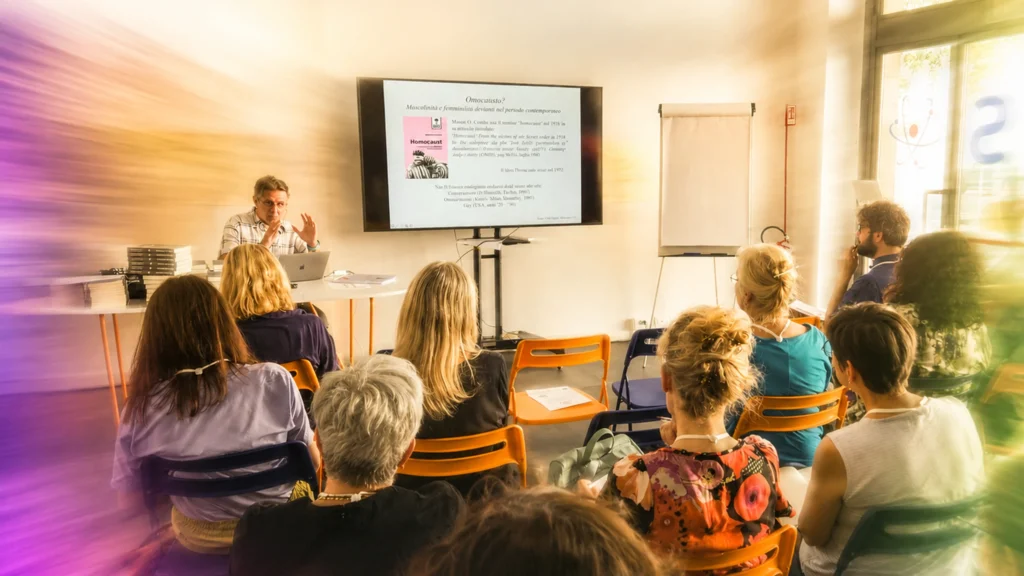
Photo: provided by Marco Reglia.
11. Court records provide very good information about repression, but they are limited when it comes to everyday life. How did you manage to reconstruct fragments of affectivity, relationships, and social life from the lines of the court files, and not just the persecution?
This topic presented and remains a major challenge: to restore the dignity of the persecuted individuals, not just as deviants. Since my research focused on ordinary people who were not accustomed to keeping diaries or writing letters, the effort involved was considerable.
A few words, some marginal notes in police documents, an element outside the usual lines, sometimes made it possible to infer something about the person who was the protagonist of the repressive events. This was different with oral sources, where, despite the difficulties related to privacy and shame, it was easier to deepen the knowledge about the person.
Photo: provided by Marco Reglia.
12. In your book, you also mention the use of oral sources. Is there a testimony that significantly changed your initial interpretation, which you had obtained from the archival documents?
Certainly, Betty, the protagonist of the deportation from Trieste to a camp near Dresden, along with five other people. Without him, I would not have been able to find some documentary sources that ultimately allowed me to tell the story of the New Year’s Eve raids, which affected 23 people.
In general, the people who became oral sources for me were also a source of inspiration to continue the research on these topics, and often also friends. I found myself in the role of discoverer and guardian of their stories, even the emotional and very personal ones.
13. Today, Trieste comprehensively celebrates its Habsburg heritage as a factor of cosmopolitan identity. How does this public memory relate to the queer dimension of that same heritage, which remains marginalized in institutional discourse?
The celebration of Trieste’s Habsburg past today has tourist connotations that highlight some aspects while concealing others. While talk of cosmopolitanism is common, the “Italianità” (Italian identity) is often praised as a central pillar of the city’s life, both past and present.
Consider, for example, the recent unveiling of a statue of Gabriele D’Annunzio in the city center, a figure not directly connected to the city, but undoubtedly associated with that “Italianità,” which is anything but cosmopolitan.
In the 18th and 19th centuries, and at the turn of the 20th century, homosexuality was certainly not freely practiced, even during the period of the great Habsburg port. Therefore, there are currently no facts or other elements that could contribute to the legacy of a liberal myth, even in terms of sexual mores.
I don’t know how often, for example, the possible homosexuality of Umberto Saba is mentioned, which is expressed in his posthumously published novel “Ernesto.”
14. In the current political context of Italy, Slovenia, and Croatia, we are witnessing new forms of pressure on LGBTQ+ rights. Do you recognize mechanisms of continuity between the fascist “strategy of invisibility” and certain contemporary rhetorics, or are these historically distinct phenomena?
I don’t see a direct continuity with the Italian and fascist “invisibility.” It should be remembered that the criminal code preceding Fascism also followed the same approach: not to criminalize homosexuality. At least partly because the visibility of the LGBTQ+ world is now a fact, and the political use of the accusation of homosexuality is becoming increasingly ineffective.
This does not mean that there cannot be a return to repression, even legal repression. But given the visibility of today, it is more likely that it will take different forms.
Photo: provided by Marco Reglia.
For the readers in Vienna, the capital of the empire that introduced Paragraph 129 and then abolished it quite late, in 1971: What is the central message you want them to take away from your book, and what responsibility lies with the Austrian public memory today?
The repeal of Paragraph 129 came late, but in some ways, other repeals were also late. Ultimately, Paragraph 175, although weakened from 1969, was not completely abolished until 1994.
I do not have an overview of the current Austrian historiography on homosexuality and its repression during the empire. This topic needs to be explored further, even by going back further in time than the effects of the Penal Code of 1852, to see what happened with the Penal Code of 1803.
I believe that the history of “unnatural lust” in the coastal region should be placed in the broader context of the perception of the bourgeois male-female model that prevailed during the empire, also taking into account the important role that the Habsburg army played as an element of cohesion for the crown and its peoples.
I wish the readers in Vienna a good reading experience, hoping for their feedback and, who knows, for a possible collaboration in attempting to view the history of the Habsburg-influenced populations in a comprehensive perspective: a perspective that compares the deviations from the male-female dual model in the coastal region with those of the capital, but also with those of the other regions of the dual monarchy.
Who knows whether the great Habsburg port of that time was perceived by the rest of the Austro-Hungarian population as a freer and/or more attractive place for same-sex affections.
FAQ
What was Paragraph 129? Paragraph 129 was the provision of Austrian criminal law that criminalized same-sex acts and was applied in the Habsburg Empire. Austria only abolished it in 1971.
What is the interview with Marco Reglia about? The historian explains how homosexuals were persecuted in Trieste during the Habsburg era and under Italian Fascism, and why this history remained largely silent for so long.
What distinguishes the Habsburg and the Fascist models of repression? The Habsburg model was judicial and prescribed clear penalties. The Fascist model operated outside of the courts, using the police, creating uncertainty, and employing a strategy of invisibility.