Alexander III of Macedonia, known as Alexander the Great, lived from 356 to 323 BC. In thirteen years of rule, he conquered the Persian Achaemenid Empire and changed the political and cultural order of the ancient world.
Alexander the Great’s sexuality cannot be definitively determined. No contemporary account of his life is completely preserved. The most important accounts emerged centuries later and were each based on their own political, moral, or literary interests. Therefore, for today’s readers in Austria, it is crucial not to equate ancient relationships with modern identity concepts too quickly.
Alexander the Great’s Sexuality: A Source Check
iksHaus | KI-generiert nach redaktioneller Konzeption, 2026
Today’s knowledge is primarily based on Arrian, Plutarch, Quintus Curtius Rufus, Diodorus, and Justin. They drew on reports from Alexander’s contemporaries and generals that are now lost. Arrian focused on campaigns and administration. Plutarch sought out character traits and weaknesses. Curtius Rufus interpreted Alexander’s life as a history of moral decline due to unlimited power. Diodorus and Justin often preferred dramatic episodes.
This distance makes it difficult to make statements about Alexander’s private life. Terms such as heterosexual, homosexual, or bisexual come from a much later era. In the Greek and Macedonian antiquity, sexual relationships were more strongly assessed based on age, social status, and power dynamics.
Reports about Alexander’s early restraint remain ambiguous. An account of the Thessalian courtesan Kallixena was interpreted by ancient authors as evidence of self-control. Modern interpretations, on the other hand, saw it as a possible indication of a lack of interest in women. None of these interpretations can be definitively proven.
Political Marriages and Courtly Life
iksHaus | KI-generiert nach redaktioneller Konzeption, 2026
Alexander grew up at the court of his father, Philip II. There, marriages, intimate relationships, and dynastic interests were closely linked to power. According to the accounts, Philip had at least seven official wives. Each union was intended to secure political alliances. Alexander’s mother, Olympias, came from Epirus and held a central position as the mother of the heir to the throne.
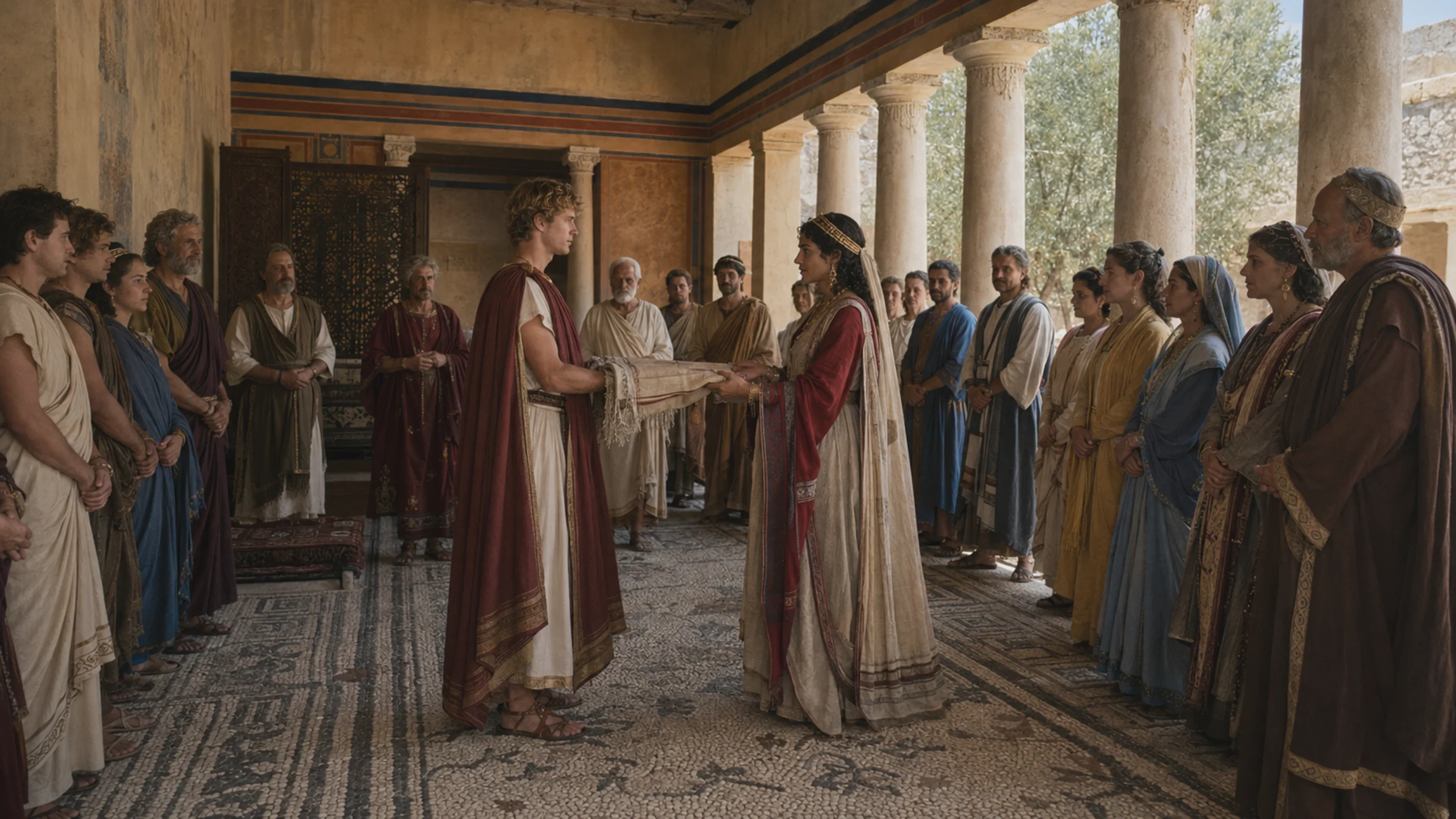
Alexander’s own marriages also served a political purpose. In 327 BC, he married Roxane, the daughter of the Bactrian ruler Oxyartes. Ancient accounts described the union as a love match. At the same time, it helped to integrate local elites in Bactria and Sogdiana into Alexander’s rule.
At the weddings of Susa in 324 BC, Alexander married Stateira, a daughter of Darius III, and Parysatis, a daughter of Artaxerxes III. At the same time, numerous Macedonian officers were married to women from Persian noble families. More than 10,000 existing relationships between Macedonian soldiers and women of Asian origin were recognized. After Alexander’s death, almost all of the leading officers dissolved their marriages. Seleucus and Apama formed the exception mentioned in the original text.
Hephaistion and Bagoas: Reflections in the Accounts
iksHaus | KI-generiert nach redaktioneller Konzeption, 2026
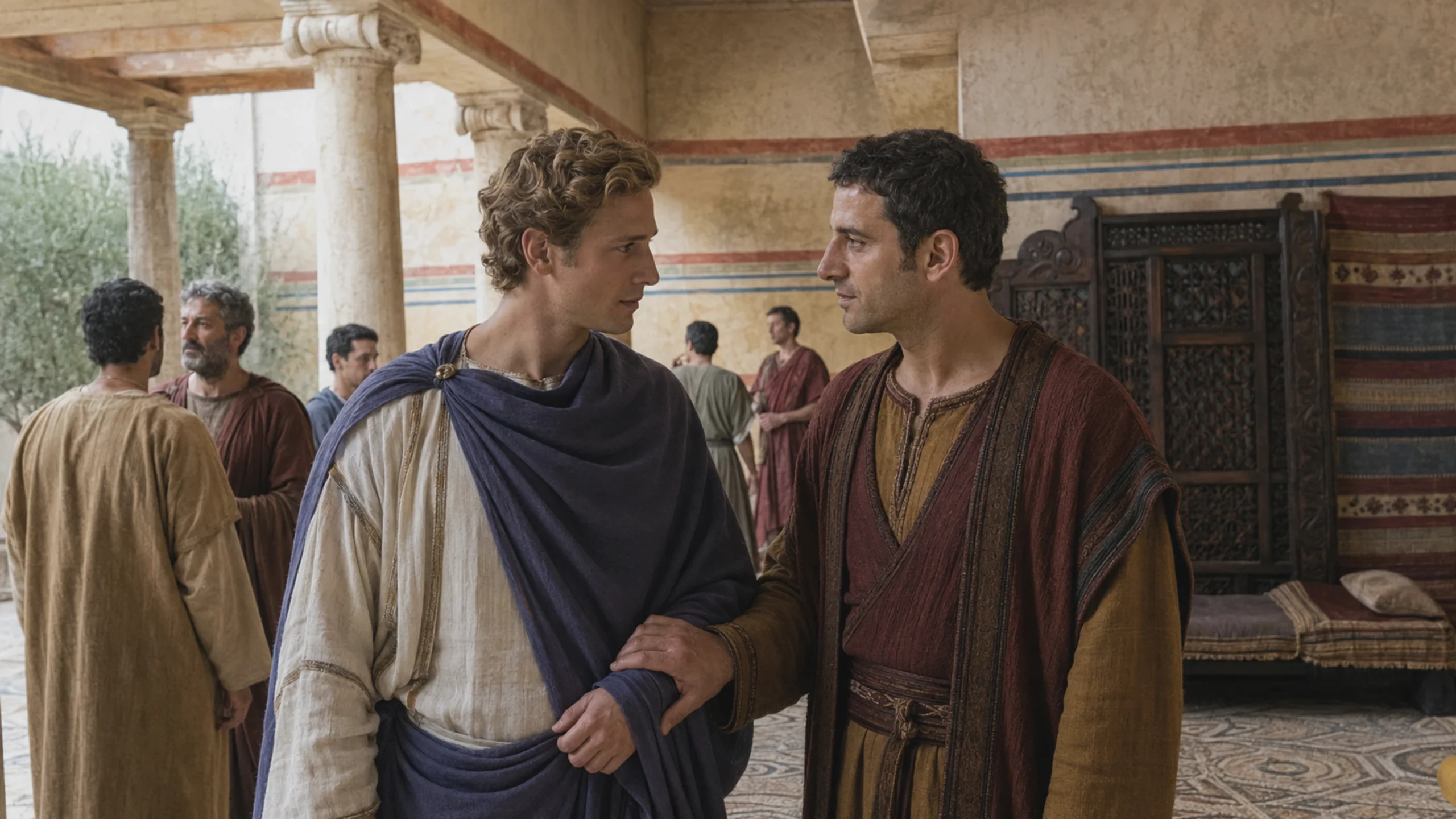
Hephaistion was Alexander’s closest companion and held high military and administrative positions. They were approximately the same age and had known each other since their youth. Their relationship therefore did not conform to the usual model between an older man and a younger protégé.
Ancient authors often described their bond as philia, meaning friendship. At the same time, Alexander and Hephaistion drew a connection to Achilles and Patroclus. During their visit to Troy, Alexander is said to have honored the site associated with Achilles, while Hephaistion paid tribute to Patroclus. In classical Greek literature, this pairing could also be interpreted romantically and sexually. Whether Alexander and Hephaistion had a physical relationship remains open due to the lack of explicit contemporary evidence.
Bagoas was a Persian eunuch and dancer who was given to Alexander after the death of Darius III. Plutarch recounts a public kiss after a dance competition in Karmania. Curtius Rufus and Athenaios interpreted Alexander’s closeness to Bagoas as a sign of diminishing self-control. This moral judgment reveals as much about the authors and their societies as it does about Alexander himself.
Pothos, Arete, and Alexander’s Self-Image
Arrian used the term pothos to describe Alexander’s drive for the distant and seemingly unattainable. This motivation was intended to explain why he undertook militarily risky ventures, such as the march to the Oracle of Siwa or the further advance into India.
The term arete denoted excellence and the desire to surpass others. Alexander looked to Heracles and Achilles, and at the same time, he wanted to surpass the achievements of his father. The original text connects this ambition with his political decisions, his grief, and his particularly intense relationships.
Grief for Hephaistion and Political Cult
Hephaistion died in 324 BC in Ekbatana from an illness. Later accounts describe Alexander’s reaction as exceptionally intense. He ordered mourning rituals, had Hephaistion’s name preserved in the cavalry unit he led, and planned an elaborate burial in Babylon.
Alexander also asked the Oracle of Siwa to bestow a religious elevation on the deceased. Hephaistion was not recognized as a god, but he was allowed to be revered as a divine hero. This honor combined personal grief with political policy and, at the same time, strengthened Alexander’s own claim to a position above ordinary people.
How Later Eras Reinterpreted Alexander
The interpretation of Alexander’s relationships changed with the societal norms of the researchers. In the 20th century, W. W. Tarn rejected homosexual interpretations. Later historians such as Paul Cartledge, Daniel Ogden, and Robin Lane Fox addressed the relationships with Hephaistion and Bagoas more openly, but cautioned against simply applying modern categories.
Mary Renault brought Bagoas into the focus in her novel “The Persian Boy” in 1972. Oliver Stone’s film Alexander, released in 2004, also clearly depicted Alexander’s emotional attraction to men. Such works have influenced public perception, but they do not replace a critical examination of the ancient sources.