

Ernst Röhm’s homosexuality was known within the Nazi Party leadership. However, Hitler remained loyal to him as long as the Sturmabteilung was needed for violence, intimidation, and the seizure of power.
When Röhm became a political obstacle, Hitler had him murdered. Afterward, the regime used his sexuality to morally justify the political purges. This created the enduring myth of Nazi organizations characterized by homosexuality.
A Perpetrator in the Nazi Power Apparatus

iksHaus | KI-generiert nach redaktioneller Konzeption, 2026
Röhm was a professional soldier, a nationalist, and an early supporter of Hitler. He viewed violence as a political tool and understood the SA as a revolutionary combat organization. Under his leadership, it grew into a violent mass organization that attacked political opponents and contributed to the destruction of the Weimar Republic.
Röhm identified himself, using the terminology of the time, as homosexual. However, his stance was not part of a democratic movement for personal freedom or equal rights. His understanding of camaraderie was shaped by war experiences, hierarchy, and aggressive masculinity.
His biography is therefore not a story of queer emancipation. His homosexuality neither diminishes his responsibility for political violence nor does it say anything about the political views of other homosexual individuals.
Hitler was aware of Ernst Röhm’s homosexuality

iksHaus | KI-generiert nach redaktioneller Konzeption, 2026
Röhm’s private life was no secret within party circles. After personal letters became public, left-wing newspapers made his sexuality public. Opponents of the Nazi Party pointed to the contradiction between the party’s stance on homosexual emancipation and Röhm’s position within the power structure.
Hitler defended Röhm as long as he was useful for Hitler’s political goals. This temporary tolerance was not an acknowledgment of homosexual people. Other men could not derive any protection from it.
The different treatment reflected the power dynamics of the regime. Röhm remained protected as long as the SA was needed for street fighting, intimidation, and the seizure of power. With the changing power dynamics, this protection ended.
Why the SA became a political problem
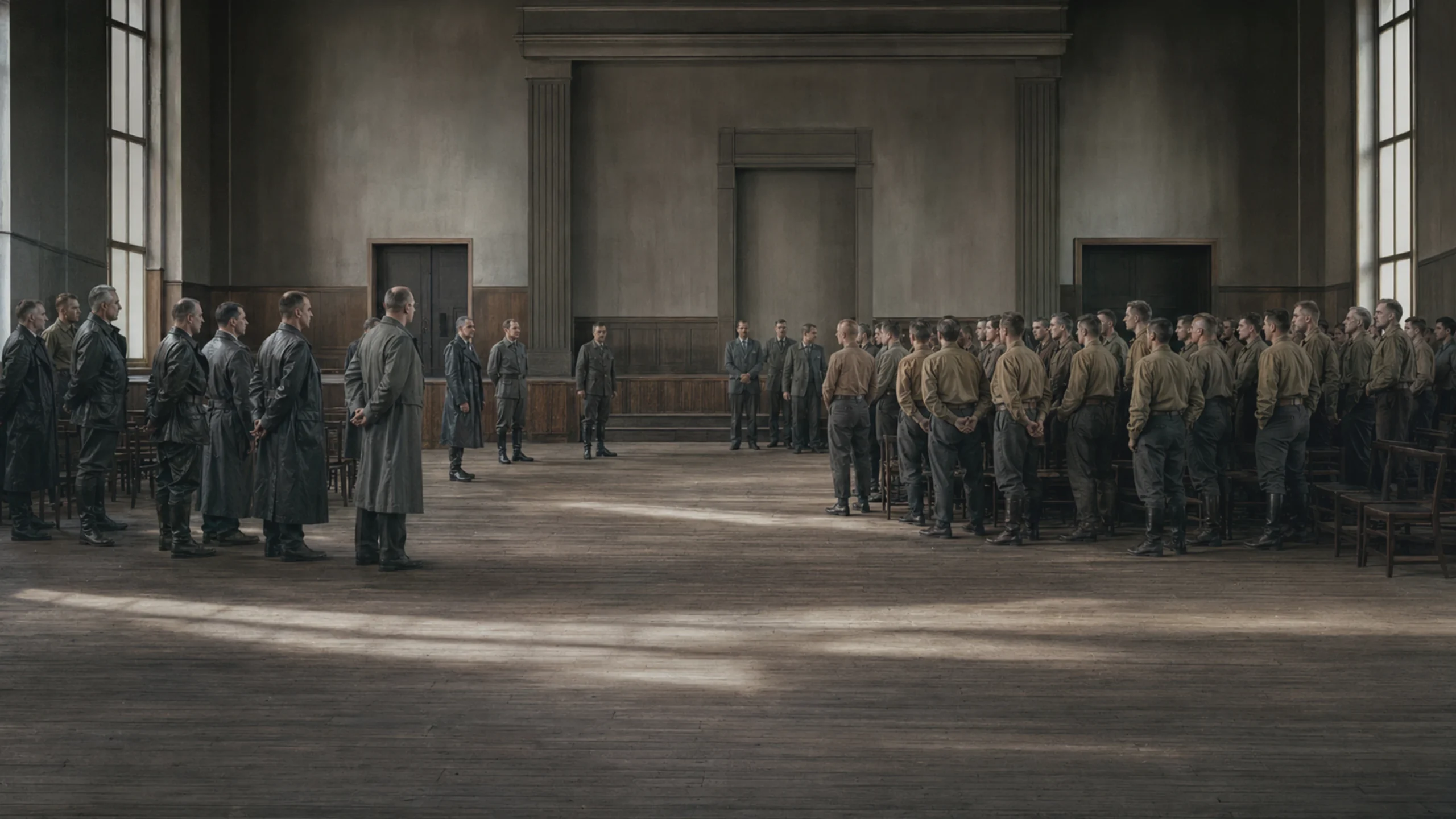
iksHaus | KI-generiert nach redaktioneller Konzeption, 2026
After the seizure of power, many SA members expected a further increase in power. Röhm wanted to transform the existing army into a new fighting force dominated by the SA. In doing so, he threatened the military leadership, conservative elites, and other parts of the Nazi apparatus.
Hitler needed the support of the professional army for his further plans. At the same time, political rivals feared Röhm’s power and the unrest within the SA. The leadership of the SS and other opponents spread rumors about an impending coup.
Röhm’s homosexuality was not the cause of this conflict. It was long known and had not prevented his career. Only after the decision to eliminate him did it become propagandistic evidence.
The political murder needed justification
In the summer of 1934, Hitler had the leadership of the SA arrested and murdered. Other political opponents and former allies were also killed. The organized political purge eliminated rivals and secured Hitler’s support from the army.
The regime presented the murders as a reaction to an alleged imminent conspiracy. Röhm’s sexuality offered an emotionally charged justification. The propaganda linked the alleged coup with sexual depravity, moral corruption, and betrayal.
In this way, homosexuality was retroactively declared a sign of political unreliability. Propaganda transformed a power struggle into a supposed moral cleansing.
The SA was not a homosexual organization
The existence of homosexual men in the SA is historically documented. However, this does not mean that the organization was defined by a shared sexual identity. The SA was a national socialist paramilitary organization with a large and socially heterogeneous membership.
Images of camaraderie, physical strength, and male loyalty were part of many military and paramilitary cultures. They should not be equated with homosexual relationships or political solidarity with homosexual people. An aggressive cult of masculinity can be associated with pronounced homophobia.
The myth of homosexual Nazism transformed individual biographies into a conspiracy narrative about secret male power structures.
The SS and Gestapo became instruments of persecution
After Röhm’s death, the SS, under Heinrich Himmler, continued to gain power. In their racist and population-political ideology, homosexual men were considered a threat because they were supposedly unable to produce children for the desired Volksgemeinschaft (national community) and maintained secret loyalties.
The SS, criminal police, and Gestapo became central organs of surveillance and persecution. They collected information, organized raids, conducted interrogations, and sent men to concentration camps after prison sentences. Members of the SS and the police were also not protected if they were accused of similar offenses.
The claim that these institutions were homosexual obscures their historical responsibility as instruments of a state that criminalized same-sex desire and violently suppressed it.
Why the myth still resonates today
A homosexual man at the head of a national socialist paramilitary organization appears as a striking contradiction. This allows for a simple narrative to be constructed. The historical connections are more complex: Röhm was a perpetrator, his sexuality was politically exploited, and other homosexual people were persecuted by the regime.
The myth shifts responsibility. When Nazism is interpreted as an expression of a supposedly homosexual male culture, the state-sponsored homophobia is obscured.
Röhm’s story isn’t about a hidden truth about homosexuality, but about power. Hitler tolerated what benefited him and condemned the same thing as soon as it could be used to justify political violence.