

The political history of astrology reveals a remarkable contradiction: rulers and religious authorities banned public predictions, yet simultaneously employed their own astrologers. In pre-modern societies, interpreting the heavens was not merely a form of entertainment. It was linked to astronomy, medicine, natural philosophy, and theology.
From an Austrian perspective, a distinction is important: the examples discussed here extend to Mesopotamia, Rome, Italy, England, and France. The underlying material does not contain specific cases from Vienna or Austria. Therefore, the historical overview only places the supra-regional developments described within a broader context.
Political History of Astrology as a History of Knowledge

iksHaus | KI-generiert nach redaktioneller Konzeption, 2026
Since Babylonian sky observers began recording planetary cycles in the third millennium BC, movements in the sky have been linked to events on Earth. In Hellenistic thought, this practice was given a mathematical and philosophical framework. Concepts such as Sympatheia, the connection of all parts of the cosmos, and Heimarmenê, cosmic destiny, were intended to explain how celestial bodies influenced the world.
In this model, stars and planets were not merely symbols. They were believed to have effects on the weather, diseases, bodily fluids, and the mood of larger groups. Calculations of conjunctions therefore appeared as part of the contemporary explanation of nature. Astrology and astronomy were closely linked under the term scientia stellarum, the science of the stars.
Johannes Kepler and Regiomontanus also practiced astrology. The demand for predictions simultaneously encouraged more accurate calculations of celestial movements. For rulers, this knowledge promised guidance in a world marked by wars, plagues, and unresolved succession issues.
Why Rome and the Church Limited Predictions
iksHaus | KI-generiert nach redaktioneller Konzeption, 2026
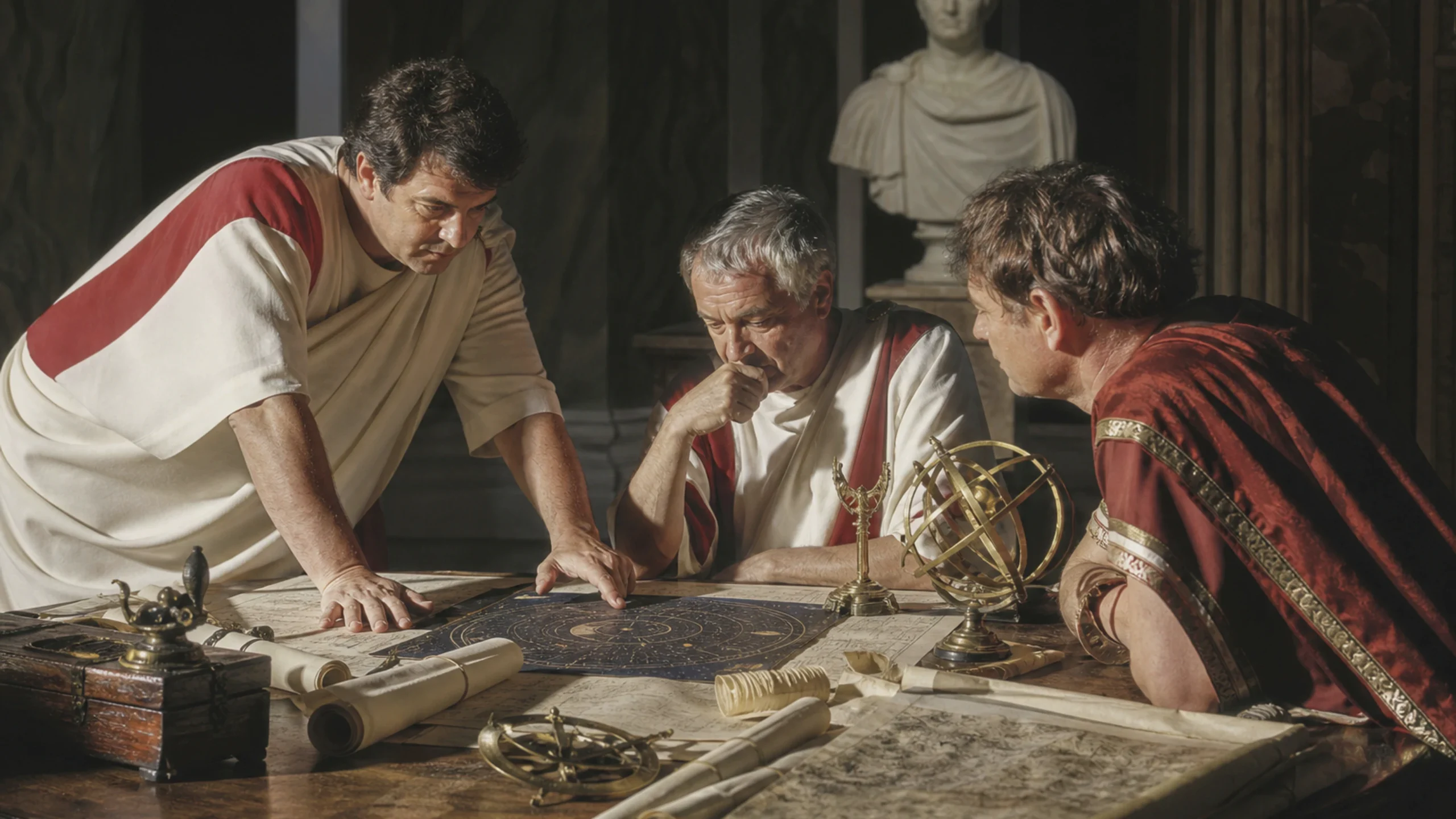
In the Roman Empire, prohibitions were primarily directed against politically sensitive predictions. Augustus issued regulations in 11 AD that restricted private astrological consultations without witnesses and prohibited predictions about the death of a person. Under Tiberius, creating a horoscope for the emperor or his family was considered a potential attack on the state order.
A prediction of the emperor’s death could trigger succession struggles, secret alliances, and unrest. Roman law therefore associated such practices with the crime of treason. At the same time, Tiberius employed the astrologer Thrasyllus on the island of Capri. Therefore, the knowledge was not fundamentally rejected, but politically controlled.
Medieval Christianity set a different limit. Complete astrological determinism contradicted the doctrine of free will, moral responsibility, and divine providence. What remained permissible was the so-called natural astrology, used for weather forecasting, agriculture, navigation, and medicine. Judicial astrology, which predicted individual fates, wars, or the death of rulers, was, on the other hand, condemned.
Astrology as a Tool of Power

iksHaus | KI-generiert nach redaktioneller Konzeption, 2026
At courts, astrology served as an instrument for decision-making under uncertain conditions. Electional astrology was intended to determine the most favorable time for coronations, military operations, peace treaties, or the laying of the foundation stones of major buildings. Guido Bonatti was an Italian military leader and city planner in the 13th century. John Dee calculated the time of Elizabeth I’s coronation and served as a scientific and political advisor.
Several Renaissance popes also promoted astrological practices. Julius II had the 18th day of April 1506, at 10:00 AM, determined to be an auspicious time for the laying of the foundation stone of the new St. Peter’s Basilica. Leo X established a chair for astrology at the Roman University “La Sapienza.” Paul III consulted Luca Gaurico before the consistories and the appointment of new cardinals.
Astrological charts could also be used to assess rivals and legitimize one’s own rule. Those who controlled the predictions about their opponents were seen, at the time, to have a strategic advantage. Public prohibitions and private use, therefore, were not a random contradiction, but rather an information monopoly.
Church censorship and its limits
The church’s distinction between natural and judicial astrology shaped the censorship of the early modern period. The Index Librorum Prohibitorum, published in 1559 under Paul IV, prohibited writings on judicial astrology and the prediction of indefinite future events. Works on medicine, agriculture, and navigation were exempt.
In 1586, Sixtus V tightened the policy with the bull Coeli et terrae creator. It condemned forms of divination and threatened political horoscopes with sanctions from the Inquisition. According to the underlying material, this censorship was applied selectively. Independent astrologers, almanacs, and political opponents were more at risk than professionals in the environment of church elites.
Death predictions as a political risk
Predictions about the death of a pope or a king were particularly risky. In political systems with uncertain succession, such announcements could trigger political maneuvers, military preparations, and economic restraint. The prediction, therefore, had an effect regardless of its actual accuracy.
One example is the case of Orazio Morandi. The Roman abbot calculated that Pope Urban VIII would die within a few months in 1630. The news spread through diplomatic channels, prompting the cardinals to prepare for a possible conclave. Morandi was arrested and died under unclear circumstances in an Inquisition prison. Subsequently, Urban VIII increased the penalties for horoscopes about the death of a pope.
Context for Austria
For readers in Austria, this story primarily highlights how closely knowledge and political authority can be intertwined. Astrology, in the epochs described, served simultaneously as an explanation of nature, a form of advice, propaganda, and a potential means of destabilization.
However, a specific history of astrology in Vienna or Austria cannot be derived from the available material. The evidence only supports a broader pattern: elites attempted to use astrological predictions for their own benefit while restricting their public use. The crucial question was therefore less about whether astrology was believed, but rather who was allowed to use and disseminate it.