

If you lie awake at night, staring at the ceiling, and worrying about microplastics in your blood, heat waves that melt Mariahilfer Straße every summer, and the feeling that it’s already too late, there’s good news. No, you’re not going crazy. And no, you’re not exaggerating. Researchers at the University of Vienna (UniWien) and the Vienna University of Economics and Business (WU Wien) are documenting something that traditional psychology has long been reluctant to admit: climate anxiety is not a pathology. It is a rational, evolutionarily-based response to an objective existential threat.
And the numbers speak very clearly.
A fear that is not exaggerated
iksHaus | KI-generiert nach redaktioneller Konzeption, 2026
iks.haus | AI-generated based on editorial concept, 2026.
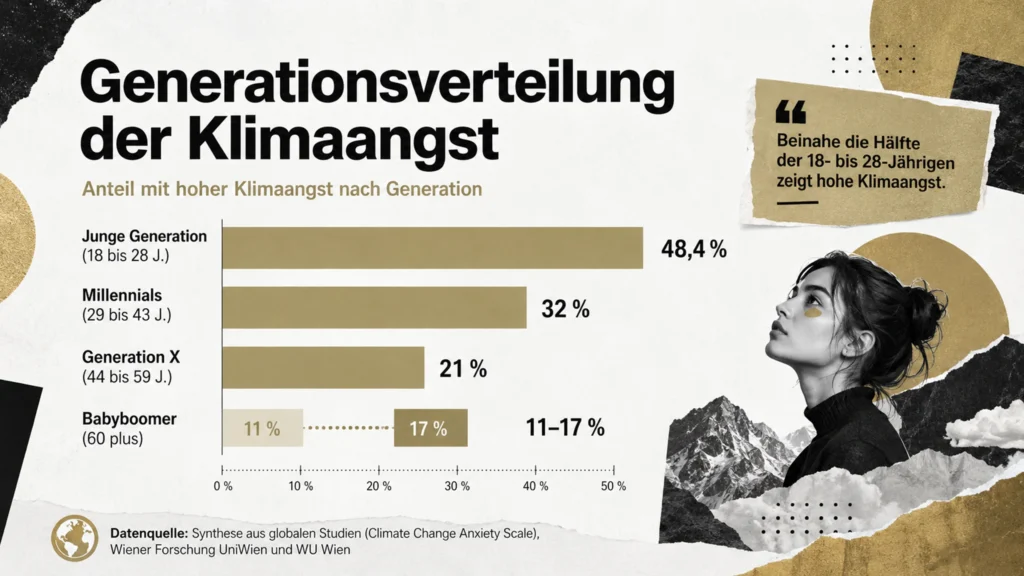
Current studies show that almost 48.4 percent of young people in their twenties report high levels of climate anxiety. That’s four times as much as the baby boomer generation. The difference is not that young people are more sensitive or dramatic. The difference is who will actually live with the consequences. People born after 1995 will inherit a world that has been turned into a thermal chamber, while at the same time, they are expected to be the main drivers of the transformation.
Sabine Pahl, a professor at the Research Group for Urban and Environmental Psychology at the University of Vienna, leads a team that has been studying the reciprocal relationship between humans and the environment for years. Her research shows that awareness of “invisible threats” (microplastics in the body, chemicals in the air, loss of biodiversity) creates a specific form of anxiety linked to physical integrity. In other words, it’s not just about worrying about “the planet.” It’s about worrying about one’s own body, one’s own breathing, one’s own life.
The Vienna-based research raises a question that others have avoided
Vienna has established itself in recent years as one of the European centers for environmental psychology. The University of Vienna and the Vienna University of Economics and Business (WU Vienna) work in parallel, but from different perspectives.
The team led by Peter Vandor, Martin Mehrwald, and Fabian Hoboditesch at WU Vienna focused on the intersection of mental health and social entrepreneurship. Their most cited study, “Don’t Look Up? The Effect of Role Models on Climate Anxiety and Climate Action,” revealed a paradox that should concern everyone who believes that success stories are automatically therapeutic. While engagement with role models in climate activism increases confidence in solutions, it also increases climate anxiety. The reason? Reflecting on role models reduces the cognitive distance from the crisis and makes the threat more personal.
The bottom line is simple: the more you think about people taking action, the less you can hide behind distance.
Numbers to keep in mind
iksHaus | KI-generiert nach redaktioneller Konzeption, 2026
iks.haus | AI-generated based on editorial concept, 2026.
The statistics show a precise generational distribution. Young generation (18 to 28 years old): 48.4 percent experience significant anxiety. Millennials (29 to 43 years old): approximately 32 percent. Generation X (44 to 59 years old): approximately 21 percent. Baby Boomers (60+): between 11 and 17 percent. These are not insignificant numbers. This corresponds to nearly half of an entire generation experiencing clinically relevant distress related to the climate, according to Austrian psychiatric standards.
What distinguishes rational fear from pathology is not the intensity. The difference lies in the source. Traditional fear often arises from distorted cognition. Climate anxiety, on the other hand, stems from scientific consensus, visible extreme weather events, and objective loss of control. If you are afraid of fire while your house is on fire, you don’t need therapy. You need the fire department.
Cognitive Dissonance: When Knowledge and Action Don’t Align
Studies by researchers in Vienna show that young people often fly more frequently than older generations, even though 41 percent of them believe that flights should be taxed to protect the environment or avoided altogether. This is not hypocrisy. This is cognitive dissonance in action: The discrepancy between what you know and what you do creates a persistent feeling of guilt that builds up and has the potential to turn into dysfunctional paralysis.
Jörg Matthes and his team at the University of Vienna also show that the younger generation is extremely skeptical of environmental claims made by companies. Concrete compensation promises, such as “one tree planted for every flight,” evoke more skepticism in young people than in older people. The reason? Young people understand the complexity of the carbon cycle and recognize greenwashing as an attempt to distract from the necessity of systemic emission reductions.
Vienna possesses a resource that other European cities do not have in this form
A study conducted at the end of 2024 and the beginning of 2025 compared Vienna and Milan in terms of climate risk perception and the use of green spaces. The result? Residents of Vienna perceive urban parks as a necessary buffer zone against stress. A high functional and emotional value is attributed to the proximity to Schönbrunn, Stadtpark, Augarten, and a vast number of smaller green oases that extend from the 2nd to the 22nd district.
In Milan, where green infrastructure is inadequate, heatwaves increase anxiety because residents lack places to escape the heat. Green spaces without shade become heat islands that people avoid. In contrast, Vienna integrates climate resilience and mental health into urban planning. This means that it’s no coincidence that you might find a sense of peace when sitting on a bench in the Volksgarten. This is policy in action.
Burnout among those who work the most
There’s a darker side to this story that is rarely mentioned. A study involving over 1,000 founders of social enterprises from 47 countries, including members of the Vienna Impact Hub, revealed alarming rates of burnout. Young innovators, motivated by climate goals, are not only experiencing professional exhaustion. They are experiencing existential exhaustion: the feeling of “not doing enough” in the fight against the planetary crisis, even when they work 70 hours a week.
Qualitative interviews reveal a recurring phrase: “If we fail, someone will suffer.” This type of hyper-responsibility is often praised as enlightened in society. In reality, it destroys people.
What the system does (and what it doesn’t)
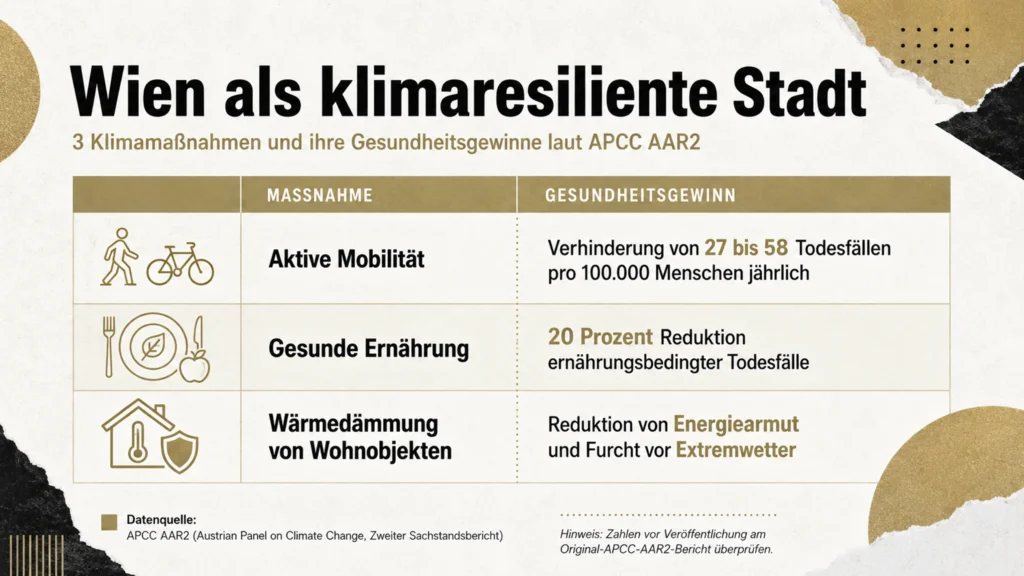
The second Austrian national report on climate change (AAR2), prepared by the Austrian Panel on Climate Change (APCC), has begun to integrate mental health into national strategy reports. Active mobility in Vienna, Graz, and Linz can, according to estimates, prevent between 27 and 58 deaths per 100,000 people annually. A healthy diet can reduce deaths related to nutrition by 20 percent, and the insulation of residential buildings reduces energy poverty and the fear of extreme weather conditions in one’s own home.
iksHaus | KI-generiert nach redaktioneller Konzeption, 2026
iks.haus | AI-generated based on editorial concept, 2026.
The problem? The education system continues to fail, according to qualitative surveys, in preparing young people for the emotional and practical challenges of the crisis. High school students and aspiring teachers report three main obstacles: superficial treatment of topics, a lack of practical action, and emotional neglect in the curriculum. Students learn about disasters, but rarely receive tools to participate in finding solutions.
Anger is more productive than fear
Perhaps the most important finding from Viennese researchers is this: Emotions such as ecological anger (Eco-Anger) are better predictors of participation in collective action than fear itself. When fear is recognized as a signal of empathy and concern, it ceases to be a burden. It becomes fuel.
This means: The question is not “How do I get rid of climate anxiety?” The question is: “How do I channel it into actions that don’t break those who are taking action?”
Three recommendations from the research:
Connecting with others reduces feelings of isolation. Local action helps in dealing with expectations, because the “big picture” can overwhelm even the strongest. Structured support systems (therapy, peer groups, unions for climate activists) are essential for those who are most active.
What now?
Climate anxiety will not disappear. On the contrary, it will continue to increase, especially with the increasing frequency of extreme weather events. However, Viennese researchers clearly state: The fear is rational, the distress is legitimate, and the solution lies not in individual therapy, but in systemic change.
In other words: If you are afraid, you are reading the signs. The only question is, what will you do with that knowledge?