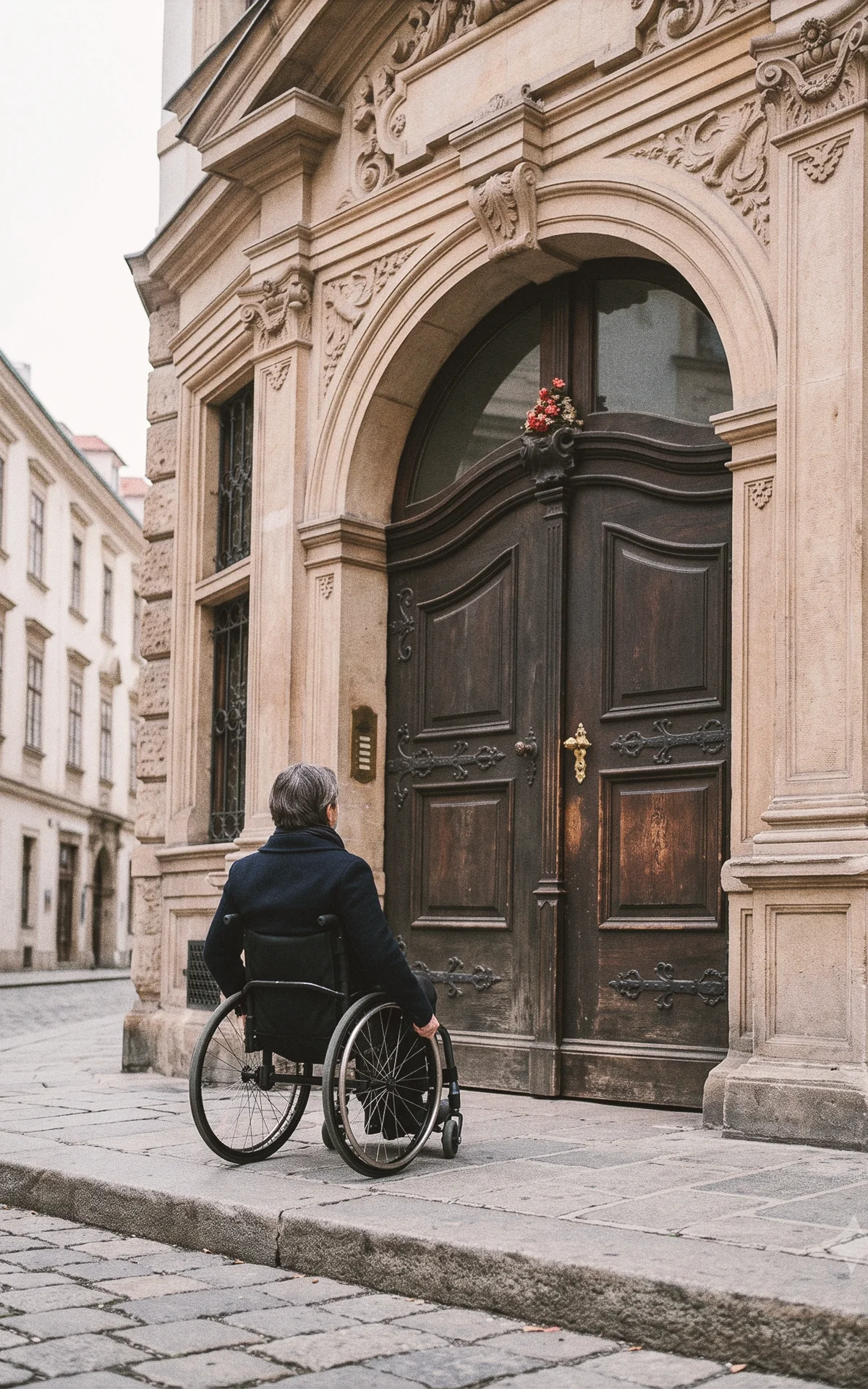
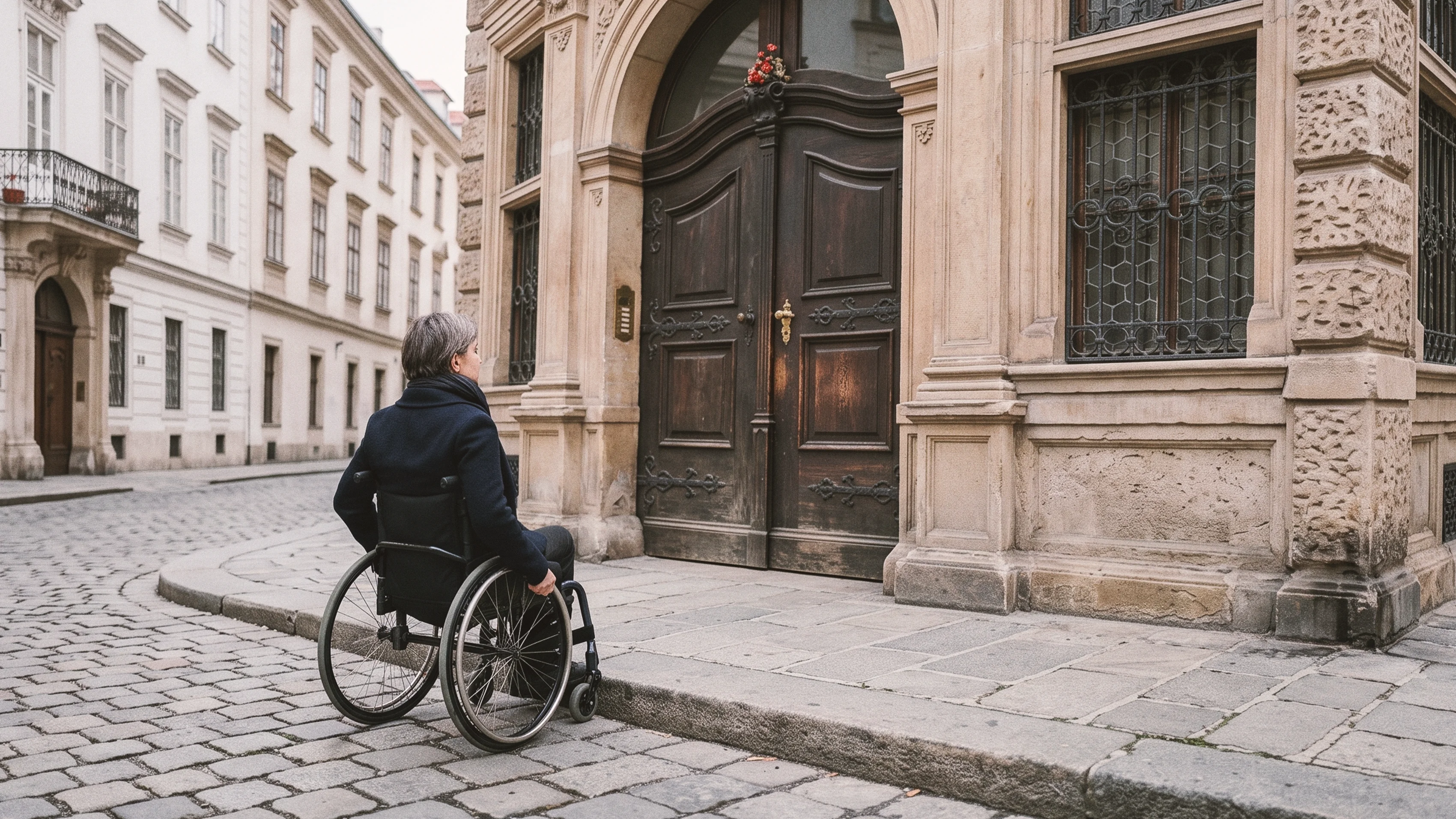
Fifteen centimeters can be enough to exclude people from everyday life in Vienna. Ironically, the winner of the Access City Award 2025 continues to face persistent barriers in the city’s historical building stock. New rules for digital services increase the pressure to act, but guidelines only become access when someone translates them into concrete projects.
Beauty that excludes
There’s an image that keeps appearing in Vienna. A person in a wheelchair stands in front of the entrance to a coffee house on the Ringstraße. The building is a masterpiece of historicism: ornamentation, high arches, massive wooden doors. And a threshold.
Fifteen centimeters of stone determine whether someone can enter or must remain outside.
Neither the owner of the coffee house is necessarily a bad person, nor is the building itself the problem. The problem is a system that has accepted this sight as normal for years.
Vienna can rightly point to many advances. In 2024, the European Commission named the city the winner of the Access City Award 2025. Public transportation, administration, and new districts show what is possible. However, this award does not eliminate the everyday obstacles in the historical building stock.
Of the approximately 176,000 buildings in Vienna in 2021, nearly one in three was built before 1945. Buildings from the Gründerzeit era, Art Nouveau ensembles, and municipal buildings from the interwar period shape the city’s landscape – and continue to pose difficult renovation challenges for owners, planners, and users.
This charm defines Vienna. The threshold defines who can participate in it.
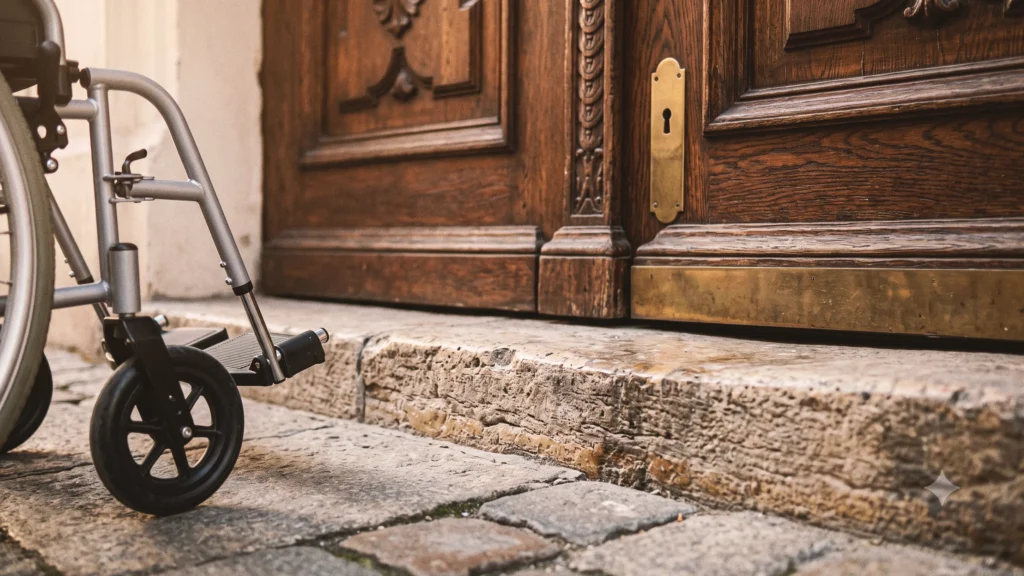
iksHaus | KI-generiert nach redaktioneller Konzeption, 2026
A law that is easily misunderstood
New rules for digital services
Since June 28, 2025, the Accessibility Act (BaFG) has been in effect in Austria. It implements the European Accessibility Act into national law and covers certain products as well as consumer-related services. These include, among other things, e-commerce offerings, banking services for consumers, e-books, certain services in passenger transport, and several types of self-service terminals.
Therefore, online shops and direct online booking systems for hotels may fall within the scope of the BaFG. In contrast, a purely informative company website is not automatically covered by the BaFG simply because it is online.
The exceptions are also important: Micro-enterprises that offer services are exempt from the accessibility requirements of the BaFG. Micro-enterprises are defined as businesses with fewer than ten employees and either a maximum annual turnover of two million euros or a maximum annual balance sheet total of two million euros. In addition, the law includes transitional provisions and exceptions in cases of fundamental changes or disproportionate burdens.
For central violations, Section 36 of the BaFG provides for fines of up to 80,000 euros; for micro-enterprises as well as small and medium-sized enterprises, the corresponding maximum amount is 50,000 euros. Therefore, it is necessary to carefully check whether a specific offering is covered. In any case, the deadline is no longer in the future.
Building law and existing structures are another area of concern
Different rules apply to the physical accessibility of buildings. In Vienna, the primary legal framework consists of § 115 of the Building Code, the Vienna Building Technology Ordinance, and the OIB Guideline 4, which is declared binding within it. The EN 17210 can serve as a European technical reference for barrier-free design and assessment; however, a standard is not automatically equivalent to a law.
For existing buildings that have not been altered, there is generally no legal obligation to retrofit every building to the latest standards. However, § 115 also contains provisions for extensions and renovations, and other work must not compromise accessibility. In addition, physical and technical barriers to access to publicly offered goods and services may constitute indirect discrimination under the Federal Law on Equality for People with Disabilities. In each individual case, it is examined which measures are proportionate and reasonable.
Therefore, historical buildings are neither automatically protected nor are they a legal vacuum. This overlap of building law, equality law, monument protection, technical regulations, and economic feasibility makes the path from good intentions to concrete solutions so complicated.

iksHaus | KI-generiert nach redaktioneller Konzeption, 2026
What is lost when accessibility is lacking
According to the most recent evaluation by Statistics Austria, in 2024, approximately 1.9 million people between the ages of 15 and 89 lived in Austrian private households with health-related limitations in everyday activities. This corresponds to 24.7 percent of this population group. For Vienna, the survey shows approximately 422,600 people, corresponding to 25.2 percent.
This statistical definition is not equivalent to an officially registered disability. However, it shows how large the group of people is whose daily lives can be directly hindered by barriers.
In addition, there are people with temporary injuries, elderly people, parents with strollers, and travelers with heavy luggage. At the same time, Vienna is also aging: the proportion of people over 65 was 16.5 percent in 2025 and is expected to rise to more than 22 percent by 2055, according to the Vienna population forecast.
Accessibility is therefore not a niche issue. It is the infrastructure for a large and growing number of people.
This is also relevant from an economic perspective. Vienna recorded more than 20 million overnight stays by guests in 2025. If travelers cannot reliably determine whether a hotel room, a restaurant, a restroom, or a cultural institution is actually accessible before their trip, they must plan with uncertainty – or choose a different option.
Accessibility is therefore not only a legal and social issue. It is part of the location’s quality.
From practice: When technology meets reality
As a civil engineer, I have overseen more than fifty projects in Vienna, from planning to completion. As a co-founder of MOVEO, a Viennese association that works on inclusion and accessibility within European projects, I have learned something that is not always clearly stated in any regulation.
Plan early rather than retrofit later
Accessibility is usually easier and cheaper to implement if it is considered from the beginning. It becomes complex when it has to be retrofitted into an already established system.
Every threshold that could have been avoided in the planning, every development without sufficient space for an elevator, and every restroom without the necessary maneuvering space represent a missed opportunity. What would have been a manageable adjustment in the design phase can require a complex and expensive reconstruction of the entrance, the routing of utilities, or the floor plan in an existing building.
Within MOVEO projects under the Erasmus+ and CERV programs, I have collaborated with organizations and local communities in several European countries. The feedback from practical experience is similar everywhere: the biggest obstacle is often not just the money. There is a lack of a clear path from identifying the problem to a prioritized, fundable, and verifiable solution.
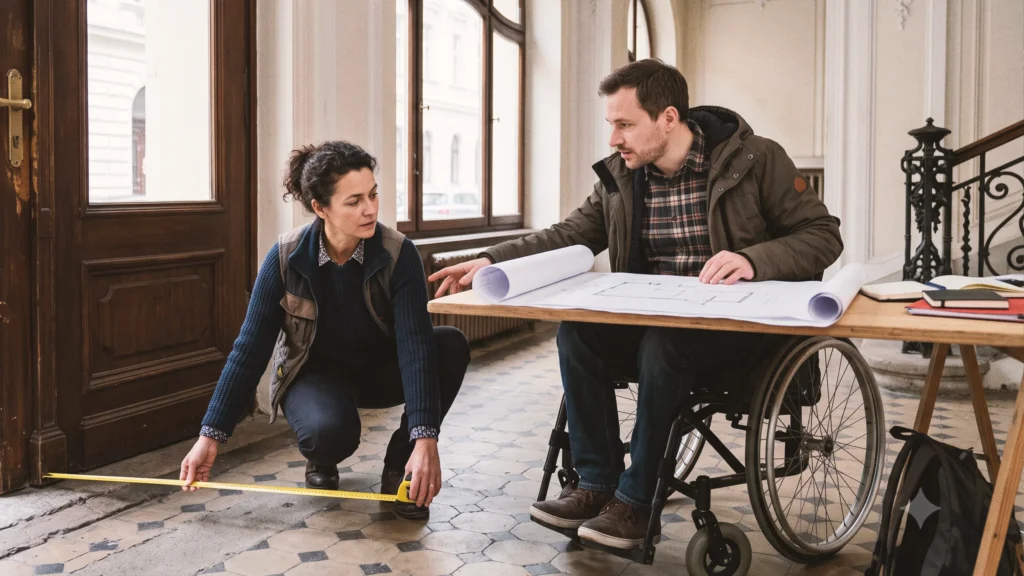
iksHaus | KI-generiert nach redaktioneller Konzeption, 2026
What can be changed – and who is working on it
This gap was the reason I founded Open Buildings – a consulting company for accessibility.
From audit to actionable plan
The approach is concrete: structural analyses based on EN 17210, assessments of digital offerings based on WCAG 2.2, a traceable prioritization of measures, and an implementation plan with a cost framework and expected benefits.
Hotels, cultural institutions, healthcare and social facilities, and public buildings face different legal obligations depending on the construction project and digital offerings – and at the same time, they represent an economic opportunity. Often, there is a need for a point of contact that translates legal requirements, technology, usage, and budget into a realistic next step.
However, Open Buildings is not the only solution – and it should not be. Vienna has essential prerequisites for systemic change: the regulatory framework is in place, the expertise is available, and there is a discernible political will.
What is often lacking is the connecting element between law and practice, between good intentions and a concrete project.