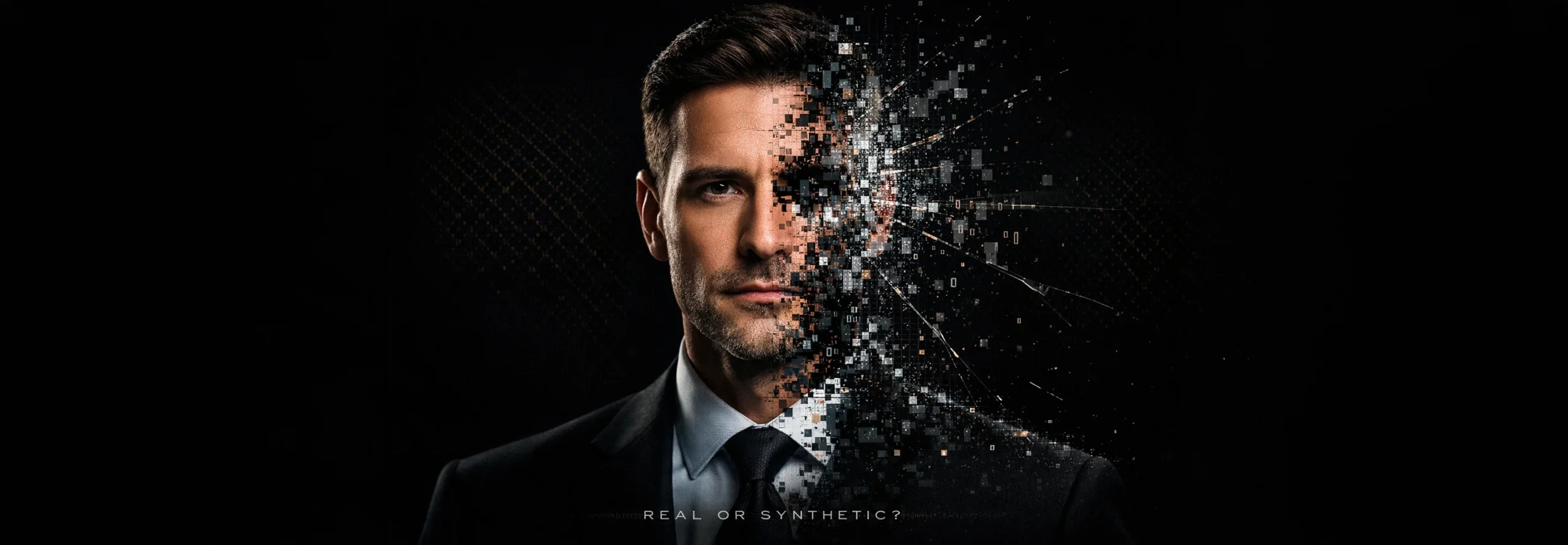
Generative AI has developed a weapon that fires no bullets. It alters memories, erases the truth and turns every piece of digital testimony into a potential forgery. Welcome to the year 2026.
There are moments that define generations. For one it was the invention of the printing press. For another, television. For us it is the moment when human beings stopped being able to tell the real from the fake simply by looking at a screen.
This is not a futuristic scenario. We are talking about an ordinary Wednesday morning, while you scroll through your news feed.
Deepfake technology, that is, synthetic media generated by deep learning, crossed a threshold in 2026 that many researchers had not expected this early. It is the stage at which the human eye is simply no longer an adequate tool for detecting lies. The average internet user correctly identifies a fake video in only 24.5% of cases. That means you will be wrong in three out of four attempts.
This is not a statistic for a yearbook. This is everyday life.
From hobby to industry: the industrialization of the lie
As recently as 2023, around 500,000 deepfake files existed on the global net. Two years later that figure exceeds 8 million, with an annual growth rate of nearly 900 percent. Yes, nine hundred percent.
Behind these figures lies something weightier than the technology itself: the democratization of fraud. The “Deepfake-as-a-Service” model has made the professional forgery of media content cheap, accessible and scalable. No IT skills are required any more, no expensive software. One click is enough.
The economic damage is catastrophic. In the US, losses from AI fraud are rising from 12.3 billion dollars in 2023 to a projected 40 billion dollars by 2027. In the first half of 2025 alone, deepfake scams robbed American citizens of more than 547 million dollars. In the United Kingdom, consumers lost an estimated 9.4 billion pounds in the first nine months of 2025.
For companies, a single deepfake incident costs almost 500,000 dollars on average. Globally, synthetic media today account for 40% of all attempts at biometric fraud. That means that facial recognition systems protecting our bank accounts and border crossings are ever more frequently confronted with an enemy they cannot detect.
The technological leap that tore down every line of defence
To understand why the situation is critical, one has to recognize what has changed technologically.
Older deepfakes had so-called glitches, small anomalies that a trained eye could spot. Unnatural shadows, biologically incorrect blinking, facial edges that broke apart during head movements. Educational materials still teach people to look for these signs. The problem is that these signs have largely ceased to exist.
The most advanced video generation models achieve what is known as temporal consistency. This is the ability to keep a person’s identity stable from frame to frame, without the pixel artefacts that would give the forgery away. Algorithms can now transfer one person’s movements onto another face without damaging the skin’s micro-textures, pore asymmetry or pigment shifts under different angles of light.
In parallel, voice cloning has crossed its own threshold of hyperrealism. With just three to five seconds of an original voice, easily found on YouTube, on social media or at public appearances, modern tools synthesize speech that replicates not only the timbre but also the accent, the breathing rhythm, emotional nuances and individual speech habits. This is why vishing attacks, that is, voice phishing by telephone call, rose by an incredible 1,600% in the first quarter of 2025 compared with the same period of the previous year.
The most dangerous evolution, however, lies not in pre-produced fakes but in real-time deepfakes. The integration of deep learning and large language models enables AI actors to respond autonomously to the person they are speaking to during a video call. In Singapore, a chief financial officer transferred almost 500,000 dollars to fraudsters because he was convinced he was taking part in a confidential video meeting with the company’s actual leadership. That leadership was entirely AI-generated.
The psychological weapon: why our brain is losing the fight
The deepest threat posed by deepfake technology is not technical in nature. It is psychological in nature.
Research conducted on more than 20,000 test subjects from 10 countries and published at the University of Texas in late 2025 clearly showed the mechanism by which deepfakes bypass critical thinking: the emotional hook. Hyperrealistic visual and auditory content activates fast, heuristic information processing. This is the instinctive part of the mind that acts on the basis of emotions and surface signals, without an analytical filter.
The so-called truth-default theory contributes to this as well: by evolutionary inheritance we passively accept the information we receive as true unless we are explicitly aware of an attempt at deception. When a deepfake looks convincing, and in 2026 it almost always convinces, cognitive defences simply fail to raise the alarm.
Even more troubling is the research on the formation of false memories. Exposure to fabricated political deepfake material leads, in 15% to 28% of cases, to fictitious events being internalized as genuine memories. Test subjects were convinced that they had personally witnessed events even after being shown that the video was fake. Deepfakes do not merely disinform in the present moment. They overwrite the cognitive history of the individual.
Particularly devastating for the media ecosystem is the phenomenon known as the “Liar’s Dividend”, the dividend the liar collects. Once the public knows that deepfakes are possible, political and public figures caught out in genuine scandals can simply dismiss authentic recordings as AI fakes. Given the general climate of distrust, a bewildered public tends to accept such claims. The most important tool of investigative journalism, namely documented evidence, is thereby disabled.
A study from 2024 showed that people who had been exposed to deepfake content once were 37% more likely, over the long term, to doubt even entirely authentic news videos. Simply knowing that deepfakes exist triggers a general distrust of all digital media.
Austria and Vienna: not a problem from far away
This is not a purely global problem belonging to distant powers. Austria, and Vienna in particular as the media and political centre of the German-speaking world, are directly affected.
The Reuters Institute Digital News Report 2025 shows that Austria is among the European countries in which trust in established media is continuously declining. Around 43% of the Austrian population state that they actively avoid the news, a figure that has deteriorated markedly over the past three years. At the same time, Austria’s leading media outlets are recording falling reach among the 18- to 34-year-old age group, which increasingly obtains information via TikTok, Instagram and AI chatbots. In several European states, trust in the media has fallen below 22%. Austria is moving within this worrying trend.
The threat posed by synthetic media is institutionally documented in Austria. The Office for Security Policy at the Federal Ministry of the Interior as well as the Directorate of State Protection and Intelligence Service (DSN) explicitly pointed in their 2025 situation reports to the rise in hybrid information operations that specifically target Austrian voters. Around the 2024 National Council election in particular, coordinated disinformation campaigns using AI-generated audio and video fragments were documented, distributed via messenger services such as Telegram and WhatsApp.
Vienna, as a diplomatic centre and the seat of numerous international organizations, among them the OSCE, the IAEA and the United Nations, is moreover a preferred target of state actors for information operations. Synthetically generated false statements put into the mouths of supposed diplomats or politicians have the potential to strike Vienna with an impact that reaches far beyond the country’s borders.
The global regulatory battle: the EU AI Act and Austria’s implementation
The European Union has responded ambitiously. The EU AI Act, which entered into force in August 2024, represents the most comprehensive regulatory framework for dealing with AI anywhere in the world. The decisive phase, namely the full application of the transparency provisions that will directly shape the future of journalism, takes effect on 2 August 2026.
For media portals, Article 50 is of central importance. It lays down obligations on two levels. Creators of AI systems must ensure that the outputs of their tools, whether image, audio or video, are machine-readable and marked as AI-generated. Users who deploy these systems professionally must clearly inform the public when they publish synthetic content, especially where the aim is to inform the public on matters of general interest.
Particularly important is the rule governing text content published with the intention of informing the public. Its AI origin must be explicitly disclosed unless the text has been through genuine human editorial review with a clear assumption of final responsibility. Penalties for non-compliance amount to up to 15 million euros or 3% of global annual turnover, whichever amount is higher.
In Austria, several authorities are responsible for the national implementation of the EU AI Act. The Datenschutzbehörde (DSB) takes on supervision of the data protection aspects of AI use, in particular where biometric recognition systems are deployed. The RTR (Rundfunk und Telekom Regulierungs-GmbH) and KommAustria bear responsibility for media law oversight and for enforcing the transparency obligations in the field of digital media and platforms. Breaches of the GDPR in connection with AI systems can result in penalties of up to 20 million euros or 4% of worldwide annual turnover.
The criminal prosecution of the malicious use of AI to deceive the public is governed in Austria by the Strafgesetzbuch, in particular with regard to the offences of fraud, forgery of documents and the publication of a person’s image. Affected individuals additionally have civil law claims for damages on grounds of reputational harm or discrimination.
On 17 December 2025, the European Commission published a draft of the Code of Practice on Transparency of AI-Generated Content. It prescribes a multi-layered labelling system as well as unambiguous visual symbols that clearly communicate to readers the difference between fully AI-generated content and content in whose creation AI merely assisted. Finalization is expected by June 2026.
C2PA: cryptographic provenance as a technological hope
In parallel with regulation, the technology sector is investing massive resources in a solution that does not depend on the law: cryptographic provenance. The idea is revolutionary. Every digital file carries an immutable cryptographic signature recording the time, the manner and the origin of its creation, as well as a permanent seal on all subsequent modifications.
The standard that has taken the lead is C2PA (Coalition for Content Provenance and Authenticity), which is already supported by more than 6,000 industry members. Hardware integration is advancing dramatically. The Google Pixel 10 cryptographically signs every photo it takes at sensor level. Sony presented the first professional TV camera with native C2PA support. Nikon, Canon, Leica and Panasonic are implementing the same solutions at different stages of development.
The reality, however, is sobering: fewer than 1% of the journalistic photos and videos that are published publicly at any given time contain active, verified C2PA metadata.
Why? Because social media platforms delete this metadata en masse when they compress and re-encode uploaded files. The delicately embedded cryptographic certificates vanish without a trace. In addition, many cameras that theoretically support C2PA signing store their signatures locally, without any link to globally verified time stamps. Because of a serious security vulnerability, Nikon was forced to shut down the C2PA service for the Z6 III models in early 2026 and to revoke the certificates it had issued.
The technology exists. The infrastructure cannot yet guarantee its consistent application.
Newsrooms’ lines of defence: tools and protocols
In this context, journalistic newsrooms are becoming the last line of defence of society’s epistemology. It is no longer enough to be a good journalist. One also has to be a media forensics expert.
The technological arsenal of modern newsrooms comprises several specialized platforms. The Microsoft Video Authenticator analyses face and movement in real time and detects biologically atypical blinking as well as degradation in pixel texture. Under test conditions it achieves an 85% detection rate.
The Deepware Scanner offers fast, web-based analysis with a focus on uneven skin textures and mathematically incorrect reflections in the pupils. It is ideally suited to the rapid filtering of incoming material.
The InVID Verification Project breaks videos down into individual frames as a browser extension and makes it possible to trace metadata, which is particularly helpful for exposing simple manipulations.
Paladin AI Detection Enterprise combines the analysis of visual artefacts and of audio with the detection of unnatural delays between vocalization and lip movement.
The acoustic phonetic analysis uncovers voice anomalies that are characteristic of synthetic speech, among them unnatural pauses, an excessively regular breathing rhythm or spatial echo that does not match the recorded environment.
Technology alone, however, is only half the battle. Professional analysis protocols also require manual examination: breaking videos down frame by frame, slowing them to 0.5x to check for the lip-sync phenomenon, and careful observation of the facial edges, where models most often fail to blend seamlessly with the background.
Operational security hygiene is equally decisive. The Freedom of the Press Foundation recommends that newsrooms disable biometric unlocking methods on sensitive field assignments, use dedicated reporting devices with freshly installed software for high-risk assignments, and rely exclusively on encrypted communication via Signal and Proton Mail for sensitive editorial material.
Ethics in the newsroom: a “trust-based” AI policy as a condition of survival
Perhaps the most important fight is not a technological one but an ethical one. Media portals that want to survive must set out clear, publicly communicated rules for the use of AI tools in editorial processes.
The Reuters Institute Digital News Report 2025 reveals a deep paradox: 55% of the public approve of using AI for spelling correction, 53% for translation. But only 26% accept the creation of photorealistic images, and a mere 19% accept synthetic news presenters or AI text authors.
The public will punish any media brand that crosses these lines. This is an asymmetric risk: invisible AI integration may go unnoticed in the short term, but when it is discovered – and it always is –, the reputational damage is permanent.
The Associated Press has an explicit ban on the direct use of AI in producing content for publication. Any AI-generated output is treated solely as an unverified source document, subject to the same fact-checking standards as any other source.
The key principles that have emerged as an industry standard are clear. Human oversight is a line that must not be crossed: no material may be published without a deliberate decision by an editor. Source protection includes a categorical ban on entering confidential editorial material into external AI platforms whose terms of use permit data to be used for model training. Image integrity means zero tolerance for adding, removing or altering elements of authentic recordings. Full transparency is guaranteed wherever AI assists in the process, by means of a clearly marked note in the published content.
In Austria, professional associations such as the Österreichischer Journalisten Club (ÖJC) and the Presseclub Concordia have taken up the debate about AI standards in journalism. The focus is on developing practical guidelines for editorial AI use, with particular attention to safeguarding independence, the labelling obligation and the protection of journalistic sources in the digital sphere.
Prebunking: the new doctrine of media defence
One of the most important strategic shifts in newsrooms is the move from debunking, that is, the after-the-fact exposure of lies, to prebunking, that is, the preventive public warning issued before a manipulation achieves viral reach.
The classic model of waiting until a piece of disinformation is widely circulated and then refuting it weeks later has proved chronically too late and ineffective. By the time the denial arrives, the public has already formed opinions and, in some cases, even developed false memories.
Prebunking means that newsrooms proactively educate readers about the manipulation scenarios to be expected, especially ahead of elections and in times of crisis. The concrete visual and psychological mechanisms of deception are explained. The public is, as it were, inoculated, prepared to recognize tactics it has not yet seen but that are coming.
In Austria, civil society initiatives such as Mimikama, one of the largest German-language fact-checking platforms, based in Vienna, and the APA fact-check network of the Austria Presse Agentur have actively taken on this role. Their preventive educational work, combined with the institutional reach of the APA as Austria’s central news distributor, forms one of the most stable lines of defence against synthetic disinformation in the German-speaking world.
This is in line with findings from cognitive psychology: exposure to a weak dose of a disinformation mechanism, without the false content itself, demonstrably increases resistance to future, stronger manipulations.
Conclusion: truth as the most valuable currency
We live at a moment when it is technologically possible to fake everything. Every voice. Every face. Every event.
In such an environment, the survivors are not those media that adapt fastest to generative AI in content production. They are those that build something algorithms cannot synthesize: verifiable, documented trust for which someone takes personal responsibility.
The paradox of 2026 runs deep. Never has it been easier to produce content. And never has it been more valuable to be an institution the public genuinely trusts.
The deepfake apocalypse is not the end of journalism. It is, ironically, its strongest argument for survival.