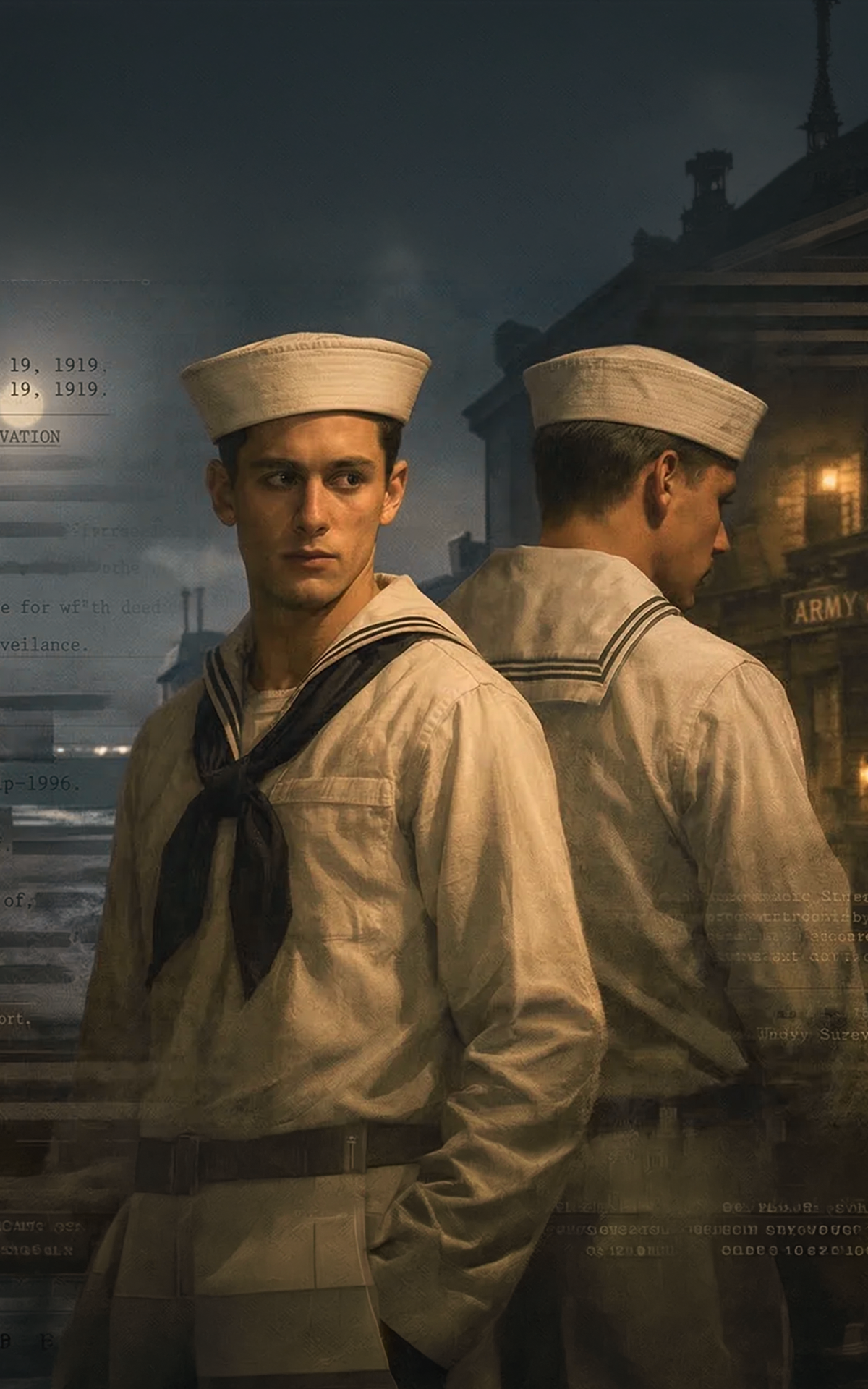
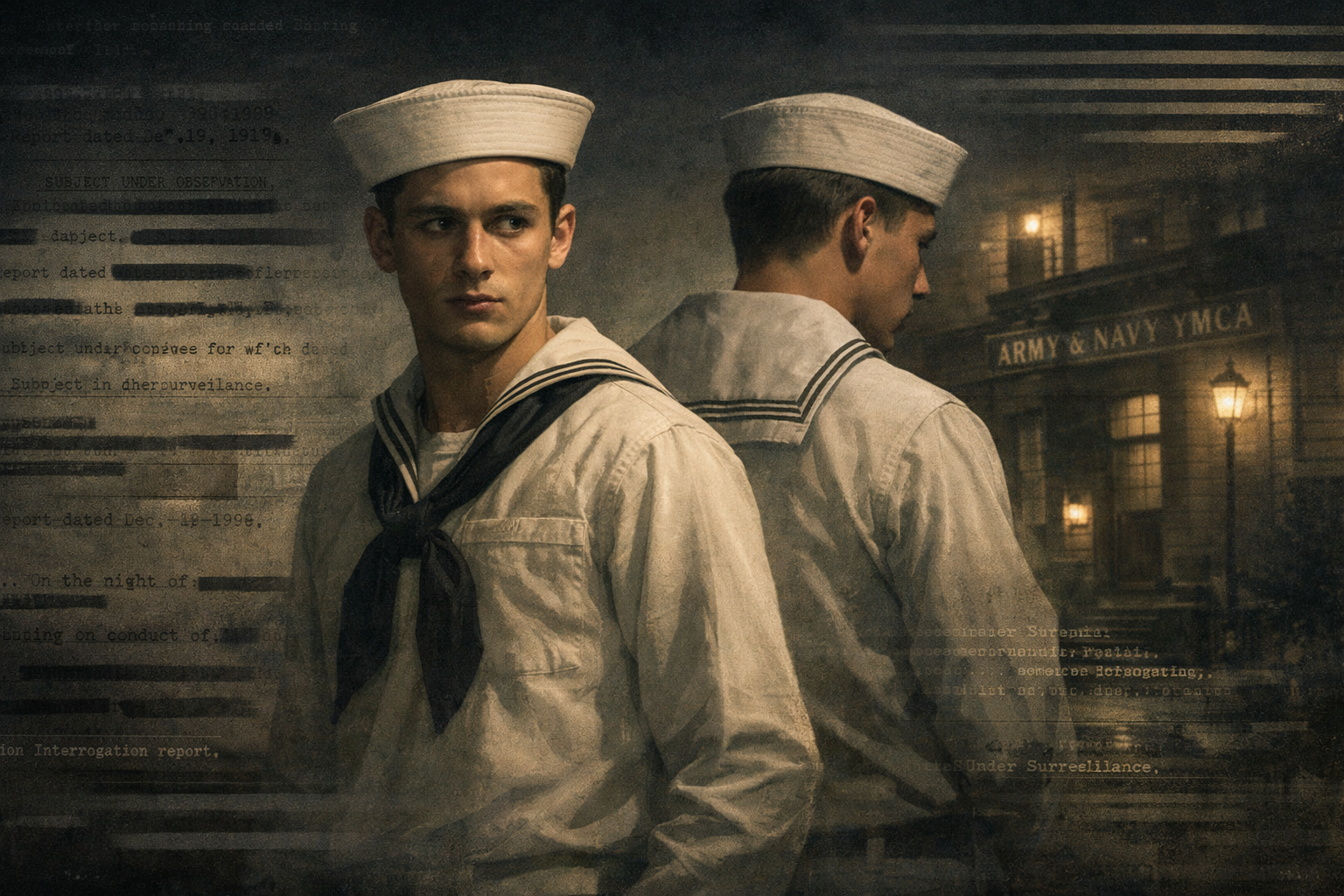
In the early post-war period, in 1919, the US Navy decided to exclude homosexual men from its ranks. The leadership saw a moral degeneration and an increase in allegedly unacceptable deviations. Therefore, high-ranking officials in Newport, Rhode Island, established a secret operation. The intention was to carry out a quick, quiet, and “hygienic” action that would remove a few isolated offenders. However, the Navy unintentionally documented a hidden queer subculture. This triggered a scandal of unknown proportions.
This chain of events, which would become known in historical and legal records as the “Newport Sex Scandal,” represents one of the most important, earliest, and paradoxical examples of systematic state persecution of sexual minorities in the United States. The Navy investigators in Newport believed that sailors were engaging in sexual relationships with each other, so they launched what is known as a “sting operation,” a bait or trap operation. Young recruits received direct orders to act covertly, infiltrate suspicious circles, flirt with potentially homosexual sailors, engage in sexual relationships with them, and report detailed information to their superiors.
What sets this operation apart from the annals of ordinary military history is its astonishing sociological consequence. The investigators expected a handful of arrests. Instead, they discovered an entire social world, the existence of which most Americans were completely unaware. In its obsessive desire for control, the Navy created the most extensive, detailed, and early archive of homosexual life in America. Through transcripts, court records, and the diaries of agents, the state preserved accounts of men who met, flirted, formed deep emotional and romantic relationships, and developed a strong sense of shared identity decades before the modern struggle for homosexual rights. This report offers a comprehensive and nuanced analysis of the operational mechanics of this investigation, the sociological structure of the subculture that was uncovered, the subsequent legal resistance, and the long-term political and historical consequences.
iksHaus | KI-generiert nach redaktioneller Konzeption, 2026
“iks.haus / AI-generated with DALL-E 3”
Historical and demographic context: Newport at the intersection of worlds after World War I
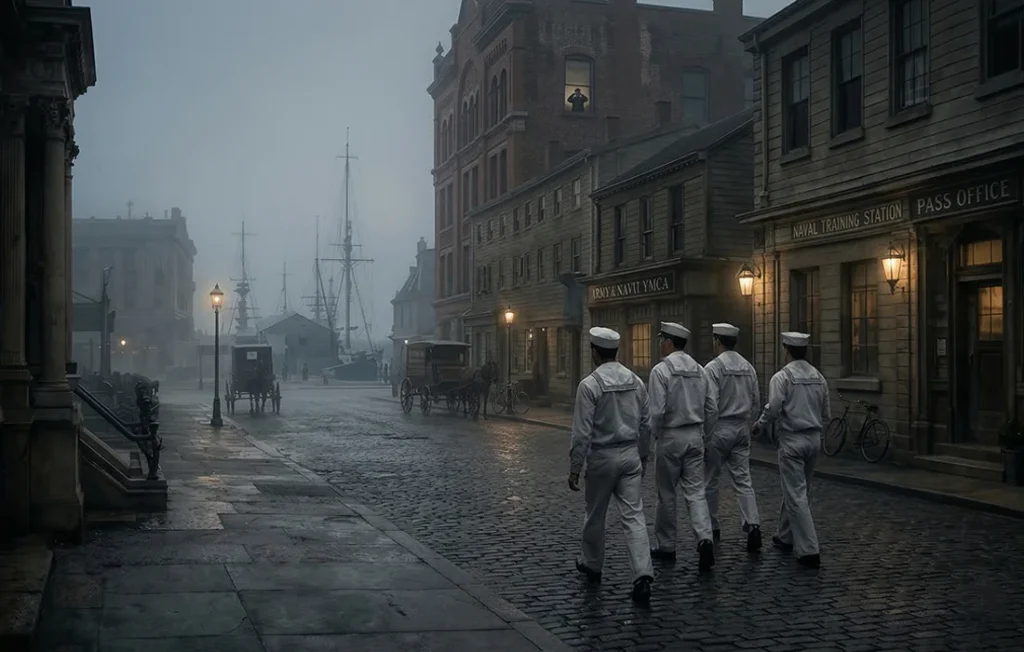
To fully understand the dynamics of the Newport scandal, it is necessary to analyze the specific socio-political conditions that prevailed in the United States immediately after the end of World War I. Newport, on the coast of Rhode Island, was historically one of the most important maritime centers, a training location for the US Navy, and a transit point for thousands of soldiers. The end of the global conflict led to a massive demobilization, but also to a concentration of a large number of young, mobile men who were in a state of transition.
These men lived in military bases, hospitals, and boarding houses. They were separated from traditional family structures and freed from the social control of rural communities. Many of them came from these communities. The constraints of civilian life before the war no longer applied. In Newport, certain urban spaces became centers of socialization. Official spaces such as the Army and Navy YMCA and the Newport Art Club served to entertain the troops. At the same time, they unintentionally became meeting places between the military and civilians. This created space for the hidden search for same-sex partners.
At the same time, the Navy itself promoted a cultural paradigm that blurred gender boundaries. To boost morale, entertain the troops, and support recruitment, the military financed and produced elaborate theatrical productions and musicals. One of the most famous examples was the production of the musical Jack and the Beanstalk, which toured throughout New England and included an orchestra of 25 members and a cast of over 100 people. In these performances, military recruits regularly played female roles in drag. Although this form of cross-dressing was considered “low comedy” in mainstream culture at the time – a harmless phenomenon in which men dressed as women were often the subject of ridicule, paradoxically reinforcing sexism and patriarchal norms – it also created a productive confusion. For queer men in the military, this institutionally sanctioned cross-dressing provided a rare and legitimate space to express alternative gender and sexual identities under the protective umbrella of military theater. This dichotomy – that the state, on the one hand, promotes drag performances and, on the other hand, prepares a brutal crackdown on men who express femininity outside the stage – forms the fundamental hypocrisy on which the upcoming scandal is based.
The genesis of institutional persecution: From hospital rumors to Section A
The actual mechanism of the investigation was triggered by what seemed like a trivial conversation in February 1919. Thomas Brunelle, a young sailor who was undergoing treatment at the Naval Station Newport’s hospital, confided in Ervin Arnold, a Chief Machinist’s Mate and former police detective from Connecticut, who had experience in “hunting” down homosexual men. Brunelle revealed a closely guarded secret to Arnold: that civilian and military men regularly met in the premises of the Army and Navy YMCA and the Newport Art Club, not only for ordinary socializing, but primarily for same-sex sexual relationships.
Arnold, driven by his own moral crusader mentality and his detective instincts, initiated an independent preliminary investigation. His early inquiries into the underbelly of Newport quickly confirmed Brunelle’s claims. Arnold discovered private parties where illegal alcohol and cocaine were common, and where men wore women’s clothing and engaged in openly sexual acts. Armed with this information, Arnold drafted a comprehensive report and presented it to his military superiors.
The reaction of the military establishment was swift and uncompromising. Admiral Spencer S. Wood, Commander of the 2nd Naval District, immediately ordered an official investigation and established an investigative panel to assess the seriousness of Arnold’s claims. By March 19, 1919, the panel concluded that the situation required a thorough, comprehensive, and secret cleanup operation. This critical assessment was forwarded to the highest level in Washington for approval.
The then Assistant Secretary of the Navy, the ambitious young politician and later President of the United States, Franklin D. Roosevelt, personally reviewed the results. Roosevelt unconditionally approved the committee’s recommendation and recognized the political explosive potential of the matter. He asked Attorney General A. Mitchell Palmer for assistance in the investigation. Roosevelt signed confidential orders that established a secret unit under the umbrella of Section A, the office of the Assistant Secretary of the Navy. With this signature, the highest ranks of the American executive branch gave the green light for the introduction of unorthodox operational tactics that would soon shock the nation.
Timeline and phases of the operation
Initial indication (February 1919):
Key individuals: Thomas Brunelle, Ervin Arnold.
Operational objectives and measures: Identifying locations such as the YMCA and the Art Club, and mapping the core network of individuals involved.
Official authorization (March 1919):
Key individuals: Admiral Spencer S. Wood, Franklin D. Roosevelt.
Operational objectives and measures: Establishment of Section A, approval of the secret investigation with the support of the highest civilian leadership of the Navy.
Recruitment of agents (March 16, 1919):
Key individuals: Dr. Erastus M. Hudson, Ervin Arnold, 14 recruits.
Operational objectives and measures: Recruiting “male decoys” based on youth and physical attractiveness.
Active infiltration (March – April 1919):
Key individuals: Decoy agents, suspected sailors and civilians.
Operational objectives and measures: Conducting entrapment, engaging in sexual contact, collecting material evidence, daily reporting.
Operational tactic: “male decoys” and state-sponsored homosexuality
The subsequent operation went far beyond the scope of normal police work. The method chosen by Arnold and his associate, Dr. Erastus M. Hudson, was based on absolute infiltration. On March 16, 1919, 14 Marine recruits secretly met at the Marine Hospital in Newport and nervously awaited instructions for their new mission. The leading operatives stated that volunteers could leave the room if they had moral objections to the impending task, but only a few did.
What followed was the recruitment of young men solely based on their youth and appearance. These newly recruited sailors, often barely of age, were given explicit instructions to act as “masculine decoys.” They were given a manual, a sort of “14-point document,” which explicitly stated that the operatives should “keep their eyes wide open, observe everything around them, and listen carefully to every conversation.” The instructions were brutally pragmatic: the agents were required to interact freely with the suspected “class of men,” to be “cheerful and good-natured,” and to extract information without arousing suspicion.
The most unnatural aspect of these instructions, which would later provoke the anger of lawmakers, was the order to actively seduce the suspects. The sailors were instructed to convince the targets, at all costs, that they were what was then referred to in Marine jargon as a “boy humper” – a man who takes the active, penetrating role in homosexual sex. They were instructed to make appointments, go to private rooms, and allow or even initiate sexual acts in order to secure irrefutable evidence for legal proceedings. The agents were strictly warned not to reveal to anyone, not even their own families, the nature of their assignment or the secret methods of the investigation, as they would otherwise be charged with perjury.
Over several weeks, these 13 to 14 agents submitted detailed daily reports to Arnold, which contained surprisingly open and explicit descriptions of homosexual acts, as well as their own involvement in them. From a historical and psychological perspective, it is interesting that these agents almost never expressed hesitation or moral doubts in their reports regarding their direct participation in acts of sodomy. According to the then-rigid understanding of sexuality and gender in the military, participating in sexual acts did not make these agents homosexual, as long as they did not assume the passive, “female” role in the act. This ontological distinction reveals the deep prejudices of the early 20th century, in which deviance was not measured by the mere act of same-sex sexual activity, but by the degree to which gender roles were violated and the perceived loss of masculinity.
The discovery of a hidden world: Ethnography, language, and spatial geography of queer Newport
The Marine Corps expected only a few arrests and believed it was dealing with isolated incidents of moral misconduct. What they discovered instead was an entire social world, the existence of which most Americans were convinced did not exist. The investigators literally intruded into a culture that had its own strict rules, sophisticated signals, and a developed social structure. It was not isolated acts, but a whole, vibrant community that led a parallel life within and around the military base.
The sailor-agents described nightly celebrations, private rooms in boarding houses, a complex coded language, and a vast network of men who knew exactly where to find each other. Senior Marine officers who read these reports were completely baffled by the terminology used by the younger agents and their targets. To decipher this subculture, the investigators had to document an entirely new lexicon of the early 20th century.
One investigator noted that certain men in this community were known by the term “fairies.” Another report described, with deep dismay, men “who preferred to be courted like women.” Expressions such as “cocksuckers” and “rectum receivers” were recorded, serving a rough categorization based on sexual role preference.
To correctly understand this terminology, we must draw on sociological analyses of earlier queer identities. As historians and sociologists like George Chauncey have highlighted in their studies of earlier homosexual subcultures, the behavior of the “fairies” was not simply a matter of gender identity. These men did not necessarily identify as women in general, but rather adopted mannerisms borrowed from the subculture of female prostitutes, such as rouge and powder, the swaying of the hips, or a “limp wrist.” These performative acts primarily served as explicit markers of sexual availability, signals intended to attract “normal” men with whom they wished to have relationships. On the other hand, men like the “boy humpers” often did not consider themselves homosexual at all; they enjoyed the gay culture, the way these people dressed and spoke, but maintained a heteronormative image of their own male identity.

iksHaus | KI-generiert nach redaktioneller Konzeption, 2026
“iks.haus / AI-generated with DALL-E 3”
Socio-linguistic glossary of Newport’s underworld (1919)
Fairy: A man who adopts feminized mannerisms and aesthetic markers, such as makeup, to clearly signal his role and sexual availability to “normal” men.
Boy humper: A specific piece of Marine slang for a man who was often perceived as dominant or heterosexual and who took on the active role exclusively in same-sex encounters; an identity that agents had to feign.
Queer / Gay cat: Terms that were just emerging, circulating in parallel urban subcultures, and referred to younger partners or men with “different” inclinations.
Salome:[/i1] A code word or nickname for individuals who participated in marine-themed drag musicals, such as for the sailor Billy Hughes, Brunelles’ partner.
The community also developed an impressive spatial geography. Investigators mapped out safe spaces, including rooms on Golden Hill Street, the Emmanuel Church rectory, and even dark corners of the YMCA building. The agents described intimate details of gatherings, noting how these men showed affection for each other, kissing each other on the face, attempting to use their tongues, forming deep friendships and romantic relationships. Contemporary artists like Ryan Arthurs draw a brilliant parallel between the secret signals that queer sailors in Newport used for recognition, and the official signal flags of the Navy – both systems represented complex visual and alphanumeric codes intended for communication under strict “radio silence” from the enemy, i.e., the military police. The Navy was deeply shocked. They had not merely discovered isolated incidents, but an entire community.
The justice system in action: arrests, prison ship, and military courts
When the investigators believed they had gathered enough incriminating evidence through their “male decoys,” the phase of active arrests could begin. The first arrests took place on April 4, 1919, and by April 22, at least 15 sailors were in custody. By the official end of the operation, more than 20 suspected sailors and 16 civilians had been arrested.
The treatment of the arrested sailors revealed the harshness of the military justice system. The detainees were not immediately brought to trial; instead, they were locked in individual cells on a dilapidated and defective ship docked in the port of Newport. There, they spent almost four months in extreme fear, dread, and isolation, before the Army officially read them charges of sodomy and “scandalous conduct.”
During the late fall of 1919, an intensive, three-week series of military court-martial proceedings followed. These trials were psychologically devastating. Each accused sailor had to sit in the courtroom and hear graphic, explicit statements from those agents with whom they had, until recently, shared beds, intimacy, and what they believed to be trust. Senior officers presiding over the court, as historical sources note, were completely “bewildered” by the terminology and specific sexual practices that were discussed, further highlighting the generational and cultural gap between the high-ranking military establishment and the reality on the ground.
The prosecution relied on the classic tactic of breaking the solidarity among the suspects. After the undercover operatives presented their irrefutable evidence, the accused were told that they could receive lighter sentences if they implicated their friends and lovers. Many succumbed to this pressure in the desperate hope of saving their careers and freedom. Thomas Brunelle, the original informant from the hospital, testified against many sailors, but historical records note a tragic nuance: Brunelle deliberately withheld the names of his closest friends and tried to protect them from the wrath of the system he himself had set in motion. The outcome of the military trials was relentless: 17 sailors were found guilty, and most were sent to serve harsh sentences in the infamous naval prison at the Portsmouth Naval Shipyard in Maine. Two were dishonorably discharged, while only two were acquitted.
The clash between civil and military law: the case of Reverend Kent and the uprising of civil society
While the Navy could relatively easily break young sailors within the closed system of military justice, their arrogance led to a catastrophic error when the investigation crossed the boundaries of the base and turned its attention to the civilian population of Newport. Among the 16 civilians arrested, the most prominent target was Reverend Samuel Neal Kent, a respected Episcopal clergyman and head of a local seamen’s social welfare organization.
Kent was a pillar of the community, a man with an excellent reputation as a benefactor. His involvement in the scheme followed the sadistic pattern of Section A. Because investigators suspected the nature of his friendship with a man named Arthur Green, they assigned the operative Charles Zipf to Kent. Zipf invited Kent for a drink, after which, according to Zipf’s statement, both men went to the rooms of the clergyman in the rectory of Emmanuel Church, where a supposedly incriminating proposal was made. Kent was immediately arrested for immoral conduct and soliciting sexual services from sailors.
Kent’s civil trial, the verdict of which was announced on January 8, 1920, was an absolute legal debacle for the Navy and a turning point in public perception. Kent was acquitted of all charges, and the civil judge used the opportunity to completely discredit the Navy agents. The judge applied a sharp legal logic: since no military authority in the world has the legal right to instruct subordinates to directly participate in unlawful “immoral acts,” the agent witnesses were one of two things. Either they were voluntary participants, which would make them accomplices whose testimony is compromised and unreliable, or they acted under duress of illegal orders from their superiors, which would make the entire investigation legally invalid.
This public exposure of the military entrapment tactics shocked Newport. The mood of the population abruptly turned against the Navy. The local clergy, outraged by the treatment of their colleague and disgusted by the moral decay of the military administration, took the initiative. A committee of Newport’s most respected clergymen – including Reverend William Safford Jones, J. Howard Deming, Everett P. Smith, and Richard Arnold Greene – drafted a comprehensive and angry letter, addressed directly to the President of the United States, Woodrow Wilson. In it, they strongly condemned the “corrupt and malicious methods” of the Navy intelligence officers and denounced the local detention of the accused under inhumane conditions without the right to a speedy trial.
The media war: The Providence Journal versus Washington
The letter from the outraged clergymen would probably have disappeared in the forgotten archives of the White House, had it not reached John R. Rathom, the astute and influential editor of the The Providence Journal. Rathom, a master of investigative journalism in his time, recognized in the documents the anatomy of a massive abuse of state power.
His newspaper published the letter and publicly named the Secretary of the Navy, Josephus Daniels, and the Assistant Secretary, Franklin D. Roosevelt, as the architects of this moral collapse. The Providence Journal then followed all ongoing proceedings daily and took on the role of an implacable critic of the prosecution. The media narrative changed dramatically: the story was no longer about a few “deviant” sailors, but about a state that was institutionally abusing its own citizens by ordering them to prostitute themselves for investigative purposes.
The exposure of the affair in the press forced Washington into a difficult defensive position. Roosevelt, whose political reputation suddenly began to decline, engaged in a sharp “tart exchange of telegrams” with Rathom. Roosevelt tried to appeal to patriotism and accused the editor of damaging the reputation of the Navy with such “sensational” journalism and actively sabotaging national recruitment efforts. Rathom did not back down; his telegrams repeatedly raised the core question that Roosevelt could not honestly answer: Had the officials in Washington personally supervised the investigation, and had they actually allowed the agent to participate in illegal sexual acts?
Under the pressure that threatened to destroy high-ranking careers, the government began attempts at cover-up. The Navy and Justice departments manipulated the system to protect prominent figures, including Roosevelt, while simultaneously actively trying to undermine critics like Rathom. In July 1920, as pressure from the local public grew, Roosevelt made a pragmatic political decision: he resigned from his position in the Navy to accept the Democratic Party’s nomination for the office of Vice President in the upcoming national elections. His departure from an agency shrouded in scandal was a strategic move for his political survival.
The legislative epilogue: Senate investigation, political censure, and outrage (1921)
Despite Roosevelt’s departure and the attempts at cover-up, the leakage of information about the details of the operation could no longer be stopped. The fact that soldiers had been instructed to engage in sexual relationships with suspects in order to gather evidence was simply unacceptable to the United States Congress. Legislators, driven by media pressure and growing public outrage, demanded answers. In the summer of 1921, a subcommittee of the Senate Committee on Naval Affairs was established – with a single task: to conduct an independent investigation into what had actually happened in Newport.
The findings of this subcommittee, officially published on July 19, 1921, represented a devastating formal condemnation of the highest-ranking Navy officials, particularly Josephus Daniels and Franklin D. Roosevelt. What was particularly noteworthy was the focus of the Senate’s outrage. The legislators were far less concerned about the mere existence of homosexual sailors in the ranks; rather, they were obsessed with the fact that the United States Navy had ordered young recruits to seduce other men, and that this was being used as an operational component of a government investigation.
The Senate transcripts depict an atmosphere of horror and anger. The senators were shocked that young teenagers had been used as participants in what they called “immoral practices” in order to obtain evidence, the details of which were deemed “not fit for publication” by newspapers like The New York Times. One senator publicly and unequivocally called these military tactics “reprehensible.” Another formulated the harshest assessment of the entire affair, stating that the Navy had, in effect, created exactly the behavior it was supposedly trying to prevent.
In its official report, the Senate committee highlighted the tragic lack of “moral perspective” among military leadership, emphasizing that “behaviors that would have made even hardened veterans of the service shudder were practically forced upon the boys.” The committee explicitly rejected the more lenient assessments of earlier military tribunals, which had merely described Roosevelt’s actions as “unfortunate and ill-advised”; the Senate assigned its own lasting historical label: “deplorable” and “despicable.” The actions of the Daniels-Roosevelt duo, according to the Senate, “violated the code of the American citizen and ignored the rights of every American boy who had enlisted in the Navy to fight for his country,” and reduced the entire investigation to a “sad, shameful, and highly unnatural process.”
The committee’s final judgment was a harsh compromise: While it acknowledged that “immoral conditions” actually existed in Newport, which “threatened the health and morale of the base,” the methodology used to combat them was deemed an incomparably greater evil.

iksHaus | KI-generiert nach redaktioneller Konzeption, 2026
“iks.haus / AI-generated with DALL-E 3”
Consequences for Roosevelt and the psychology of power
The political and personal consequences of this Senate scandal for Franklin D. Roosevelt were profound, even though later biographers systematically omitted them or completely removed them from the canonical history. According to historian John Loughery, the ease with which Roosevelt found it perfectly normal to have young sailors sleep with other men as a form of enticement reveals a great deal about his psychology, his moral compass, and his leadership style. This incident is considered an early example of the tendency to expand the national security apparatus at the expense of civil and human rights – a process that Roosevelt would later refine during World War II.
Roosevelt refused until his death to take responsibility for Newport. He attributed the Senate scandal solely to politically motivated revenge by the Republicans, and directed all of his pathological hatred towards the Republican committee member, Senator Henry W. Keyes, whom he accused of making him a scapegoat and denying him the right to speak. A fascinating psychological detail, as noted by historian David Michaelis, is that Roosevelt was consumed by a desire for revenge against Keyes for fifteen years; Roosevelt himself was convinced that the immense stress that Keyes had inflicted on him during the 1921 hearings had weakened his immune system and made him susceptible to the virus that would soon lead to his permanent paralysis. Although modern medicine attributes his illness to contaminated water, the fact that FDR psychologically linked his physical disability to the process of persecuting homosexual men shows how deeply the Newport scandal was ingrained in his consciousness.
Modern Legacy and Recontextualization: Art, Historiography, and Legal Development
Despite attempts by powerful men to erase this shameful episode from history, the transcripts of that Senate investigation were, through a bureaucratic quirk, permanently preserved, providing one of the earliest, most detailed, and valuable records of gay life in the United States. These dusty court records now serve as a window into another time. They undeniably show men who cultivated relationships, engaged in casual flirting, entered into romantic relationships, shared living spaces, and built a shared visual and verbal identity – decades before the official beginning of the modern human rights movement.
The legacy of this investigation also extends into modern legal theory. As legal experts have pointed out in connection with the modern Employment Non-Discrimination Act (ENDA, 2009) and the 14th Amendment to the United States Constitution, the actions of the government in Newport represent an early “zero-point” precedent, in which the state apparatus used its power to systematically discriminate against sexual minorities, solely on the basis of emotional prejudices and false stereotypes, and thus in violation of the Equal Protection Clause. What began in Newport as a moral cleansing led to a clear violation of the constitutional rights of the citizenry.
In the present day, the cultural recontextualization of these events is experiencing a renaissance. Artists, archivists, and historians have not sifted through these infamous transcripts to condemn the victims, but to expose the system. The project Scandalous Conduct: A Fairy Extravaganza, a multimedia and multi-channel musical installation by the artists Jason Tranchida and Matthew Lawrence from 2024, draws on these historical documents and transforms them into an instrument of resistance. Their work masterfully juxtaposes the rigid surveillance by Section A with the aforementioned absurdity of Marine drag musicals like Jack and the Beanstalk, thereby exposing the incredible hypocrisy of a state that simultaneously commercialized queer aesthetics and criminalized queer people.
Similarly, the artist Ryan Arthurs, in his photographic series Masculine Decoys, depicts the faces of these young “bait” sailors and covers them with camouflage patterns of navy blue flowers and symbols of naval signal flags. His works force today’s viewers to decipher visual communication and to understand the complexity of hiding in plain sight – how queer sailors communicated their existence in the face of tyranny.
The city of Newport, where these dramatic events once unfolded, has today embraced its dark history. Institutions such as the Newport Art Museum and organizations like NewportOUT are hosting lectures, exhibitions, and discussions during Pride Week about the 1919 affair, transforming a former site of brutal persecution into spaces that celebrate love, acceptance, inclusion, and the diversity of LGBTQ+ identities.

iksHaus | KI-generiert nach redaktioneller Konzeption, 2026
“iks.haus / AI-generated with DALL-E 3”
Concluding thought: Documenting the indelible
The Newport scandal occupies a unique place in the pantheon of American military, political, and social history. The operation initiated by Ervin Arnold and Franklin D. Roosevelt was designed as a perfect mechanism of destruction. The Navy intended to eradicate this at all costs; it intended to forever extinguish the subversive spark that threatened the puritanical ideal of masculinity within its ranks. Instead, due to its obsessive bureaucratic need for proof of guilt, the Navy did the opposite: it documented everything.
The investigation in Newport was, from the perspective of its architects, intended to definitively prove that homosexuality in the United States was exclusively a rare, isolated, and monstrous deviation. However, what the same investigation actually revealed through the statements of distressed informants and convicted sailors was something entirely different. It proved an undeniable and significant truth that extended beyond the Navy and the Senate: that even in the repressive climate of 1919, in strict military towns, queer communities existed, connected, and thrived. Their persecution paradoxically secured their immortality in American history.