Bipolar! A single word. The entire person disappears behind it. All that remains is the diagnosis. An empty space where once there were a name, friends, family, plans, and everything else that makes up a life.
This series begins exactly there. And from here, it’s about more than just the diagnosis—it’s about identity, perception, and the reality behind the labels. It’s a place where people stop calling you by your name and start calling you by what you have. A place where your illness becomes your entire identity in the eyes of others. A place that only a few people understand, but through which millions pass.
Bipolar disorder doesn’t fit into a TikTok clip, a tweet, or the sentence “He just has good and bad days.” That’s why we’re writing five parts.
Why the title “Call Me By My Name”
The film “Call Me By Your Name” from 2017 tells the story of an intimacy so deep that someone gives you their own name. Two names become one. It’s a gesture of love.
We’re turning the logic of the title on its head. “Call Me By My Name” means: Don’t call me by the diagnosis I carry, but by my name. I am not a “bipolar person,” a “manic person,” or a “depressed person.” I have a name. And my name makes me a person before any medical classification puts me into a category.
Gregory Bateson, a significant 20th-century anthropologist, often quoted Alfred Korzybski, the founder of General Semantics. Korzybski said: “The map is not the territory.” The map (diagnosis, classification) is not the actual object, the actual experience, or the actual state, which is the person in that state (the territory). The fact that language – that is, semantics – can change the perception of reality is not a trivial matter in the influencer discourse. It is clinically measurable and scientifically proven.
Person-centered language (“a person with bipolar disorder,” the territory) can determine whether a young person seeks help at all, or remains silent for so long that the illness causes irreversible damage, as opposed to identity-centered language (“the bipolar person,” the map).
Bipolar is not a TikTok mood
If someone has ever told you: “You know, my ex was totally bipolar,” then that person didn’t know what they were talking about. That’s diagnostic noise. The real thing is much quieter and much more difficult. The actual “territory” is something completely different.
Bipolar disorder is not:
- “Mood swings” because it’s raining and you feel down.
- Irritability in middle school.
- A week of poor sleep before final exams.
- A dramatic phase after a breakup.
Bipolar disorder is a state in which your brain fundamentally switches modes. You don’t just feel different. You function biologically, neurochemically, and physically at a different energy level, with a different sleep pattern, a different thought speed, and a different risk assessment. This is not a vibe shift. This is a system that switches operating modes.
Psychiatrists explicitly stated this in the DSM-5, the most current version of the official diagnostic manual for mental disorders.
What the DSM-5 actually says
iksHaus | KI-generiert nach redaktioneller Konzeption, 2026
iks.haus | AI-generated based on editorial concept, 2026.
The current diagnostic manual, DSM-5, has made an important change in the definition of bipolar disorder. While the previous version (DSM-IV) only considered abnormally elevated or irritable mood as a criterion, the DSM-5 additionally requires a markedly increased energy level and goal-directed activity for the diagnosis of a manic episode. This clarification emphasizes that it is not only about the mood, but also about the level of activity.
In other words, it is not enough to simply feel different for a diagnosis. According to the DSM-5, both mood changes and an increase in energy and goal-directed activity must be present.
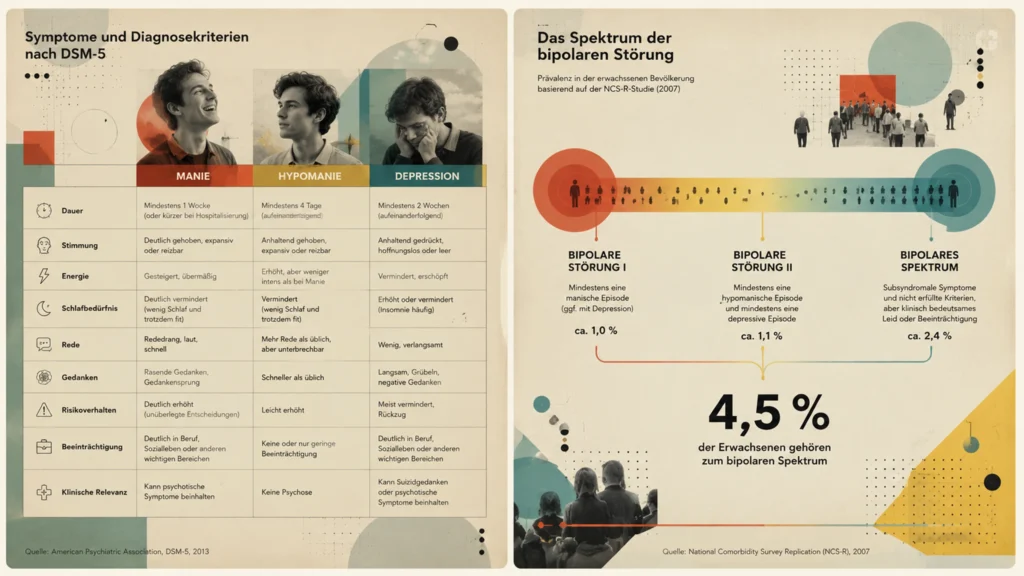
According to the DSM-5, a manic episode lasts at least one week, or less if you are hospitalized due to loss of control. During this week, at least three of the following symptoms must be present (four, if the mood is primarily irritable):
- inflated self-esteem, feelings of superiority, and grandiosity.
- markedly decreased need for sleep (you feel rested after two hours).
- a pressing need to talk incessantly (logorrhea).
- flight of ideas, the feeling that your mind is racing at a million miles per hour.
- extreme distractibility, which is also noticed by those around you.
- increased psychomotor activity or the tendency to jump into new projects.
- risky behavior with serious consequences (impulsive spending, hypersexuality, entering into meaningless contracts).
A hypomanic episode shows a similar picture, but lasts at least four days and is somewhat milder; it does not completely destroy your life. You do not end up in the hospital. There are no psychotic symptoms. But the people around you notice that something is not right.
The depressive phase is the other pole. Anhedonia (loss of all pleasure), a cognitive speed that collapses, the feeling of being worthless, appetite and sleep disturbances, and recurring suicidal thoughts.
And then there are the mixed states. Here, a combination of depression and manic energy occurs simultaneously. Hopelessness plus inexhaustible energy. This is clinically the most dangerous phase, because the combination of fear, despair, and physical energy carries the highest risk of suicide.
Mania, Hypomania, Mixed States: Cheat Sheet
| Mania | Hypomania | Depression | Mixed State | |
| Duration | Minimum 7 days | Minimum 4 days | Minimum 14 days | Varies |
| Functionality | Breakdown | Impaired | Impaired | Breakdown |
| Hospitalization | Frequent | No | Possible in severe cases. | Frequently |
| Psychosis | Possible | No | Possible in severe cases | Possible |
| Suicidal risk | Low | Low | High | Highest |
This table is a simplification, but it helps to understand why mixed states are not “half mania plus half depression.” They are clinically a distinct category, the most unstable and dangerous phase of the entire spectrum.
The bipolar spectrum is wider than you think.
iksHaus | KI-generiert nach redaktioneller Konzeption, 2026
iks.haus | AI-generated based on editorial concept, 2026
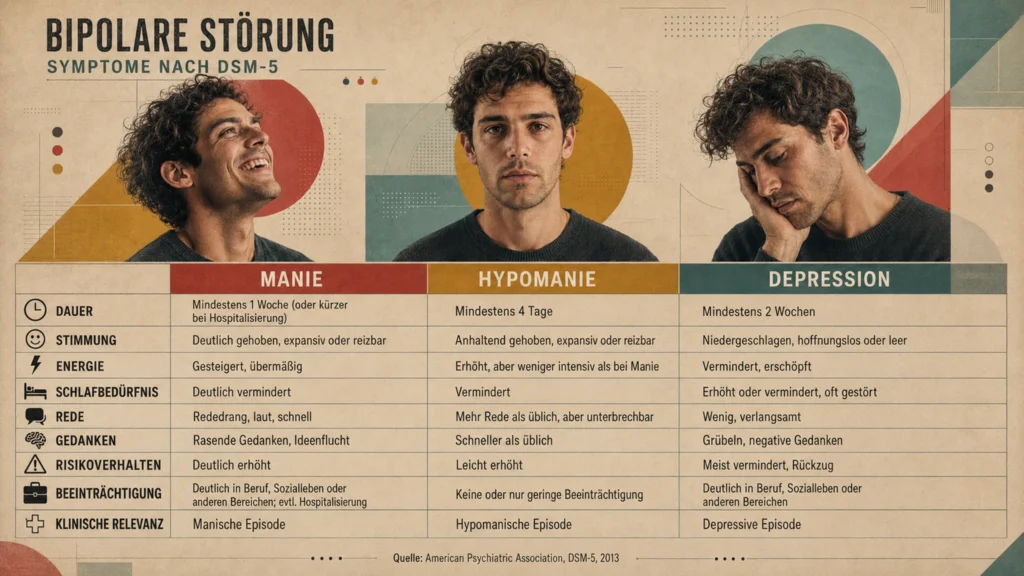
The classic classification distinguishes between bipolar disorder type I (at least one manic episode) and type II (hypomania plus depression, without full mania). But the reality is broader.
The large US study, the National Comorbidity Survey Replication (NCS-R), conducted with 9,282 adults, found that the bipolar spectrum affects approximately 4.5% of the population throughout their lives. Breakdown: 1.0% for type I, 1.1% for type II, and 2.4% for so-called subthreshold forms.
This means that statistically, around you, about 1 in 20 people has some form of the bipolar spectrum. In a class of 30 people. In a company with 200 employees. At a concert with 5,000 attendees.
Subthreshold forms are not “mild” forms. It’s not just that someone finds it a little harder. Subthreshold bipolar disorder leads to severe comorbidity, especially with anxiety disorders, and radically changes quality of life. But it is rarely recognized because it does not manifest spectacularly.
The true cost of silence
The World Health Organization (WHO) estimates that approximately 37 million people worldwide suffer from bipolar disorder. This corresponds to about one in 200 people on the planet.
An even more shocking statistic: The life expectancy of people with bipolar disorder is significantly shorter than that of the general population. The reasons are not only suicide, although that is also a factor. The reasons include cardiovascular diseases, metabolic syndrome, and obesity. Bipolar disorder has a systemic toxicity that damages the entire body, not just the brain.
This is called “allostatic load.” Each manic or depressive episode leaves biochemical scars. Inflammation, hormonal dysregulation, and oxidative stress at the cellular level. The brain reorganizes itself. The body wears out faster.
And all of this usually happens in late adolescence and early twenties. At a time when people should be finishing university, starting their first job, forming their identity, and building relationships. The illness strikes precisely where life is most vulnerable.
What you can expect in the series
This is part 1 of 5 in the series “Call Me by Your Name.” The next parts will cover:
Part 2: The Beginning in Silence. Why it often takes 5 to 10 years for someone with bipolar disorder to receive a correct diagnosis. What happens when young people are first confronted with the symptoms and everyone interprets them as “teenage rebellion”?
Part 3: Are They Improving, or Are We Just Seeing Them Better? Global epidemiological data: What the Global Burden of Disease study really says, and how to distinguish between biological prevalence and the media narrative.
Part 4: The Real Life. School, work, relationships, money, and the digital world. How the TikTok algorithm can trigger a manic episode, what research says about online exhibitionism, and why sleep is the most powerful medicine.
Part 5: A System That Doesn’t Listen. How, in Austria, one of the richest countries in Europe, there is a 90-day waiting time for an appointment with a child psychiatrist. What the home treatment model is, and why IPSRT therapy is a game changer.
The goal is not to create fear. The goal is understanding. Understanding your own brain – the brain of friends, partners, and siblings. Understanding why the language we use when referring to people with illnesses is not a minor detail, but a concrete intervention in their lives.
And understanding why this series has the title it has. Because every person with bipolar disorder deserves to be named first and foremost.
If you need help
If you recognize symptoms in yourself or in a loved one, the first step is to talk to a family doctor or directly to a psychiatrist. In Vienna, there is the Bipolar Outpatient Clinic at the Sigmund Freud Private University, which offers affordable rates. Telephone counseling for mental health crises in Austria: 142 (available 24/7, free of charge).
Frequently asked questions
What is the difference between “I have bipolar disorder” and “I am bipolar”?
Person-centered language (“I have bipolar disorder”) separates the person from the diagnosis and emphasizes that the diagnosis is a part of their identity, not the entirety of it. Identity-centered language (“the bipolar person”) merges the person and the diagnosis into one word, reducing the person to the illness. Most psychiatric associations and mental health organizations recommend person-centered language as the standard in medical and media communication. Bateson: “The map is not the territory.”
How many people actually live with bipolar disorder?
According to data from the World Health Organization in 2021, approximately 37 million people worldwide live with bipolar disorder, which is about 0.5% of the world’s population. When considering the broader bipolar spectrum (including milder forms), the National Comorbidity Survey Replication estimates the prevalence at about 4.5% of the adult population.
What is the difference between bipolar disorder and ordinary mood swings?
Bipolar disorder is not a mood swing caused by external circumstances. It is a chronic neurobiological condition in which energy levels, sleep cycles, thought speed, risk assessment, and motor activity all change simultaneously. A manic episode lasts at least one week, with a drastically reduced need for sleep, while a depressive episode lasts at least two weeks, with a loss of all interests and suicidal thoughts. The difference is structural, not emotional. External circumstances can trigger bipolar fluctuations, but they are not the underlying cause.
Sources
This is part 1 of the series “Call Me By My Name” on the iks.haus platform. Part 2 follows: “Beginning in Silence.”
- American Psychiatric Association. Diagnostic and Statistical Manual of Mental Disorders, Fifth Edition (DSM-5). 2013.
- Merikangas, K. R. et al. Lifetime and 12-Month Prevalence of Bipolar Spectrum Disorder in the National Comorbidity Survey Replication. Archives of General Psychiatry, 2007.
- World Health Organisation. Mental Health Atlas 2021. WHO Press, 2022.
- Institute for Health Metrics and Evaluation. Global Burden of Disease Study 2021. IHME, 2024.