

In 2024, 972 men and 247 women took their own lives in Austria. The figures come from the 2025 Suicide Report of the Federal Ministry of Social Affairs, Health, Care and Consumer Protection (BMSGPK), compiled by Gesundheit Österreich GmbH (GÖG) based on data from Statistics Austria. The suicide rate is 22 per 100,000 inhabitants for men, and 5 for women. This difference is no coincidence. It is the result of a cultural message that most boys in Vienna, Linz, Graz, and Salzburg hear before they even know their own last name. The message is: “Be a man.”
What the “Be a Man” Syndrome Does to Boys
“Be a man” sounds like upbringing. Parents use the phrase when a child is crying, afraid, or seeking comfort. In practice, it is an instruction to amputate. The boy receives the message that there is a narrow corridor of acceptable emotions, and that anything outside of this corridor means a loss of status.
In 2018, the American Psychological Association (APA) published official guidelines for psychological work with boys and men. These guidelines formally classified the rigid adherence to traditional masculinity norms as harmful to health. The APA identifies five specific components: the establishment of power over women, the perpetuation of relationship violence, aggressive behavior, emotional detachment, and compulsive heterosexual self-presentation.
The concept is scientifically supported by the theory of precarious masculinity, developed by Joseph Vandello and Jennifer Bosson. This theory posits that masculinity, unlike femininity, is not biologically acquired but must be continuously and publicly demonstrated. A global study from 2021, encompassing countries representing over 80 percent of the world’s population, confirmed this phenomenon as a cross-cultural pattern.
The Price of Silence: What Austrian Data Reveals
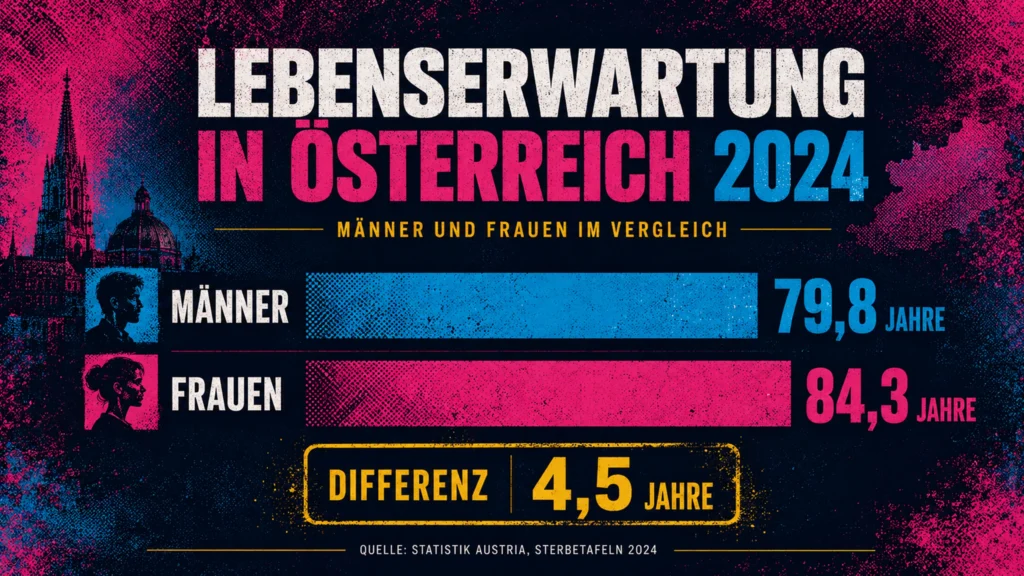
In Austria, a man currently lives an average of 79.8 years. According to Statistics Austria for 2024, a woman lives an average of 84.3 years. The difference is 4.5 years. The Austrian Chancellery’s Gender Index indicates that this difference is not primarily biologically determined, but rather results from different approaches to physical health, mental well-being, and seeking help.
iksHaus | KI-generiert nach redaktioneller Konzeption, 2026
iks.haus | AI-generated based on editorial concept, 2026
Figures that rarely appear in the media:
- 41.4 percent of Austrian men are overweight, compared to 27.9 percent of women.
- Only 15 percent of the Austrian population utilizes free preventative health check-ups annually.
- According to the 2025 Suicide Report, the suicide rate among men in Austria has decreased by 36 percent from 1986 to 2024, while the rate among women has decreased by 61 percent.
- Most suicides occur in the age group of 45 to 64 years, representing 34 percent of all cases.
- The most common method is hanging (44 percent), followed by firearms (19 percent).
In Austria, suicide is one of the most common causes of death among men under 50 years of age. Among the 15- to 34-year-old age group, it is the leading cause of death in absolute numbers. The data is based on the Eurostat standard population of 2013, processed by Statistics Austria.
How Gender Becomes a Prison: The Theory of Uncertainty
Vandello and Bosson argue that masculinity functions as a status that must be continuously defended. When this status is threatened, men compensate. According to research, this compensation manifests as: taking on physical risks, aggressive behavior, avoiding seeking help, pursuing dangerous occupations, excessive alcohol consumption, and risky driving behavior.
This mechanism explains why Austrian men have higher mortality rates from accidents, cardiovascular diseases, lung diseases, and prostate cancer, but are less likely to seek medical attention when symptoms appear. Studies show that seeking help is often perceived by many men as a loss of their masculine status. This is not a character flaw, but a learned reflex.
Sociologist R.W. Connell described the concept of hegemonic masculinity in 1995, a cultural norm that defines masculinity through dominance. This has led to the metaphor of the “Man Box,” a narrow framework of expectations from which a boy cannot deviate without facing consequences. The consequences include isolation, ridicule, or violence from peers.
Toxic masculinity: a term that generates resistance
The term “toxic masculinity” rarely sparks calm discussions. A study involving 203 men and 52 women showed that approximately 80 percent of the respondents found the term offensive or counterproductive. This is partly due to the language used, as the combination of “toxic” and “masculinity” sounds like a condemnation of men as a category.
Historically noteworthy: The term did not originate from academic feminism. It was coined by Shepherd Bliss as part of the mythopoetic men’s movement of the 1980s, as a critique of a corporate, competitive form of masculinity. Sociologist Michael Kimmel contextualizes this movement as a response to the influence of the second wave of feminism.
It was only since the 2010s that the term has become widespread in psychology and the media. Sociologist Michael Flood uses it to describe rigid expectations that demand activity, aggression, and dominance from boys. At the same time, some Austrian studies show that a strong masculine identity can, in certain contexts, have a protective effect on mental health. The problem is not masculinity itself, but its rigid, inescapable form.
Three pillars of toxic masculinity
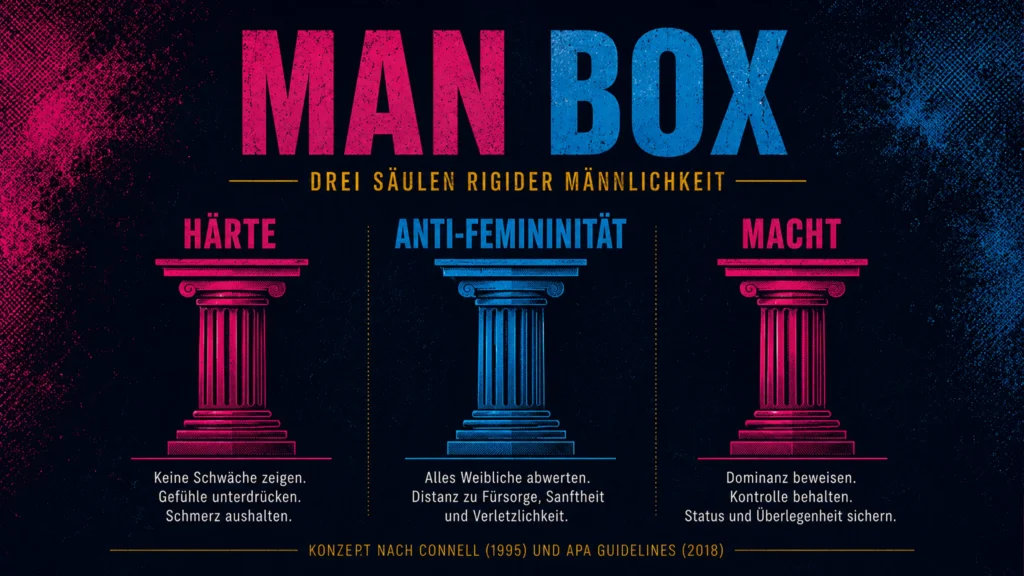
Contemporary psychology identifies three pillars of the rigid male norm. The first is toughness; this means that any form of fear, sadness, or insecurity is considered a weakness. The second is anti-femininity, the systematic rejection of everything culturally associated with women, including seeking comfort and providing care. The third is power, defining personal worth through status, money, and the ability to dominate.
iksHaus | KI-generiert nach redaktioneller Konzeption, 2026
iks.haus | AI-generated based on editorial concept, 2026.
For a boy in Vienna, this translates to specific experiences. If he cries in the fifth grade, he gets a nickname. If he asks for help at school, he is considered “weak.” If he likes art that is not action-oriented, he is considered “feminine.” If he is gay, he is exposed threefold because he does not fulfill the heterosexual component either. Data from the Wiener Linien regarding school violence, as well as EU studies from the FRA, show that this dynamic is commonplace.
Vienna knows where the problem lies: what the city is doing
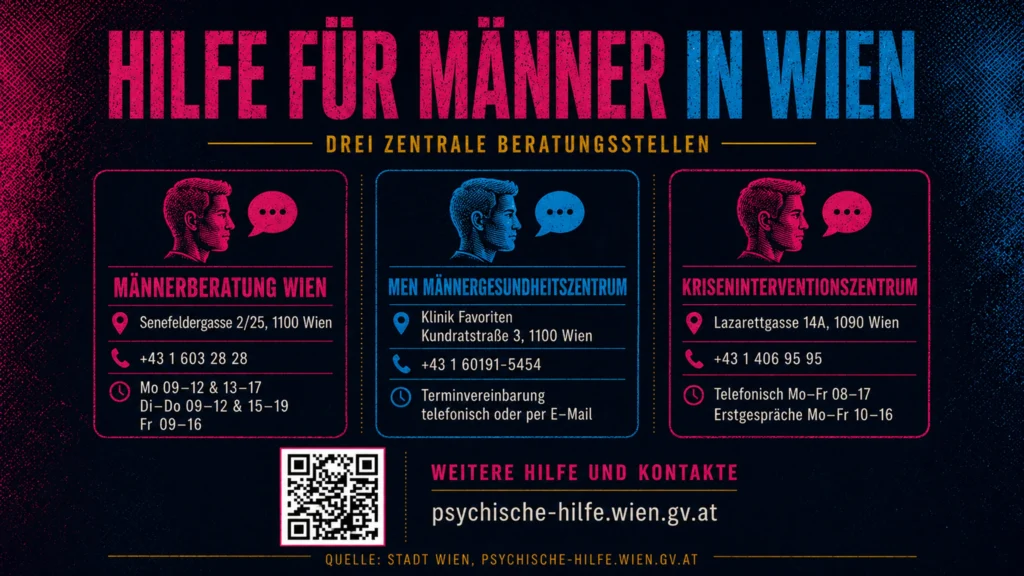
Vienna has a well-developed network of men’s counseling centers, a rarity in Central Europe. The Männerberatung Wien (Men’s Counseling Vienna) (Senefeldergasse 2/25, 1100 Vienna) offers free psychological, legal, and social support for men. The MEN Men’s Health Center (Klinik Favoriten, Kundratstraße 3, 1100 Vienna) specifically focuses on the mental and physical health of men. The Crisis Intervention Center (Lazarettgasse 14A, 1090 Vienna) provides support during crises; phone number: 01 406 95 95.
iksHaus | KI-generiert nach redaktioneller Konzeption, 2026
iks.haus | AI-generated based on editorial concept, 2026.
There is also the Institute for Women’s and Men’s Health (FEM, FEM Süd, MEN), which combines health programs for women and men under one roof. The City of Vienna funds educational programs for young men on emotional learning and non-violent communication through the Magistratsabteilung 17 (MA 17).
These resources exist. The statistics also exist. The WHO Mental Health Atlas 2024 shows that only a small percentage of Austrian men who would benefit from psychological help actually seek it out. The capacity is there, but the utilization is not. The reason goes back to the beginning of the text. A boy who has learned that crying means weakness will not主动 call a counseling center as an adult.
What parents in Vienna can do differently
Educational programs like “Program Y,” developed for the Balkan and Central European contexts and adapted for Austrian schools, focus on socio-emotional learning for boys aged 13 to 17. The program does not require boys to abandon their male identity; it asks them to expand their definition of it.
Concrete tools for parents in Vienna:
- Do not punish boys for crying, neither in early childhood nor later.
- Ask about feelings as often as you ask about achievements.
- Avoid phrases like “don’t be a crybaby” or “men don’t cry.”
- Show vulnerability yourself, because boys learn through role models.
- Name and identify your own emotions in front of your child.
This is not a pedagogical luxury; it is preventative medicine. The difference between a man who has a heart attack at 47 because he never asked himself how he was doing, and a man who can, begins in the living room before puberty.
FAQ
What is the "Be a Man" syndrome?
The "Be a Man" syndrome is the sociological term for a set of cultural norms that demand that boys and men suppress emotions, avoid seeking help, and display performative toughness. The American Psychological Association linked it to an increased risk of depression, suicide, and violence in its 2018 guidelines.
Why do more men die by suicide in Austria?
According to the 2025 suicide report, in 2024, 972 men and 247 women took their own lives in Austria. Experts explain this by a combination of less frequent help-seeking behavior, later diagnosis of depression, and the choice of more violent methods in crisis situations.
Where in Vienna can men find free psychological help?
In Vienna, the Männerberatung Wien (01 603 28 28), the MEN men's health center at the Klinik Favoriten (01 60191 5454), and the Kriseninterventionszentrum in Krisen (01 406 95 95) offer support. All three institutions provide free services in multiple languages.
What are the three pillars of toxic masculinity?
Contemporary psychology identifies three pillars of rigid masculine norms. The first is toughness; this means that any form of fear, sadness, or insecurity is considered a weakness. The second is anti-femininity, the systematic rejection of everything culturally associated with women, including seeking comfort and providing care. The third is power, defining personal worth through status, money, and the ability to dominate.
What can parents in Vienna do to support their sons?
Educational programs like "Program Y" focus on socio-emotional learning for boys aged 13 to 17. Specific tools for parents in Vienna include: avoiding punishing boys for crying, asking about their feelings as often as you ask about their achievements, avoiding phrases like "don't be a crybaby" or "men don't cry," showing vulnerability yourself, as boys learn through role models, and naming and identifying your own emotions in front of the child.