

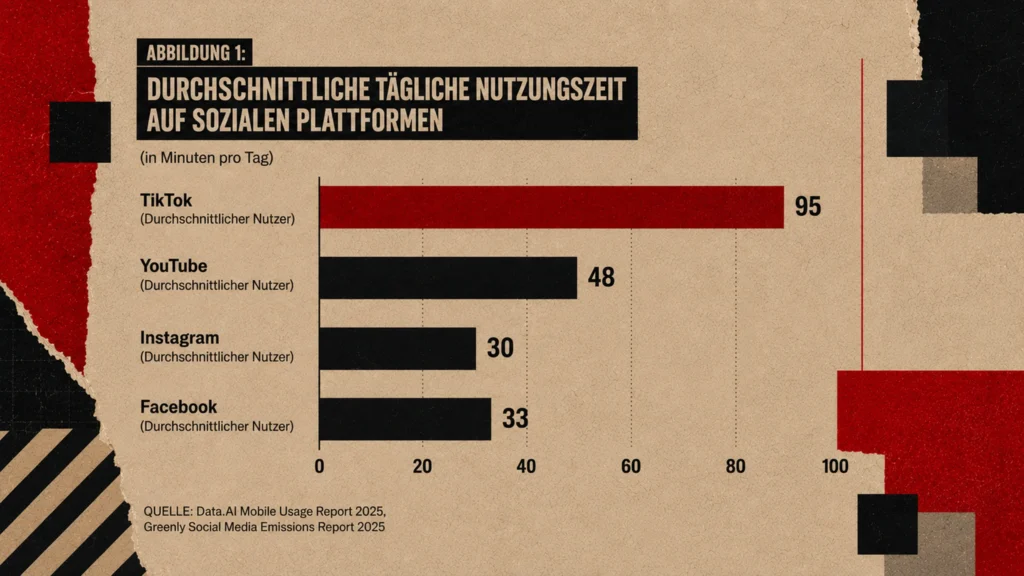
Nine hours. That’s how long young people in Austria spend in front of a screen on average each day. More than a third of every waking hour is spent scrolling, watching, and liking. The figures from the Data.AI Global Mobile Report (2025) leave no room for doubt. The younger generation in Austria lives in a media environment that is increasingly being described as an ecological problem.
Attention is a resource. Like water, like soil, like silence. When we expose it to prolonged digital exploitation, its mental environment is degraded. This is not a metaphor, but an increasingly widespread thesis from European neuroscience (University of Vienna, Faculty of Psychology, 2025).
The Mental Environment Under Stress
The global average screen time stabilized at 6 hours and 40 minutes per day in 2025. In Austria, the younger generation is exceeding this limit. Nine hours. More than the average person in Vienna sleeps. More than they spend at work. Almost half of all waking hours.
Neuroscientists are warning about specific consequences. A weaker attention span. A weaker working memory. Erosion of executive functions, those brain regions that help with decision-making and sticking to them.
iks.haus | AI-generated based on editorial concept, 2026.
Experts are now openly discussing whether the Flynn effect, the continuous increase in IQ over generations in developed countries, has been halted or has already been reversed. Spending nine hours a day on the dopamine-driven platforms of TikTok and Instagram is not a neutral activity. It is a structural burden on the cognitive ecosystem.
Attention as pollution, push notifications as microplastics
The analogy to classical ecology is not coincidental. When we pollute the air, we breathe shallowly. When we contaminate water, we choose bottled water. When we overload the mental space with notifications, attention becomes fragmented, shallow, and unusable for anything that lasts longer than thirty seconds.
More than a third of those surveyed (36 percent) state that they cannot go 24 hours without a smartphone. When asked about desired changes, they give a surprising answer. As many as 83 percent of young people are actively trying to reduce their screen time (Gallup 2025). Not because they are told to. Because they themselves have felt the weight of those nine hours.
At the Viennese clinics for mental health, professionals are observing a trend. An increasing number of young people are coming with symptoms that psychiatrists describe as chronic cognitive exhaustion. Sleep is fine, nutrition is fine, physical findings are fine. Only the mental space, which cannot be measured in standard tests, is exhausted.
Restoration of the physical environment
Ecological solutions are emerging quickly. If the problem lies in excessive exposure, then recovery is the therapy. The market has already spoken. The global toy market grew again in 2025, after three years of decline, by 7 percent in value and 3 percent in volume (Circana 2025).
iks.haus | AI-generated based on editorial concept, 2026.
The categories that screens cannot replace are experiencing the strongest growth. Board games and puzzles increased by 37 percent in the United States. Construction kits are growing for the sixth consecutive year, with 18 percent global growth. Two out of three young people say they would pay more for a real-life experience, such as a live concert, camping, a workshop, or a movie theater visit, than for the same content online (Razorfish 2025).
This is also evident in Vienna, even without statistics. On weekends, lines form in front of the Filmcasino on Margaretenstraße, the Top Kino, and the Stadtkino. Walks through the Augarten and the Volksgarten are once again the dominant afternoon activity. Restaurants and cafes in the 6th and 7th districts report that weekend reservations are increasingly coming from young people who previously rarely left their homes without a valid reason. Physical space has regained a value that screens cannot simulate.
City planners in Vienna are closely observing this data. The Vienna Municipal Department MA 18, responsible for urban development, has already commissioned studies to investigate how urban spaces, parks, neighborhood centers, and pedestrian zones function as places for mental decompression. Green space is no longer just an ecological issue for improving air quality; it has become infrastructure for attention.
Vienna’s response: YOU-are-ART
The most intelligent institutional response came from an unexpected source. The YOUareART initiative, “Unfiltered Beauty,” jointly supported by the Federal Ministry of Social Affairs, Health, Care and Consumer Protection (BMASGPK) and Gesundheit Österreich GmbH, uses augmented reality to counter augmented reality itself.
Visitors, especially school groups, visit the Heidi Horten Collection and the painting gallery of the Academy of Fine Arts. Using the Artivive app, you point your smartphone camera at Rembrandt’s portrait of a young woman from 1632. The app applies modern beauty filters to the classic painting in real time. The young woman’s skin appears unnaturally smooth. Her face is geometrically altered. Individuality disappears.

iks.haus | AI-generated based on editorial concept, 2026.
This is the moment when a young person, wearing headphones, applies their own, algorithmically distorted body image to a four-hundred-year-old work of art. The accompanying workshops are led by psychologists from the FEM Süd and MEN institutes. It’s not therapy, but a space where it becomes clear: the problem isn’t in the face reflected in the mirror, but in the filter before it.
The Vienna museum thus becomes a place of digital deconstruction. Technology is turned against itself. Young people who have grown up with filters are given a language for what they have intuitively felt for years.
Attention ecology as urban policy
Vienna is the city that can see this change first. A dense network of cultural institutions. A public health system that is already launching programs. Young people who, according to surveys, are the most motivated in Europe to reduce their screen time (Eurobarometer 2025).
What is lacking is the infrastructure outside the museums. More physical places where one can appear without an app. More neighborhood cafes where it is not expected that one should post stories every hour. More clubs, reading rooms, and sports fields without prior reservation through a platform.
Nine hours a day in front of a screen is not the norm. It is a symptom of a damaged mental environment. Vienna has the tools, the public health system, the cultural institutions, and the city parks, to be the first to show how the environment can be cleaned up. Attention is a public resource. It is time to treat it like water, air, and soil.
FAQ
How many hours a day do young people in Austria spend in front of a screen?
On average, nine hours per day, significantly more than the global average of six hours and 40 minutes (Data.AI 2025).
What is the YOUareART initiative?
A Vienna-based initiative of the Austrian Federal Ministry for Art, Culture, and Media Policy and Gesundheit Österreich GmbH, which uses augmented reality in museums to make digital self-image distortion visible.
Why is the concept of an "ecology of attention" being discussed?
Attention is understood as a scarce resource, like water or air, and its overuse through digital stimuli leads to cognitive exhaustion.
How is Vienna responding to the increasing screen time of young people?
Vienna is focusing on urban spaces, parks, and cultural institutions as places for mental recovery. Urban development promotes green spaces and physical locations where one can be present without using an app.
What are the effects of prolonged screen time on young people?
Young people are experiencing a weakening of attention span, erosion of executive functions, and chronic cognitive exhaustion. At the same time, 83 percent are actively trying to reduce their screen time.