“I know I am safe. Why doesn’t my body know it?”
Perhaps you have caught yourself thinking things like this:
“My brain feels like it’s shrouded in fog.”
“I can’t concentrate anymore.”
“I’m forgetting the simplest things.”
“I am constantly exhausted.”
“It’s as if my brain never stops searching for danger.”
You are not alone in this.
These experiences are often described by people who have experienced traumatic or severely stressful situations over an extended period.
Many fear that they are losing their minds. Others worry that their brains have been permanently damaged.
However, modern neuroscience paints a different picture.
Trauma does not mean that your brain is broken.
It means that your brain has become extraordinarily good at a specific task:
keeping you alive.
Imagine your brain as a smartphone

iksHaus | KI-generiert nach redaktioneller Konzeption, 2026
Think for a moment about your smartphone.
Under normal circumstances, hundreds of processes run within it, without you being consciously aware of them.
Photos are automatically sorted.
Apps update themselves.
Messages arrive.
The battery lasts all day.
Different systems work together simultaneously.
Now imagine that your phone suddenly detects something it perceives as a massive cyberattack.
Immediately, intensive security checks begin.
Every notification is classified as urgent.
Background applications are stopped.
The processor gets hot.
The battery discharges more quickly.
The phone is not broken.
It is simply using a large portion of its available energy to protect itself.
The human brain can react in a similar way to an overwhelming danger.
When it perceives a serious threat, it temporarily redirects its resources. Learning, long-term planning, nuanced memory, and creativity become less of a priority.
Another task becomes more important:
Survival.
This does not mean that these abilities completely disappear. They simply receive less space at that moment, because attention is focused on potential threats.
Why does this happen?
The human brain evolved long before smartphones, large cities, and social media.
It developed in environments where overlooking an actual danger could have been fatal.
If our ancestors heard a rustling in the bushes, it was safer to initially assume it was a predator than to completely ignore the sound.
Evolution favored brains that occasionally overreacted.
It did not favor brains that consistently overlooked potential dangers.
Traumatic experiences can put this ancient survival system under permanent strain.
The difficulty is that modern threats often do not come in the form of a visible predator. They can be physical, psychological, social, or interpersonal.
Abuse.
Neglect.
Bullying.
Domestic violence.
War.
Medical traumatization.
Sexual violence.
Chronic stress.
The immediate threat may disappear.
However, the brain’s alarm system does not always receive this message immediately.
One part of a person may already know that the dangerous situation has ended. Nevertheless, the body continues to behave as if it needs to react at any time.
The brain under chronic stress
iksHaus | KI-generiert nach redaktioneller Konzeption, 2026
Every time we perceive a danger, the body activates one of the oldest survival systems in human biology.
A central component of this system is the hypothalamus-pituitary-adrenal axis, usually referred to as the HPA axis.
It can be thought of as a biological emergency response system.
When a threat is perceived, the hypothalamus sends an alarm signal.
The pituitary gland relays this information.
The adrenal cortex then releases cortisol.
In parallel, the sympathetic nervous system activates further physical stress responses, including the release of adrenaline and noradrenaline.
The entire organism prepares for survival.
The heart rate increases.
Breathing changes.
A short-term increase in energy is made available.
Attention narrows.
Muscles tense.
Pain may be perceived as less intense, temporarily.
In the short term, this reaction is exceptionally effective.
It can save lives.
The problem begins when the alarm system does not reliably return to its initial state.
The HPA axis is activated during stress through a signaling chain involving the hypothalamus, pituitary gland, and adrenal glands. However, research on trauma and post-traumatic stress disorder does not show a consistent pattern of permanently elevated cortisol levels. Depending on the timing, type of stressor, and the group being studied, the findings can vary. Therefore, it is scientifically more accurate to speak of a possible change or disruption in the regulation of the stress system.
What neuroscience says
Short-term stress reactions help us respond to immediate dangers.
However, months or years of persistent stress pose a different challenge for the brain and body.
Research suggests that chronic stress can affect communication between brain regions involved in memory, attention, emotional regulation, and decision-making.
These changes are not simply an error.
They can be understood as an adaptation.
The brain attempts to function as effectively as possible under conditions that it interprets as dangerous.
In an uncertain environment, it may be useful to observe facial expressions very carefully, to classify sounds as threatening more quickly, or to focus attention more strongly on potential risks.
This adaptation becomes problematic when the danger has passed, but the brain continues to operate according to the old rules.
A system that provided protection under dangerous conditions can make it difficult to concentrate, sleep, maintain relationships, and recover physically in a safe everyday environment.
How survival mode can feel
Many people with traumatic experiences describe, among other things:
- Brain fog or mental cloudiness.
- Emotional numbness.
- Difficulty concentrating.
- Difficulty remembering conversations.
- Losing words in the middle of a sentence.
- Feeling overwhelmed in crowds.
- Constantly observing the facial expressions of others.
- Difficulty relaxing.
- Poor or disrupted sleep.
- Extreme fatigue despite minimal physical activity.
One sentence often comes up in trauma therapy:
“I know that I am safe, but my body doesn’t know it.”
This sentence particularly highlights the difference between thinking and survival mode.
The thinking part of the brain can understand that the danger is over.
The survival system is not yet convinced.
Therefore, a smell, a particular tone of voice, a physical sensation, or even a seemingly insignificant situation can trigger a reaction that seems too intense in the present.
However, the body does not only react to the current situation.
It reacts to what this situation means within the learned alarm system.
Imagine it like a smartphone again
Imagine your phone constantly displaying the same message:
“Possible security threat detected.”
Every single minute.
Eventually, the battery drains.
Applications become slower.
The storage fills up.
Overall performance decreases.
Not because the phone is broken.
But because it never gets the permission to return to a normal operating state.
Trauma can affect the brain and body in similar ways.
A significant portion of available energy is used for monitoring, preparation, and protection.
This leaves less capacity for activities that would normally be taken for granted in a safe environment: focusing, organizing information, making decisions, thinking creatively, sleeping, or emotionally connecting with others.
Can chronic stress really change the brain?
iksHaus | KI-generiert nach redaktioneller Konzeption, 2026
Yes, but probably not in the way it is often portrayed on social media.
Trauma doesn’t simply cause the entire brain to shrink uniformly.
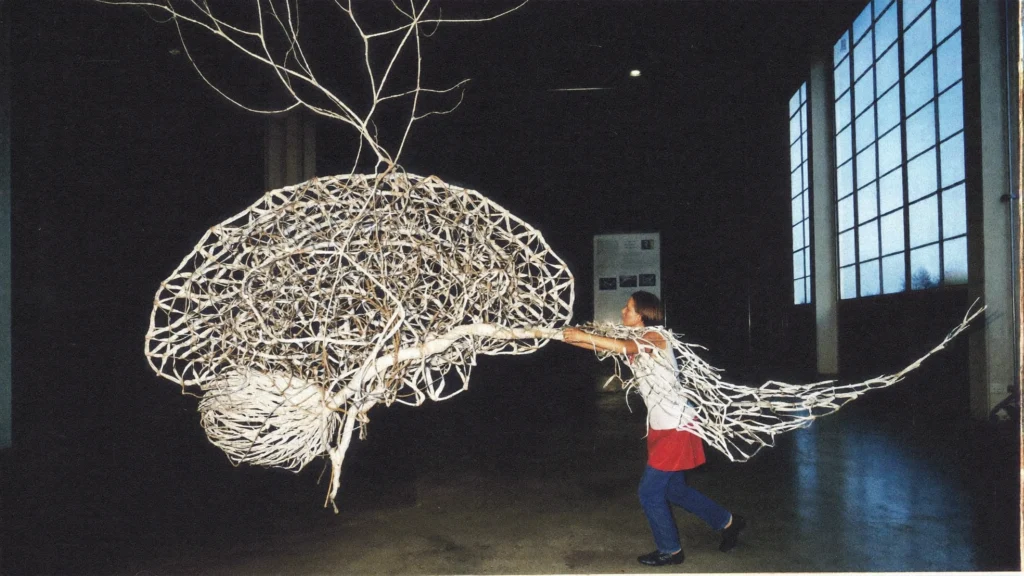
Instead, prolonged stress and post-traumatic stress are associated with structural and functional differences in specific, interconnected brain regions.
The hippocampus, amygdala, and prefrontal cortex are particularly frequently studied.
These regions help us to contextualize experiences, place memories in context, regulate emotional responses, and make decisions.
Research indicates that chronic stress can be associated with different remodeling of neuronal structures within these networks. The hippocampus, amygdala, and prefrontal cortex do not react identically to stress. Furthermore, these findings do not automatically mean that every observed change is solely caused by trauma, or that it appears the same in all affected individuals.
The frequently repeated claim that trauma inevitably shrinks the hippocampus is too general. Some studies show smaller hippocampal volumes, particularly in cases of chronic, non-remitting post-traumatic stress. Other longitudinal studies show no progressive volume decrease after trauma and suggest that certain differences may already represent a vulnerability.
In Part 2, we will learn about the three members of what could be considered the brain’s survival team:
The hippocampus organizes memories and provides them with a temporal and spatial context.
The amygdala is the brain’s internal smoke detector.
The prefrontal cortex plans, evaluates, and co-regulates emotional responses.
The interaction of these regions helps explain why the past sometimes feels like the present.
It also explains why psychological recovery is possible.
The most important takeaway:
Trauma is not proof that your brain has failed.
It is an indication that your brain has adapted to conditions it perceived as dangerous.
Many symptoms that people fear are not signs of personal weakness.
Brain fog.
Hypervigilance.
Forgetfulness.
Emotional overwhelm.
Exhaustion.
These can be signs of a survival system that is constantly working overtime.
The encouraging news is:
The brain that has learned to survive can also process new experiences of safety.
This ability is called neuroplasticity.
Neuroplasticity describes the brain’s ability to change its functions and connections through experience and learning. It generally persists into adulthood and is influenced by factors such as sleep, exercise, learning, and the general physical and psychological environment.
However, this does not mean that every structural change simply “grows back” or that healing must be clearly visible on a brain scan. Studies on trauma-focused psychotherapy provide evidence of possible functional changes, particularly in prefrontal networks. However, the findings regarding clear structural changes are currently limited and not consistent.
Psychological recovery is therefore not a simple biological process of reverting to a previous state.
It is a learning process.
The nervous system repeatedly gathers new information:
This place is safe.
This person is not the one from before.
This sound means something different today.
This memory is painful, but it will not return again.
I can feel tension without an immediate catastrophe following.
Safety does not always arise from a single realization.
Often, it arises from many small experiences that gradually convince the brain and body that the old survival rules no longer need to govern every situation.
That is where our journey continues.