

Before we begin
In Part 1, we learned that trauma does not “break” the brain. Instead, it activates a very old survival system whose purpose is to keep us alive.
But what actually changes in the brain?
Imagine you open Google Maps and zoom in further and further.
Instead of looking at the entire city, we now focus on three city districts. Each of them plays a crucial role in how you remember the past, react to potential dangers, and make decisions.
Meet the Brain’s Survival Team:
The Hippocampus: Your Brain’s Internal Memory Librarian.
The Amygdala: Your Brain’s Internal Smoke Detector.
The Prefrontal Cortex: Your Brain’s CEO.
None of these regions work in isolation.
Similar to how different apps on a smartphone exchange information continuously, if one application consumes too much processing power, the entire system slows down.
Trauma can disrupt this balance.
The Hippocampus: Your Brain’s Memory Librarian

iksHaus | KI-generiert nach redaktioneller Konzeption, 2026
Imagine entering a library where every single book has been thrown on the floor.
The stories are still there.
However, finding the right book becomes extremely difficult.
This is a simplified way to describe how trauma can affect the function of the hippocampus.
The hippocampus is not only involved in storing memories. One of its most important functions is to organize memories and place them in context.
It helps answer questions like:
What happened?
When did it happen?
Where did it happen?
The hippocampus functions in a way similar to the timeline in the photo gallery of a smartphone.
The phone doesn’t simply store photos randomly. It organizes them by date, location, and event. This allows us to distinguish between pictures from yesterday’s vacation and a photo taken five years ago.
The hippocampus serves a comparable function for our life experiences.
Under chronic stress, the persistent exposure to stress hormones like cortisol can impair the functioning of the hippocampus.
Imaging studies have also found a smaller hippocampus volume in some individuals, particularly in cases of prolonged or severe traumatic experiences.
This does not occur in all individuals.
These research findings describe average differences between the groups studied. They do not mean that every person with traumatic experiences will necessarily develop the same changes.
When the hippocampus has difficulty placing memories in the correct temporal and spatial context, the past can feel surprisingly present.
How a disrupted sense of time can feel
Many people with traumatic experiences describe their memories using phrases such as:
“It doesn’t feel like I’m remembering it.”
“It feels like I’m reliving it.”
A particular smell.
A song.
A specific tone of voice.
Suddenly, the heart rate accelerates, as if the event is happening again right now.
This is one of the reasons why traumatic memories often feel different from ordinary memories.
They are not always experienced as events that happened in the past. Instead, the body and nervous system may react as if they are happening now.
Imagine opening the photo gallery on your smartphone and discovering that the pictures from today are mixed with images from ten years ago, without dates or folders.
Each picture appears equally current.
Trauma can affect the brain’s ability to organize experiences in time and space in a similar way.
The most important takeaway is:
The hippocampus not only stores memories; it also helps to contextualize them in terms of time, place, and context.
When traumatic stress disrupts this process, the past can feel painfully present.
The amygdala: Your internal alarm system

iksHaus | KI-generiert nach redaktioneller Konzeption, 2026
If the hippocampus is the librarian, then the amygdala is the security system.
Its function can be simply described as:
detecting potential danger.
Quickly.
Very quickly.
The amygdala can react to potentially threatening information even before we consciously perceive what we are seeing or hearing.
From an evolutionary perspective, this speed is beneficial.
If something looks like a snake, it is safer to step back first and then take a closer look.
However, after traumatic experiences, the amygdala can become more reactive.
It is not trying to make life more difficult.
It is trying to prevent another catastrophe.
The problem is that it sometimes begins to treat not only actual danger, but also uncertainty itself, as a danger.
Where hypervigilance arises
This is where hypervigilance begins.
You notice everything.
The stranger walking behind you.
The slightest change in the facial expression of another person.
An unexpected silence in a conversation.
A loud bang on the street.
You are not consciously trying to overreact.
Your brain is simply collecting information that it believes could save your life.
Many people say:
“I can’t relax.”
Or:
“I am constantly waiting for something bad to happen.”
This is not simply imagination.
It is biology shaped by experience.
Imagine you have a smoke detector in an apartment.
A properly calibrated smoke detector will trigger an alarm when there is an actual fire.
Now imagine that it goes off every time someone makes toast.
Nothing is burning.
However, the alarm system does not reliably distinguish between the two.
An amygdala sensitized by trauma can react in a similar way.
Functional imaging often shows increased amygdala reactivity in people with traumatic experiences when they are confronted with emotionally significant or threatening stimuli.
This increased sensitivity can contribute to hypervigilance, stronger startle responses, and persistent anxiety.
However, the reaction patterns vary from person to person. They are also not immutable and can change during recovery.
The amygdala is not trying to ruin your life.
It is trying to prevent you from being hurt again.
The challenge is to gradually teach it the difference between a potential and an actual danger.
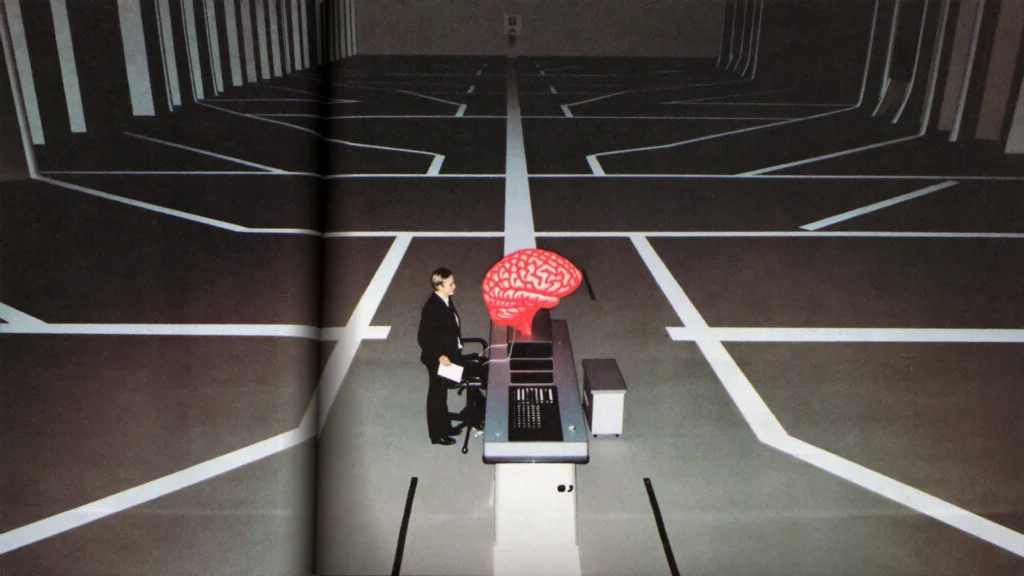
The prefrontal cortex: The CEO of your brain
iksHaus | KI-generiert nach redaktioneller Konzeption, 2026
Imagine a successful company.
The CEO doesn’t personally extinguish every fire.
Instead, they gather information, evaluate different options, manage reactions, and make well-considered decisions.
The prefrontal cortex performs a similar function in the brain.
It helps you to:
plan ahead,
solve problems,
focus your attention,
control impulses,
regulate emotions,
and distinguish between facts and assumptions.
However, during an overwhelming stress response, the CEO temporarily leaves their office.
The emergency team takes over.
This is extremely useful if you need to escape an immediate physical danger.
It is less helpful when you want to write an email, study for an exam, or have a calm conversation with a loved one.
What it feels like when the emergency team takes over
People often describe this experience in the following ways:
“My head suddenly becomes completely blank.”
“I know what I want to say, but I can’t find the words.”
“I can no longer make even simple decisions.”
“Everything feels overwhelming.”
This is one of the reasons why people with traumatic experiences may sometimes appear indecisive or emotionally reactive.
The thinking brain has not disappeared.
Its function is merely being overridden by systems that are convinced that survival is more important at the moment.
Imagine you are trying to edit a video on your smartphone.
At the same time, the device is installing important security updates, running an antivirus program, and scanning each file for threats.
The video editing application is still running.
It simply doesn’t have enough processing power available.
The traumatized brain faces a comparable challenge.
Executive functions do not disappear completely.
They are temporarily given a lower priority.
Research findings suggest that chronic stress can alter communication between the prefrontal cortex and limbic regions such as the amygdala.
When this regulatory network functions less efficiently, emotional reactions may become stronger, while cognitive control and nuanced evaluation become more difficult.
However, it is important to note:
These changes are not necessarily permanent.
The brain can improve when it repeatedly experiences conditions of safety, stability, and recovery.
The prefrontal cortex is the CEO of the brain.
Trauma does not dismiss this CEO.
Instead, it temporarily transfers control to the emergency response team.
Recovery helps the CEO gradually return to their position.
No brain region works in isolation
The hippocampus, the amygdala, and the prefrontal cortex perform different functions. Nevertheless, traumatic stress cannot be understood if we consider each region in complete isolation.
The amygdala detects a potentially threatening stimulus.
The hippocampus attempts to determine whether this stimulus belongs to the present or to a past experience.
The prefrontal cortex assesses the situation, controls impulses, and helps to select an appropriate response.
When this system functions properly, a loud noise may initially attract attention. The hippocampus categorizes it as a present, harmless event. The prefrontal cortex recognizes that it is likely just a door slamming.
The alarm system can then calm down.
After traumatic experiences, this exchange can become more difficult.
The amygdala may react particularly quickly and intensely.
The hippocampus may have difficulty clearly classifying the reaction as a memory or as a reaction to a present trigger.
The prefrontal cortex may not have enough time or resources to assess the situation in detail.
The result can feel like the body is reacting before the conscious mind has even understood what is happening.
Can the brain regrow?
If trauma can change the brain, can healing also change it?
The answer is one of the most important discoveries of modern neuroscience:
Yes.
But not necessarily in the way that many people imagine.
The brain doesn’t have a simple reset button.
It doesn’t simply revert to its previous state overnight.
Instead, it continuously changes and reorganizes itself through neuroplasticity.
Every new experience strengthens certain neural connections, while others may weaken over time.
Imagine your brain as a forest.
Each recurring thought, feeling, and behavior is comparable to walking a particular path.
Trauma creates a particularly well-developed survival path, because this path is repeatedly used.
Healing doesn’t simply erase this path.
It promotes the creation of new paths.
Paths that are associated with safety, curiosity, connection, and emotional flexibility.
At first, these new paths feel unfamiliar.
The old survival path is wider, more familiar, and easier to find.
However, with each repetition, the new paths become clearer.
Eventually, the brain begins to choose them more naturally.
That’s how neuroplasticity works.
Not through magic.
But through repeated experience.
The brain is not a hard drive
Imagine your brain not as a hard drive, but more like a navigation app.
A navigation app typically recommends routes that are frequently used.
If you choose a particular route often enough, it gradually becomes the default route.
This doesn’t mean that the old route completely disappears from the map.
However, it loses its automatic priority.
The same logic applies to the nervous system.
Repeated experiences of danger strengthen certain reaction pathways.
Repeated experiences of safety can strengthen other pathways.
A secure relationship.
A situation where a boundary is respected.
A physical reaction that arises and subsides without a catastrophe following.
A difficult conversation that does not end in humiliation or violence.
A memory that can be accessed without overwhelming the present moment.
Each of these experiences can provide the brain with new information.
The survival pathway doesn’t need to be erased for other pathways to develop.
Why recovery is possible
Trauma changes the brain because it is designed to learn from experiences.
Recovery is possible for the same reason.
The brain never completely stops learning.
This doesn’t mean that healing is always quick, linear, or the same for everyone.
Genetic factors, age, the nature and duration of the traumatic experience, social support, physical health, and access to professional treatment all influence how a person reacts to trauma and how recovery progresses.
Furthermore, the three brain regions described do not change in the same way for all affected individuals.
There is no single “trauma brain” that looks identical in every person.
Neuroscientific findings describe average differences between groups. They cannot precisely predict what has happened in the brain of a single individual or how their recovery will proceed.
The central finding remains:
The brain is not an immutable organ.
It adapts to experiences.
The crucial question is therefore:
What experiences are we teaching it today?
What happens in Part 3
In the third part, we answer the question that many people ask:
If the brain can change, what actually helps it in recovery?
We examine the scientific basis of EMDR, trauma-focused psychotherapy, exercise, sleep, mindfulness, and secure relationships.
We also explore why psychological recovery is much more than a purely biological process.