When a chronic illness, a disability, or barriers change life, some people grieve for plans, roles, and opportunities. Not everyone experiences this as a loss. This text describes a possible experience and does not make a general statement about life with a disability.
When we think of grief, we usually think of visible losses such as death, separation, or the loss of home and work. Society acknowledges these. There are rituals, comforting words, and an understanding that adaptation takes time.
However, deep losses can remain invisible. There is no funeral for the imagined future, and no rituals for the expected life. After a diagnosis or a newly acquired disability, abilities, opportunities for action, and the internal narrative about one’s own future can change.
Therefore, some people go through a process that resembles grief after a diagnosis or a profound change, even though what is lost never actually existed. It is not the future itself that is lost, but an expected possibility and the story we associate with it.
We are also living in the future that we imagine
People react not only to what is happening here and now. A large part of our psychological lives is shaped by expectations, planning, and ideas about the future.
When someone starts a degree, enters a relationship, saves money, or plans a trip, they are also investing in a vision of their future life. These future visions are not illusions. They help us to organize our lives, make decisions, and give meaning to our actions.
Therefore, their loss can be just as painful as the loss of something present. When illness, disability, or an inaccessible environment changes important possibilities, we may lose not only plans, but also a part of the story of who we thought we were going to become.
iksHaus | KI-generiert nach redaktioneller Konzeption, 2026
Ambiguous Loss: When Presence and Absence Coincide
The family therapist and researcher Pauline Boss coined the term “Ambiguous Loss” in English to describe situations in which physical and psychological presence or absence do not clearly correspond.
This term can be used as a framework for understanding chronic illnesses, disabilities, and altered future visions. The term “Nonfinite Loss” is also used in the literature to describe ongoing losses that become apparent in new life situations.
The body is still there, but its abilities, reactions, or needs may have changed.
A relationship may continue, but it may have taken on a different form.
A career may continue, but perhaps not in the way that was once planned.
Life goes on, but not on the expected path.
Such a loss can be particularly stressful because the boundary between what remains and what is lost is blurred. Some people experience their own body as both familiar and foreign after a profound change, while others do not. Grief can relate to functions, certainties, roles, or plans, without necessarily referring to the loss of one’s own body. People may know that something is hurting, but find it difficult to explain exactly what is missing.
Secondary Losses: What Changes Around an Illness
In the case of chronic illnesses, the focus is often on the symptoms. However, psychological stress can also be associated with changes in daily life, relationships, roles, income, self-image, and participation in society. These secondary losses can affect spontaneity, professional identity, physical safety, independence, or participation in important activities.
In Vienna and throughout Austria, accessibility, support, working conditions, and social security determine the available options. Not every limitation originates in the body. Often, an environment that does not adequately consider diverse needs exacerbates the situation.
Secondary losses often manifest gradually. Grief does not follow a fixed plan. It can recur, temporarily recede into the background, or not encompass some of the frequently described reactions. A new limitation can make previous losses felt again. This does not mean that the adaptation has failed.
Why grief can become palpable again
One of the most common misconceptions is the idea that grief needs a clear endpoint. Experiences with chronic illnesses often paint a different picture.
New life phases can give previous losses new meaning. For example, grief can resurface when someone desires to have children, or when people of the same age achieve professional goals that were once part of one’s own plans.
When grief becomes palpable again, it does not necessarily mean a lack of acceptance or a setback. Life changes, and with it, the meaning of a loss under new conditions.
From the perspective of meaning-making, this is not a setback. It is a continuation of adapting to conditions that new life phases expose us to.
iksHaus | KI-generiert nach redaktioneller Konzeption, 2026
Grief as a process of meaning reconstruction
The grief researcher Robert A. Neimeyer also understands grief as a process of meaning reconstruction. A loss can shake our understanding of ourselves, others, and the world. People then re-evaluate their self-image, their expectations, and their relationship with the deceased.
This approach can be applied to profound changes resulting from illness or disability. Reconstructing meaning does not require a positive interpretation of the loss. It means finding one’s way again under changed conditions.
The problem is not only that some opportunities have been lost. A person may also have to reorient themselves in a world that no longer looks the same as before.
Who am I if I can no longer do what has long defined me?
What does my life look like if my plans do not become reality in the expected way?
What do success, closeness, and a fulfilling life mean under these new conditions?
There are no universal answers to these questions. Answers can evolve over time and may also remain open. Therefore, every grieving process is unique.
Acceptance does not mean giving up
The term “acceptance” can give the false impression that a person must stop being sad or completely abandon their desires.
Acceptance, in this context, does not mean approving of what has happened, ending the grief, or giving up on desires. It means gradually acknowledging the current reality and seeking opportunities for action within it.
Only then can a different question become possible.
No longer: “How can I get my life back, the life I have lost?”
But: “How can I live in the reality that is now mine?”
This shift in perspective does not eliminate the pain. However, it can create space for possibilities that may not have been visible before, and enable new forms of contentment.
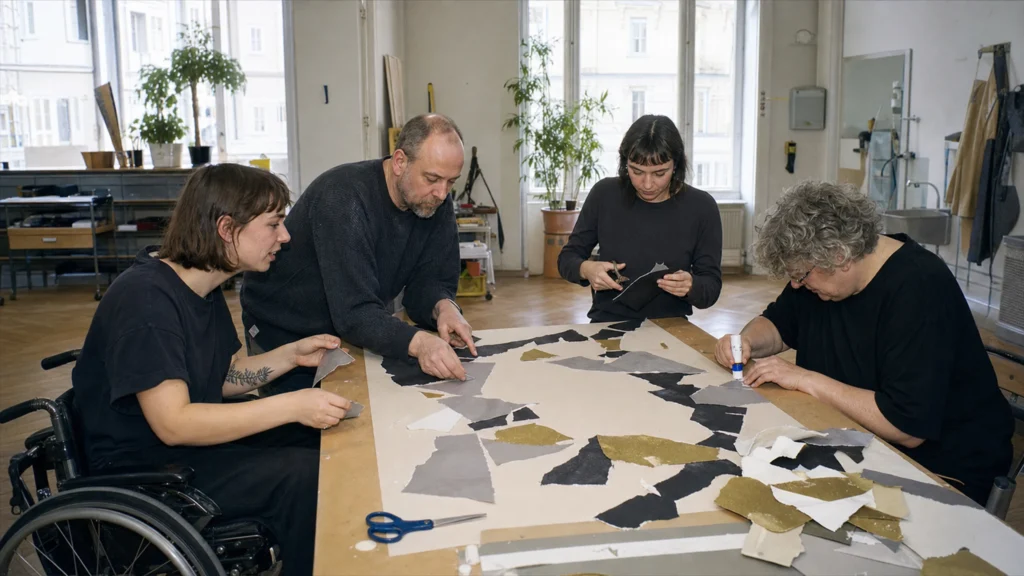
iksHaus | KI-generiert nach redaktioneller Konzeption, 2026
Between loss and new possibilities
Heinz von Foerster, a physicist, cyberneticist, and philosopher of science born in Vienna, was a prominent figure in second-order cybernetics. His ethical imperative is: “Always act in such a way that the number of choices increases.”
In the context of chronic illness and disability, this idea should not mean that those affected are solely responsible for new opportunities. Societal barriers, care, income, and social support shape the actual choices available.
When a person loses a part of the future they envisioned, their attention naturally focuses on what is no longer possible. This is often unavoidable. Loss demands to be seen and acknowledged.
Long-term adaptation can also mean gradually discovering the possibilities that remain or have newly emerged. The new future does not have to be the same as the one previously envisioned. It does not necessarily have to be better. But it can become real and livable, and it can contain relationships, belonging, creativity, love, participation, and meaning, without diminishing the original loss.
Grief then becomes a process in which the lost future does not have to be forgotten. It becomes a process in which a new way of relating to it emerges. This approach can enable the recognition of other and diverse paths.
What does this mean for us?
Perhaps one of the biggest mistakes in dealing with a chronic illness is to assume that the goal should be to stop grieving as quickly as possible.
Grief is not the opposite of adaptation. Often, it is the way a person acknowledges how important what was lost was.
Only when we stop fighting against our own grief or trying to overcome it as quickly as possible can space be created for something new. Not necessarily for optimism. Not necessarily for happiness. But for the possibility that life opens up to the future again.
Perhaps not to the future we planned, but to a future that can still be lived.