

Bipolar disorder is a condition that affects young people. The fact that you might only hear about it when you’re thirty or so doesn’t mean it didn’t start much earlier. More often, it began ten years prior, while everyone around you said, “It’s just a phase.”
In part 1, we separated bipolar disorder from the TikTok meme. In this part, we’ll show why the condition often hides itself precisely when it should be most visible: during the years when you’re 16, 17, or 18, and your identity is just beginning to form.
iks.haus | AI-generated based on editorial concept, 2026
Young people are the primary targets
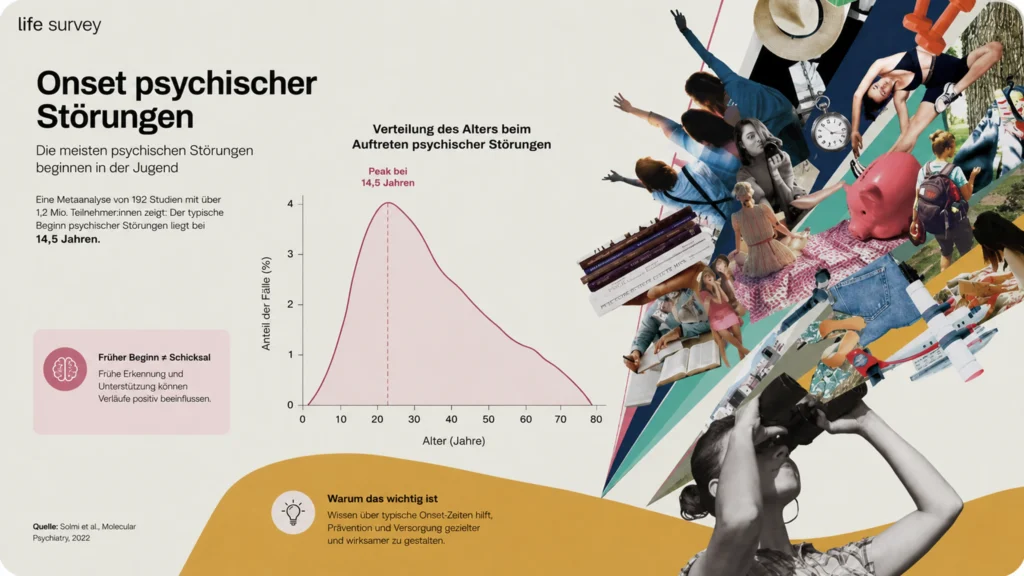
The most comprehensive meta-analysis to date, published in the journal Molecular Psychiatry in 2022 (Solmi et al.), examined the age of onset of all mental disorders on a global scale. The peak onset is at 14.5 years. Half of all mental disorders (48.4%) begin before the age of 18. A full 62.5% begin before the age of 25.
Bipolar disorder holds a special place in these statistics. Specific epidemiological data show that the first symptoms most often manifest between the ages of 15 and 19, with a significantly higher incidence among young women in this age group.
Consider the years involved. These are the years of upper secondary school, the first serious relationship, the final exams, and the first move away from the family home. These are years when your primary task is to understand who you actually are. The illness manifests precisely during this formative period.
Women of reproductive age face double pressure
The clinical picture in women between the ages of 15 and 49 is particularly complex. The reasons are varied: hormonal fluctuations of the menstrual cycle, pregnancy, the postpartum period, reproductive stress, and conflicts between social roles. All of this acts as a biological and psychological amplifier of the symptoms.
For example, postpartum psychosis is often an expression of an undiagnosed bipolar I disorder. This means that the illness has been present for years, and the birth was merely the trigger that revealed what had previously been hidden.
Diagnostic mimicry: how bipolar disorder can remain hidden
Why does bipolar disorder often go undiagnosed for years? Because it rarely presents itself as described in textbooks. A manic episode with delusions and psychosis is the extreme, dramatic form. Most young people do not end up in psychiatric care in this state. Instead, they arrive completely exhausted, anhedonic, suicidal, and depressed. They appear to have a classic, severe depression.
And that completes the first cycle. The doctor sees a depression, prescribes an antidepressant, and sends the person home. Hypomanic phases that occurred six months earlier are not mentioned, because even the individuals themselves often do not recognize them as an illness. On the contrary, the hypomania is often remembered as: “Ah, I felt great, I was more productive than ever before.”
The second reason: Early symptoms are often confused with other conditions. Irritability, impulsivity, unstable relationships, sudden changes in interests – all of this is routinely attributed to:
- Burnout and academic stress.
- Pubertal rebellion.
- ADHD.
- Borderline personality disorder.
- The consequences of a breakup or the loss of a loved one.
All of these diagnoses can coexist with bipolar disorder, but when they are used as substitutes, bipolar disorder disappears from consideration.
The difference that can save lives
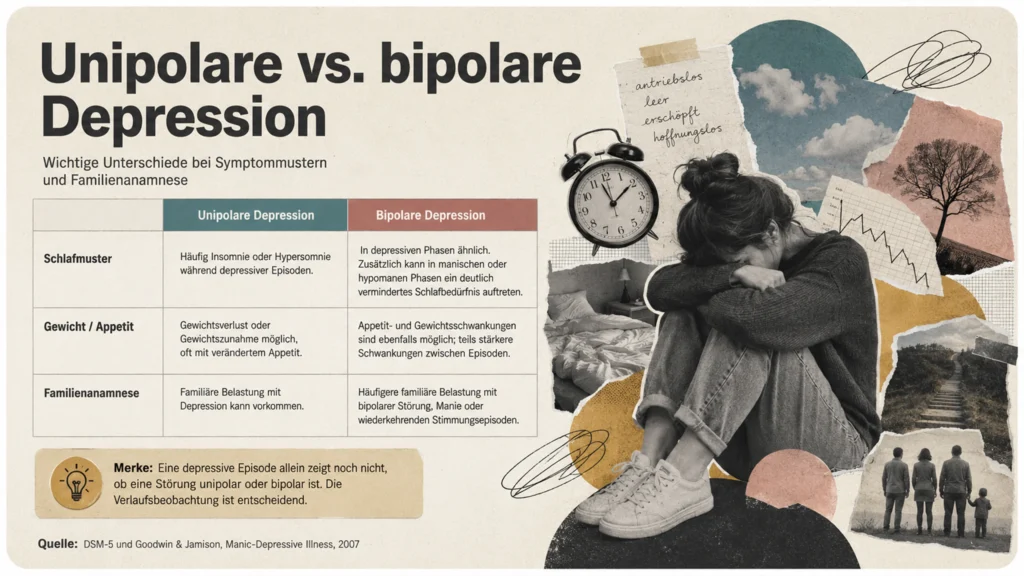
There are specific clinical signs that distinguish bipolar depression (another term for bipolar affective disorder, abbreviated as BAS) from unipolar depression. They are not absolute, but if they accumulate, it should raise a red flag.
iks.haus | AI-generated based on editorial concept, 2026
| Signs | Unipolar Depression | Bipolar Depression (early) |
|---|---|---|
| Age at first occurrence | Mostly 25 to 35 years | Mostly 15 to 19 years |
| Sleep during the episode | Classic insomnia (you can’t sleep) | Hypersomnia (you sleep 12 hours and are not rested) |
| Appetite | Reduced, weight loss | Increased, carbohydrates, weight gain |
| Family history | Often unremarkable | Often relatives with bipolar or severe depression |
| Reaction to antidepressants | Gradual improvement over 4 to 6 weeks. | Sudden shift to hypomania or irritability. |
The most dangerous point: When a young person with an undiagnosed bipolar disorder receives monotherapy with an antidepressant (SSRI or SNRI without a mood stabilizer), the antidepressant can act as a chemical trigger for a manic switch. This is called a treatment-emergent manic switch. It can occur in the first few weeks of treatment.
Antidepressants can also trigger something called an activation syndrome, which must be distinguished from a manic switch. The simplified difference is: activation syndrome is when an SSRI/SNRI “overstimulates the nervous system,” causing you to feel nervous, restless, unable to sleep, and as if you’ve had eight coffees at once. You may not necessarily feel good; rather, you feel overstimulated and anxious.
A manic switch is when an antidepressant triggers a true hypomania or mania: suddenly, you have a huge amount of energy, need very little sleep, feel great, powerful, or “finally like your true self,” become hyperproductive, impulsive, and often do risky things without feeling that anything is wrong. That’s why it’s so important to report any behavioral changes to both the family doctor and the psychiatrist after starting antidepressant therapy.
Five to ten years lost
Studies from various clinical settings, including a large Spanish study, have shown that only about 30% of patients with bipolar disorder receive a correct diagnosis during the initial psychiatric evaluation. The average delay from the onset of the first symptoms to the correct diagnosis is 5 to 10 years.
This is not due to a lack of expertise among psychiatrists, but rather the complexity of the bipolar disorder. A relatively long period of the person’s life must be evaluated, as they usually present with a severe depression, in order to recognize that it is a disorder that manifests in its own unique way. One of the reasons why bipolar disorder is not recognized is that patients do not see their “good” phases, which precede the low phase, as part of the bipolar picture.
What happens in the next 5 to 10 years?
- Repeated, untreated episodes (each leaves biochemical scars).
- Accumulating cognitive deficits.
- Dropping out of studies due to prolonged depression.
- Financial ruin following a manic episode.
- Destruction of romantic relationships and families.
- Substance abuse as self-medication.
- Increased risk of suicide during mixed episodes.
This is not abstract. These are concrete things that happen month after month, year after year, while someone is seeking a doctor who says, “This is not a typical depression.”
Neuroprogression: Why every delayed year matters
In modern neuropsychiatry, there is a concept called neuroprogression. The idea is simple and brutal: Every manic or depressive episode is not an isolated event. Each episode changes the brain. It activates inflammatory processes, alters the hormonal axis, and damages structures in the prefrontal cortex and the hippocampus.
The more episodes, the more difficult they become to treat. Medication resistance develops. The stable phases between episodes become shorter. Cognitive deficits become permanent.
In contrast, early intervention with mood stabilizers (medications that stabilize the “swinging” of bipolar disorder) can completely stop this cascade. Lithium not only treats the episode but also has a neuroprotective effect. It protects the brain from future damage.
What an early diagnosis means for you
An early, correct diagnosis is not just paperwork in the medical record. It is an intervention that changes the course of life.
A young person who receives the correct diagnosis and treatment at age 17 can complete their studies. They can build a career. They can have long-term relationships. They can plan for children in consultation with a gynecologist and psychiatrist. They can have a life that looks like any other, with smaller or larger challenges.
A young person who receives the wrong diagnosis at age 17 and then spends the next ten years going from one antidepressant to another enters their 27th year as someone who may have already attempted suicide twice, dropped out of school, incurred unnecessary debts taken out during the manic phase, been fired from two jobs, experienced a divorce, and had three years of alcohol and drug abuse, etc., etc.
Effective management involves a timely diagnosis, appropriate pharmacological treatment, and effective psychotherapy. The difference between these two scenarios lies in a timely diagnosis, effective pharmacological treatment, and effective psychotherapy.
What awaits you in Part 3
In the next part of the series, we will answer the big question: Is the number of people with bipolar disorder actually increasing, or are we simply better at identifying it? The media is talking about an “epidemic of mental health.” The statistics are more nuanced.
We will examine the Global Burden of Disease study from 2021. We will see why the absolute number of people affected worldwide has increased from 30 million to 54 million, while the biological prevalence has remained almost unchanged. And why wealthier countries are reporting more cases.
If you need help
If someone in your close circle has depression that is not behaving normally (atypical, early onset, accompanied by hypersomnia or a positive family history of bipolar disorder), seek a second opinion from a psychiatrist. Ask specifically: Could this be bipolar disorder? In Vienna: AKH Vienna, University Department of Psychiatry and SFU Outpatient Clinic. Crisis hotline: 142 (telephone counseling, 24/7, free of charge).
Frequently asked questions
Why does bipolar disorder most commonly manifest in late adolescence?
Bipolar disorder has a significant neurodevelopmental component. The brains of adolescents undergo intense maturation of the prefrontal cortex, hormonal changes during puberty, the first significant social stressors, and the first periods of significant sleep deprivation. All of this acts as a biological trigger in individuals with a genetic predisposition. A study by Solmi et al. in Molecular Psychiatry (2022) showed, at a global population level, that the peak age of onset for all mental disorders is 14.5 years.
Why is it dangerous to take antidepressants when a bipolar diagnosis is not confirmed?
Monotherapy with antidepressants can trigger a manic switch (treatment-emergent manic switch) in individuals with bipolar disorder, accelerate the cycling between depression and mania, or induce mixed states with the highest risk of suicide. Therefore, it is crucial that antidepressants are prescribed by a specialist in mental health who can accurately assess the family history and the risks of pharmacotherapy. Clinical gold standard guidelines require the simultaneous use of a mood stabilizer in every confirmed or suspected case of bipolar disorder.
How long does it take to diagnose bipolar disorder?
According to research from various European and American clinical settings, the average delay from the onset of the first symptoms to the correct diagnosis of bipolar disorder is between 5 and 10 years. Only about 30% of patients receive the correct diagnosis during the initial psychiatric evaluation.
Sources
This is part 2 of the series “Call Me By My Name” on the iks.haus platform. Part 3 will follow: “Bipolar disorder is increasing, or are we just seeing it better?”
- Solmi M. et al. Age at onset of mental disorders worldwide: a meta-analysis. Molecular Psychiatry, 2022.
- American Psychiatric Association. Diagnostic and Statistical Manual of Mental Disorders, Fifth Edition (DSM-5). 2013.
- Goodwin F. K., Jamison K. R. Manic-Depressive Illness, 2nd ed. Oxford University Press, 2007.
- Vieta E. et al. Early intervention in bipolar disorder. American Journal of Psychiatry, 2018.