

Bipolar disorder is treatable. Medications work. Psychotherapies work. The knowledge exists, the guidelines exist, and there are professionals who know exactly what to do. The problem is not the science. The problem is the distribution.
In parts 1 to 4, we examined diagnosis, late detection, global epidemiology, and the impact on daily life. In this final part, we ask the most uncomfortable question: What happens when the treatment exists, but the system doesn’t provide it?
The case study is Austria. Not because it is the worst, but because the country is rich enough not to have an excuse. The recent report from the Austrian Court of Auditors, dated August 2025, paints a shocking picture of a deep structural crisis in psychiatric care, especially for children and adolescents. Let’s go through it step by step.
What modern psychiatry has to offer
Current international guidelines for the treatment of bipolar disorder, including the Canadian CANMAT guidelines (Yatham et al.) and the guidelines from the Royal Australian and New Zealand College of Psychiatrists (RANZCP; Malhi et al., 2020), describe a clear, evidence-based approach.
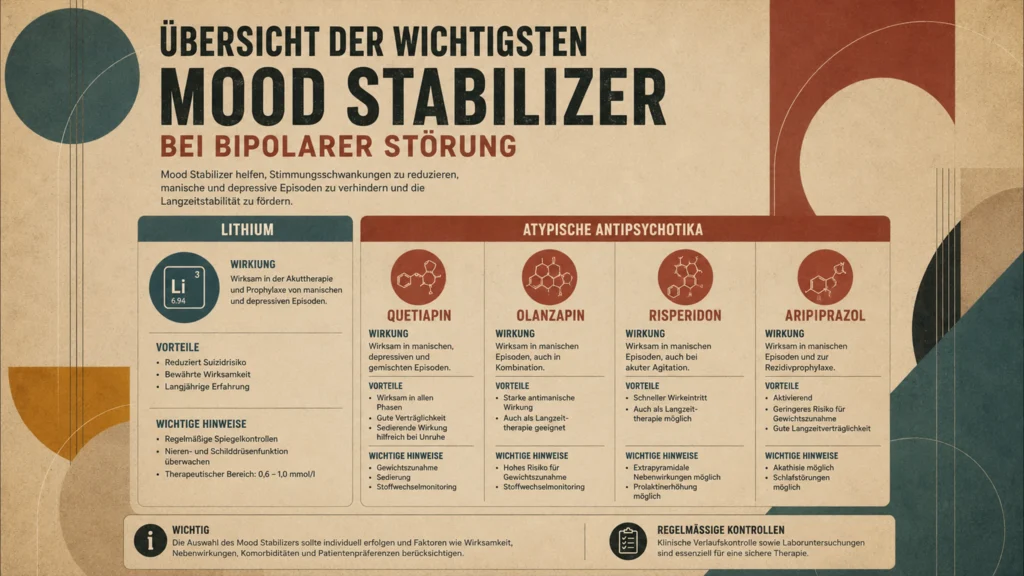
The foundation of treatment consists of mood stabilizers. In addition, psychiatrists prescribe a combination of medications that, together with the stabilizer, form the therapy:
iks.haus | AI-generated content based on editorial concept, 2026
Mood Stabilizers
The most well-known is lithium, typically prescribed as lithium carbonate, which was the first and only basic medication for many years. Clinically, it is unique due to its strong and scientifically proven protective effect: it drastically reduces the risk of suicidal thoughts, suicide attempts, and completed suicides. No other medication in psychiatry has as much evidence for reducing suicidal behavior. Like all medications, lithium has side effects. Therefore, modern pharmacology has developed a whole range of alternative stabilizers that are now available to medical professionals.
Antiepileptic Drugs
For example, valproate is very effective in acute mania. Lamotrigine is preventative against depressive phases. Carbamazepine is used in certain cases. Psychiatrists prescribe antiepileptic drugs in combination with the basic pharmacological treatment, if indicated.
Atypical Antipsychotics of the Second Generation
Quetiapine, olanzapine, aripiprazole, lurasidone, and asenapine show strong stabilizing properties and are used as an alternative or supplement to lithium, depending on the patient’s profile.
Strict Contraindications
Monotherapy with conventional antidepressants is not standard practice and is not used in patients diagnosed with bipolar disorder, because bipolar disorder and unipolar depression are two different conditions. The reason is the risk of iatrogenically induced rapid cycling, an acute manic switch, and the induction of mixed states with the highest suicide risk. Therefore, it is crucial, and this is the practice in developed Western healthcare systems, that antidepressants and psychiatric medications are generally prescribed as a specialized category only on the recommendation of a specialist (with very rare exceptions), i.e., on the recommendation of a psychiatrist.
Psychotherapy that Protects the Rhythm
Medications alone are never enough. A key role is played by a specific psychological intervention that was developed specifically for bipolar disorder: Interpersonal and Social Rhythm Therapy (IPSRT), along with other approaches, whose goal is stabilization.
IPSRT, developed by Ellen Frank at the University of Pittsburgh, combines two approaches. The first is the rigorous stabilization of biological and circadian rhythms: regular sleep schedules, consistent wake-up times, structured nutrition, and predictable physical activity. The second involves working with so-called social zeitgebers, which are external people and commitments that naturally structure the day (partners, work, regular meetings, family rituals).
In addition to IPSRT, cognitive behavioral therapy (CBT) and psychoeducation for patients and their families are integrated. Psychoeducation is more important than it sounds. When the family understands the illness, recognizes early signs, and knows how to respond, the number of relapses decreases significantly. Supporting the families of people with bipolar disorder is increasingly understood as a fundamental component of treatment, not just an option or supplement to standard therapy. There is still a great deal of work to be done in this area.
The system that is failing in Austria
All of this exists on paper, in guidelines, and in scientific journals. The question is whether it reaches the patients. In Austria, one of the richest countries in Europe, the answer is increasingly: No.
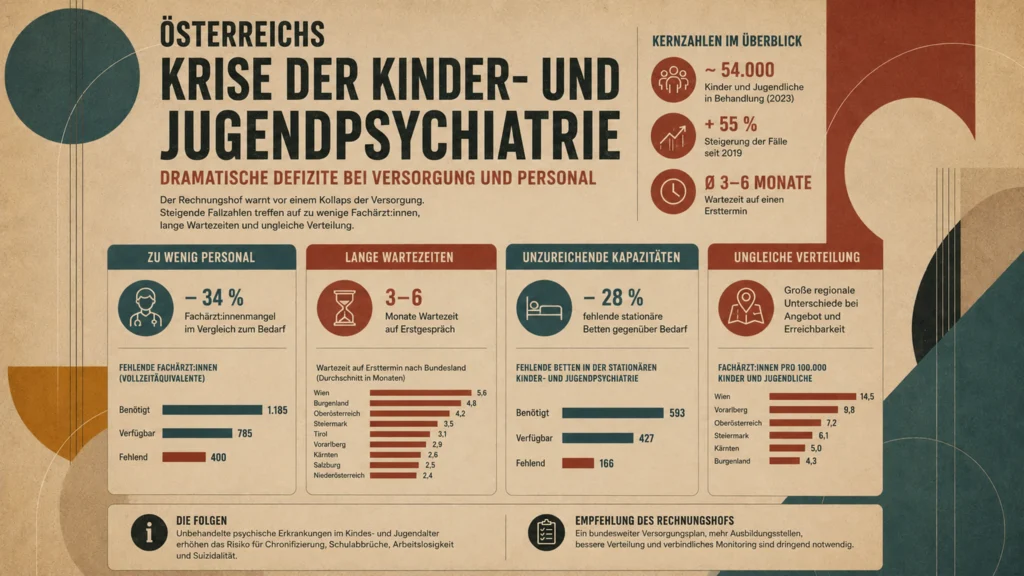
In August 2025, the Austrian Court of Audit published an official report on child and adolescent psychiatry, as well as on the planning and implementation of care. The report paints a systemic picture of crisis.
iks.haus | AI-generated based on editorial concept, 2026.
| Aspect of psychiatric care in Austria. | Status (Court of Audit, 2024/25). |
|---|---|
| Waiting time for the first appointment in Vienna. | On average, 90 days for child psychiatrists with contracts with public health insurance. |
| Regional availability of care for young people. | At least 12 out of 32 health regions have a drastic deficit. |
| Capacity to accept new patients. | Approximately 40 percent of registered practices are not accepting new patients. |
| Demographic risk for doctors until 2029. | Approximately 24 percent of child psychiatrists and 37 percent of adult psychiatrists are nearing retirement. |
| Budgetary intervention package: Gesund aus der Krise (Healthy out of the crisis). | Approximately 50.12 million euros for 15 short-term sessions per adolescent. |
| Costs of private psychiatric care for young people. | From 1,500 to over 20,000 euros per year. |
What these figures mean in practice
90-day waiting time in Vienna
In 2024, the Vienna Medical Association conducted so-called “mystery calls” – covert phone calls to doctors’ offices, where the callers pretended to be parents seeking an appointment for their child. The average waiting time for an initial appointment with pediatric and adolescent psychiatrists who accept public health insurance is an unacceptable 90 days in the capital. Three months during which a young person in an acute phase can dramatically worsen or harm themselves.
40 percent of practices are not accepting new patients
Currently, approximately 40 percent of Austrian psychiatric practices openly state that they have reached their absolute capacity. They are simply no longer accepting new, undiagnosed patients. Parents who call the tenth practice after nine rejections often give up.
The wave of retirements facing the system
The demographic situation in the field is alarming. By 2029, approximately 24 percent of currently active child psychiatrists and even 37 percent of psychiatrists for adults in Austria will meet the requirements for retirement. If the training quotas are not radically increased, the already thin workforce will become even more depleted.
Budgetary band-aids instead of a strategy
In response to the exploding needs of young people following the pandemic lockdowns, the Austrian Ministry of Health launched a national intervention project with the symbolic name “Healthy Out of the Crisis.” Through this mechanism, the state provided approximately 50.12 million euros for short-term packages consisting of 15 free psychological sessions per adolescent.
The Austrian Court of Auditors sharply criticized this approach in its report. The argument is clear: Tax money directly from the federal budget should not be used to permanently patch structural gaps in care for which the regular institutions of social security (ÖGK and others) are legally responsible. Fifteen sessions are not a treatment for a lifelong neurobiological diagnosis. This is crisis relief, and therefore something different.
The prices of private care
The logical consequence of the collapse of the funding system is a massive shift of patients into the private sector. The costs for treating children and adolescents in renowned private psychiatric clinics in Vienna, Graz, and Salzburg range from 1,500 to over 20,000 euros per year. This is unaffordable for the average family.
There are a few isolated examples of good practice. The outpatient clinic for bipolar disorders at the Sigmund Freud University (SFU) in Vienna offers structured psychoeducation, stress management exercises, and an integrated psychiatric-psychological approach at a price of around 15 euros per session. These models demonstrate that high-quality care is achievable. However, they are the exception, not the rule.
Three things that the system urgently needs to do
The future of effective treatment for bipolar disorder does not primarily depend on the discovery of a new miracle drug. It depends on organizational decisions. Three things must urgently happen, not just in Austria.
First: The home treatment model
It is absolutely necessary to move beyond the outdated models of isolated inpatient care. Multidisciplinary teams consisting of social workers, occupational therapists, clinical psychologists, and psychiatrists can treat patients experiencing an acute episode in their home environment under strict medical supervision. This reduces expensive and traumatic hospital stays. It reduces stigma. It teaches the family how to respond. This is not an experiment, but a proven model that has been used for decades in the Scandinavian countries and in northwestern England.
Second: A drastic increase in training positions
The state and regional medical associations must create financial incentives for young assistant doctors in child and adolescent psychiatry. Without a radical increase in the number of training positions, the wave of retirements in 2029 will bring a system that is already collapsing to its knees. In addition, early psychiatry must be integrated into health centers and general medical practices. General practitioners need tools and training to recognize early signs of a bipolar disorder, not just a unipolar depression.
Third: Availability of specific therapies
The umbrella organizations of social insurance (such as the ÖGK in Austria) must radically increase the number of doctor’s offices and ensure coverage for specific bipolar therapies. IPSRT, CBT, and structured psychoeducation should not be a private privilege. Anyone with a lifelong neurobiological diagnosis needs legally guaranteed access to care, not access that depends on their parents’ income.
The name as an intervention: the conclusion of the series
Let’s go back to the title: Call Me By My Name.
In five parts, we have explored the biology of the illness, the late diagnosis, global epidemiological trends, the everyday devastation in school, work, and the digital world, and finally, a system that fails to provide what it already possesses.
The central theme is simple. Bipolar disorder is not an identity. Bipolar disorder is a diagnosis. A person with bipolar disorder has a name, a life, plans, friends, the right to work, to love, to privacy, and to adequate healthcare.
When the media reduces a person with an illness to the term “bipolar,” when the family says, “They’re just bipolar,” when the system sets a waiting time of 90 days between the person and their first appointment, the same thing always happens. The person is lost. The diagnosis remains.
Change begins with language. It continues with access. It ends with a system that delivers. If medicine has the tools, but the system keeps them locked behind administrative doors, they are not available to the person who needs them.
Every person with bipolar disorder deserves to be called by their name first. And then, the doors open.
If you need help
If you recognize patterns from this series in yourself, the first step is to talk to your family doctor or directly to a psychiatrist. In Vienna: Pro Mente Wien (https://promente-wien.at),), the outpatient clinic for bipolar disorders at the Sigmund Freud Private University, as well as the University Clinic for Psychiatry and Psychotherapy at the AKH Vienna. Telephone crisis counseling: 142 (telephone helpline, available 24/7, free of charge). If you are in acute danger, call 144 or go to the nearest psychiatric emergency room.
iks.haus | AI-generated based on editorial concept, 2026.
Frequently Asked Questions
Why is monotherapy with antidepressants dangerous in bipolar disorder?
An antidepressant without a mood stabilizer can trigger a manic switch in people with bipolar disorder, accelerate the cycling between phases, or cause mixed states, which have the highest risk of suicide. Current CANMAT and RANZCP guidelines therefore explicitly prescribe the simultaneous administration of a mood stabilizer (such as lithium, valproate, lamotrigine, or atypical antipsychotics) for any confirmed bipolar diagnosis.
What is IPSRT and why is it a key therapy for bipolar disorder?
IPSRT (Interpersonal and Social Rhythm Therapy) is a psychotherapeutic method specifically developed for bipolar disorder. It combines the stabilization of circadian rhythms (sleep, diet, exercise) with work on interpersonal relationships, which act as social zeitgebers. Clinical studies show that IPSRT, in combination with pharmacotherapy, significantly reduces the number of relapses and prolongs stable phases.
How long does one have to wait for an appointment with a psychiatrist in Austria?
According to the report by the Austrian Court of Audit from 2025 and the mystery call investigation by the Vienna Medical Association from 2024, the average waiting time for an initial appointment with child and adolescent psychiatrists with public health insurance contracts in Vienna is 90 days. Approximately 40 percent of registered practices are not accepting new patients, and at least 12 out of 32 health regions report a drastic shortage of capacity.
Sources
This is part 5 and the final part of the series “Call Me By My Name” on iks.haus.
Austrian Court of Auditors. Child and Adolescent Psychiatry, Planning and Provision. August 2025. Vienna Medical Association. Mystery Call Study on Waiting Times for Child and Adolescent Psychiatrists. 2024. Malhi G. S. et al. Royal Australian and New Zealand College of Psychiatrists clinical practice guidelines for mood disorders. RANZCP, 2020. Yatham L. N. et al. Canadian Network for Mood and Anxiety Treatments (CANMAT) guidelines for the management of patients with bipolar disorder. CANMAT, updated edition. Frank E. Treating Bipolar Disorder: Clinicians’ Guide to Interpersonal and Social Rhythm Therapy. Guilford Press, 2005. Sigmund Freud Private University. Outpatient clinic for bipolar disorders. https://psy-wien.sfu.ac.at