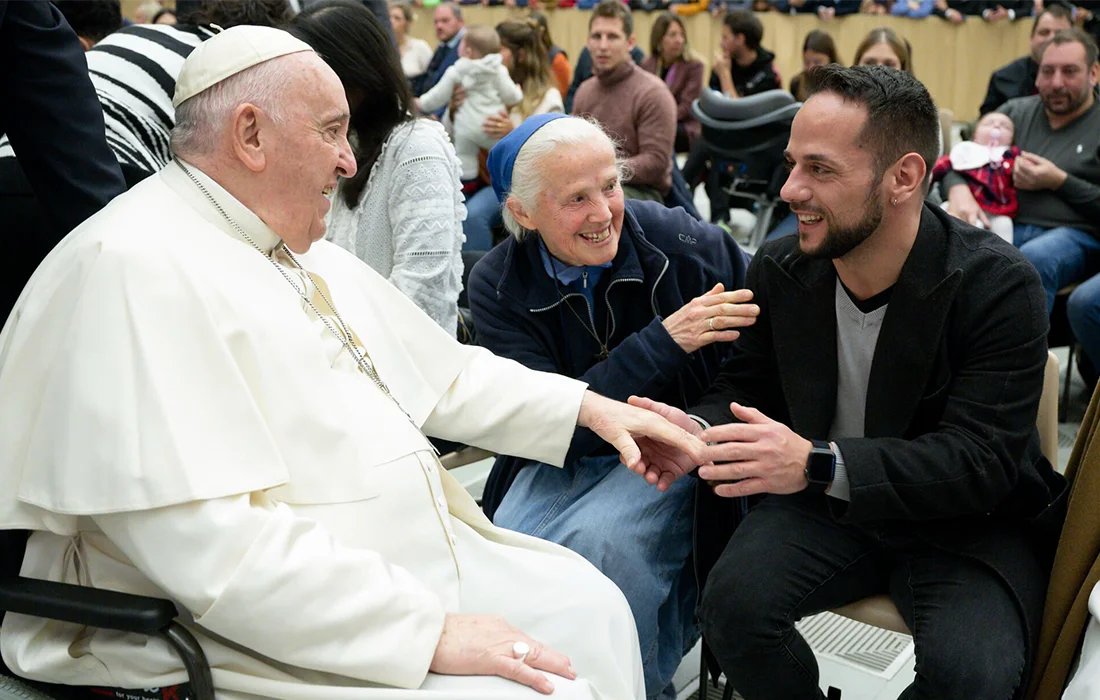
Imagine living in a perfect, pre-defined box, one that shines from the outside but confines you internally. This is how it was for Tiziano Fani Braga, known as @artr.ome: a graphic designer, a master of typography, yet trapped between professional success and the pressure of a conservative environment. Burnout, hiding, and a marriagein which he couldn’t express his identity, defined his life.
The lockdown became a turning point for Tiziano. While many experienced the pandemic as a boring time on the couch, for him, this isolation stripped away every mask. Confined within his own four walls, he could no longer suppress who he truly was. He decided to be honest with himself. He came out to his parents and his wife. This meant losing his old community and ending the marriage. However, it was the first step towards freedom.
Recognizing a toxic environment and spiritual abuse is challenging. Today, Tiziano openly talks about spiritual abuse—a manipulation that people often experience in religious circles. He describes the illusion of a “gilded cage” that is difficult to escape. Tiziano wants to break down this cage and show that faith should never be toxic.
When pop culture meets theology: lessons from Sex Education. Many people think that theological texts are only for older generations. Tiziano refutes this. He explains his spiritual perspective using Eric from the Netflix series Sex Education. Like Eric, Tiziano experienced a conflict. It was the conflict between the religious beliefs of his family and his own joyful identity. Tiziano quotes the scene where God tells Eric: “I have made you radiant, so that others may see in the darkness.” The message: a queer identity is not a burden. It is a God-given strength to bring light to dark and prejudiced areas.
Today, Tiziano coordinates the Mosaiko Cristiani LGBT+ group in Rome and created Young Oikos, a safe space for young queer Christians. In 2025, he organized a historic pilgrimage of LGBTQ+ believers to Rome, passing through the Holy Door and openly reciting the Creed. Tiziano has transformed from someone hidden to a role model at the Vatican.
Interview with Tiziano Fani Braga
1. About Design and Life:
As a graphic designer, you have created order for years through strict geometric shapes and hexagonal grids. How much has this analytical and creative mindset helped you to “redesign” your life and deconstruct the rigid rules of church tradition?
Imagine a life designed on a millimeter-perfect grid – outward perfection with a hidden system error: the impossibility of being yourself. That was my reality as @artr.ome. A graphic designer, trapped in the “golden cage.”
For years, I built perfect geometric cages while my life was drowning in a facade marriage and silence. Then I realized that God does not live in rigidity, but in freedom. That is my revolution.
My broken grid: How I redrew my faith outside the closet
The boxing world was my “golden cage”: a conservative environment, ten years of marriage, a secret belief. On the outside, perfection; on the inside, a hidden identity.
The burnout of perfection
The world saw me as a successful professional and a devout man. But I was suffering from emotional burnout. The attempt to fulfill the expectations of a church that wanted to make me invisible was a torment. Society also preferred to see me “in order.” This gnawed at me internally. For ten years, I played a role. I told myself that my sexual orientation was a system error. I saw it as a pixel in the wrong place in a file that had to remain clean.
But then I realized something fundamental: God is not a rigid architect who forces you into a predetermined mold. God doesn’t want you to live in the closet.
Deconstructing Tradition
Here, my analytical and creative mindset saved me. I began to treat my life like a graphic design project. If a layout doesn’t work, you can’t just add more elements and hope it gets better: you have to have the courage to delete everything and start over on a blank canvas.
I took the rigid rules of the church tradition that had bound me and broke them down. I dismantled prejudices like unnecessary Photoshop layers. I discovered that I could rediscover my “broken calling.” This was only possible if I was honest. My coming out was not a farewell to faith. It was my true entry into it. I understood that I could be gay and a man of God. These two realities do not exclude each other.
Becoming a Game Changer
Today, I create more than just letters. I am creating new paths for those who, like me, felt out of place between church pews. LGBTQ+ pilgrimages, open reports on Gionata.org or La Repubblica: this is my new form of design – creating a space where acceptance is the norm.
I have destroyed the hexagon. Today I know: spirituality does not need closed angles, but open spaces. For years, I sought order through geometry. Now I know: only the order of the heart matters. I am no longer a prisoner of a grid. I am finally the author of my own story. The layout has never been so vibrant.
2. The turning point during the lockdown:
The pandemic forced you into an extreme confrontation with yourself, leading to your coming out and the end of your marriage. What was the exact moment, or the specific thought, within those four walls, when you said to yourself: “This is enough, I can no longer pretend to be someone else?”
The silence of those four walls during the lockdown was like a scanner for my life. Nothing distracted me anymore: no work, no pastoral duties, no social excuses. The hum of my dissatisfaction was now clearly audible. I was standing still. I saw myself – an image that no longer fit me.
The moment the glass cracked was on a normal afternoon. I saw the light on the walls of our house. I looked at my wife and realized: she was no longer my companion. She was a mirror of a promise that I betrayed every day – especially to myself. The thought struck me: “I am robbing her of her life and God of the truth.”
In that emptiness, the question was no longer: “How do I go on?” But: “Who am I, if I no longer have to please anyone?” I realized: my ten-year marriage was my last major safety net. It was taking my breath away. The pandemic had lifted the veil. While the world was collapsing outside, I could no longer maintain a facade. Everything inside was already dusty.
I told myself clearly: “If I don’t come out of the closet now, I won’t leave it alive.” I wasn’t talking about the virus, but about my soul. I understood: God does not demand this sacrifice of pretense from me. I had confused the martyrdom of my identity with holiness.
I stopped trying to fix the file. I accepted that the project had failed. The only honest act of faith was to tear it all down and start over. Between the sofa and the desk, I said that “enough is enough,” which changed everything.
3. Spiritual Abuse and Red Flags:
You use strong metaphors like “waterboarding” and “golden cage” to describe the manipulation of conscience in some communities. What are some of the first red flags that young people should be aware of today, to recognize that they are in a toxic environment?
I speak of “abuse” because it is the only term that does justice to the systematic destruction of the self that I experienced. For years, within the Cammino, I did not experience a sudden, violent trauma, but rather psychological torture: a slow, methodical, and relentless dripping on my conscience, which session by session, eroded my critical thinking.
If I were to speak to a young person today who is confronted with such realities, I would say: Look beyond the music and the sense of community.
Red flags are not bright warning signs; they are whispers that sound like spiritual advice.
1. The delegation of one’s own capacity for discernment (the “father-ruler”).
The first red flag appears when your confessor or catechist stops being a companion and becomes the architect of your life. If you feel unable to make any decision – whether it’s a job change, a choice of studies, or a relationship – without their “okay,” then you are already in a trap. A healthy environment teaches you to go; a toxic one sells you crutches and then convinces you that you have no legs.
2. Guilt as fuel
Pay attention to how mistakes are handled. In the communities I have experienced, guilt was not a temporary state, but the normal state of being human. The “torture” consists precisely of making you feel permanently inadequate, as a “sinner” who must be grateful to the group for their salvation. If your faith is fueled by spiritual performance anxiety rather than peace, then leave. This is not humility, but submission.
3. Emotional isolation “for your own good”
Another significant red flag is the subtle sabotage of external relationships. You are told that those who do not belong to the “way” cannot understand you, that your parents or friends “from the outside world” are obstacles to your purity. In reality, only emptiness is created around you, so that you become dependent on the community. This is how the “golden cage” is created: the windows are locked, and you are convinced that there is only darkness outside.
4. The violation of the inner forum
If you feel compelled to reveal your sins or vulnerabilities to a group or laypersons who have no expertise in the matter – and often no obligation of confidentiality – then that is an abuse. Using your own story to control or publicly “correct” yourself is a form of manipulation of conscience and leaves deep scars.
For years, I confused this pressure with the will of God. But God is freedom, not a judge who checks whether you have conformed to a certain pattern. If you feel that, in order to be a “good Christian,” you must suppress your ability to say “no,” then you are not in a community: you are in a mechanism that grinds you down.
4. Theology and Pop Culture:
You have brilliantly used Eric from Sex Education to explain divine acceptance. Is there another character from a series, a film, or the current music scene who perfectly embodies your message of a “theology of light”?
When I saw in Eric from Sex Education the exact moment when faith stops being a burden and becomes a dance, today I am focusing on another character who embodies what I call a “theology of light”: a light that does not blind, but makes visible the true contours of who we are.
I am thinking of David Rose from Schitt’s Creek. This may sound strange when talking about spirituality, but David performs the miracle of transforming his extreme vulnerability and his emotional “residue” into an armor of authenticity. His famous metaphor about wine – “I like the wine, not the label” – is pure theology for me. It is the overcoming of dogma (the label) in favor of essence (the wine/the soul). David teaches us that God does not want us as an industrial mass production, but accepts us as unique vintages, with our sweet and sour notes.
The soundtrack of my life and my liberation: Elisa
If I had to give this process of deconstruction and rebirth an Italian voice, it would be Elisa. Her music is permeated by that search for white space that I pursue both in design and in spirit.
“Luce (Tramonti a nord est)”
This is my anthem for inner self-discovery. When she sings “Siamo nella stessa lacrima / Come un sole e una stella,” she perfectly describes this merging of the human and the divine, which only happens when we stop lying. The light that Elisa speaks of is not a static light; it is a light that moves, just like the faith that I rediscovered after the lockdown.
“Palla al centro”
This is where my entire turning point lies. “Cambiare tutto per non cambiare niente / O cambiare niente per cambiare tutto.” This is the exact description of my zero point: I had to destroy the architecture of my former life in order to save the only thing that really mattered – my center, my divine spark.
“Gli ostacoli del cuore”
In this song, I hear the struggle to overcome the “torture by drops” that we talked about. The obstacles are not outside, but the walls that we have built to protect ourselves. But at some point, you have to decide to “go and see” what lies behind the fear.
Cinema as a mirror: Everything Everywhere All At Once
If we are looking for a current cinematic reference, the Daniels’ film is the perfect parable for my theology. In a multiverse of possibilities and versions of ourselves who have “failed” according to the standards of the world – or the church – the ultimate message is: radical goodness.
Acceptance comes not when we become perfect, but when we, in the midst of chaos, of broken grids and hexagons, decide to embrace each other – and ourselves – exactly as we are. It is the victory of feeling over structure.
This is my theology of light: not spotlights that judge you from above, but a lamp that you carry in your hand as you navigate your own mess, and discover that God is smiling right there in that mess.
5. Youth and Young Oikos:
You consciously founded Young Oikos as a space for young people. When young people first enter your safe space, what uncertainty or what fear do they feel most strongly?
When young people first enter Young Oikos, they bring not only a backpack, but also the weight of many years in which they have tried to put together puzzle pieces that they have been told are wrong.
The greatest fear? It is the fear of divine rejection, reflected in the eyes of others. Many come with the dread that the “word,” once they show themselves as they are, will lead to judgment rather than tenderness. They fear that their identity is a “design flaw” that excludes them from the community.
The Oikos tool: a path to freedom
Oikos is a legacy that I took from my experience with the Neocatechumenal Way. Despite everything, I didn’t want to throw the baby out with the bathwater. The “house gathering,” the shared sitting around the word of God, so that it resonates in concrete life, is an incredibly powerful tool that I wanted to reinterpret.
Within the Way, Oikos sometimes ran the risk of becoming a court of conscience; in Mosaico, and especially in Young Oikos, we transformed it into a laboratory of authenticity.
The uncertainties of young people
In this protected space, I see two types of experiences that deeply touch me.
1. The uncertainty of the “survivor”
Young people who, like me, carry the marks of exclusion and suffering within them. Their fear is that acceptance is conditional. They look at me as if they want to ask: “Can I really be gay / trans / queer and be here, without a ‘but’?” Their uncertainty is a trauma from systematic abuse and can only be healed with patience and time.
2. Envy for freedom
Then there are the younger ones, those whose naturalness I myself envy. They carry the uncertainty of people who live in a world that is changing, but is still permeated by condemnation. Their fear is that they will lose this newly gained freedom of identity as soon as they collide with the wall of tradition.
The mosaic of truth
When we sit in a circle, this uncertainty begins to dissolve the moment they understand that Oikos is not a rigid hexagon into which they must fit, but a small piece in a larger mosaic.
Her greatest fear is to be “too much” or “not enough.” My role as a coordinator is to show them that the word of God is not a control grid, but a mirror that finally reflects a complete picture. My greatest joy is to see a young person enter with their shoulders slumped under the weight of their secret, and after a few meetings, begin to speak about their life with their head held high, because they have understood that their identity is not an obstacle to faith, but precisely the place where God meets them.

iksHaus | KI-generiert nach redaktioneller Konzeption, 2026

iksHaus | KI-generiert nach redaktioneller Konzeption, 2026

iksHaus | KI-generiert nach redaktioneller Konzeption, 2026

iksHaus | KI-generiert nach redaktioneller Konzeption, 2026

iksHaus | KI-generiert nach redaktioneller Konzeption, 2026

iksHaus | KI-generiert nach redaktioneller Konzeption, 2026
6. Vatican politics and double standards:
You have openly criticized the Vatican for trying to “please both sides” by opening up blessings, but at the same time condemning gender identity in documents like Dignitas Infinita. Do you believe that a real doctrinal change is possible soon, or are we fighting windmills?
More than just a criticism of the Church – which is my home, my family, and the place where I breathe – it is a painful observation of those massive structures that seem to hinder every attempt at a “church in progress.” Sometimes I get the impression that certain apparatuses move so slowly, while the world runs and people suffer who cannot keep up with the spirit of the times.
When I read documents like “Dignitas Infinita,” my heart is torn. As I wrote in my blog, I receive this text “at least in part” with gratitude: That the innate dignity of every person is affirmed “under all circumstances” is significant. That the Church officially condemns violence, torture, and even imprisonment based on sexual orientation is a major step forward that we should not downplay. It is a ray of light.
And it is here that I simultaneously feel the weight of the structure. There is this attempt to “give something to both sides”: on the one hand, there is an openness to protecting life and dignity, but on the other hand, there is a firm closing off regarding the issue of gender identity, which is described as a danger of “self-determination that separates itself from God.” In this closing off, I see the fear of losing control over patterns that have existed for millennia, and the forgetting that the human being is a constantly evolving mystery, and that identity is not a decision against God, but often the most authentic way to inhabit one’s creation.
Do I believe that a doctrinal change is possible? Yes, but not quickly. We are not fighting windmills, but we are sowing on ground that needs time. Doctrine is not an archaeological exhibit under glass; it is a living body. But for this body to move, we must free it from bureaucratic and ideological burdens that paralyze it.
I am not seeking a revolution that destroys, but a synodality that truly listens. Therefore, I look to those who have the responsibility to lead us – with hope, but also with the clarity of a person who can no longer silently wait.
I look at Leo with cautious, but sincere support. However, I clearly tell him and the entire hierarchy: do not stop halfway. I call for synodal steps that do not remain mere words on paper, but become concrete gestures of inclusion. The Church must stop being a customs office that checks identity documents, and become a home again, where every child can finally feel at home with their story and their gender.
7. Staying the course:
After the trauma of exclusion, you could have easily stopped engaging with the Church. Instead, you chose to remain, as a younger brother, following in the footsteps of Charles de Foucauld. What gave you the strength to stay and fight from within?
First and foremost, it’s important to clarify something that is central to my decision: I have not taken any vows. My path is completely secular. This is not a technical distinction, but a vital answer for the church of today. It means living the faith not protected by a structure or a garment that separates, but fully immersed in the world, in its contradictions, its cafes, its offices – in a language that is open, free, and unconstrained.
After the trauma of exclusion, the simplest, and perhaps even the most logical solution for my mental health would have been to leave the church. Why did I stay anyway?
The Nazareth of the Heart
For me, the strength came from encountering Charles de Foucauld. His spirituality resonated with me because he didn’t talk about grand cathedrals, but about the “Nazareth of the Heart.” For me, it means following his path as a Little Brother of the Hospitallers and living an effective invisibility. Foucauld didn’t want to convert people through speeches; he wanted to “shout the Gospel through life” by living alongside the marginalized as a universal brother.
In this Nazareth, I understood that I could “surrender,” as an instrument in God’s hands, without denying myself. As I have often written, we must have the courage to say: “Let us surrender, we are instruments.” This surrender is not a weakness; it means allowing God to work through us, even if the line of our lives seems shaky and uncertain.
The Church: an imperfect mother
Many ask me: “Tiziano, why do you stay? There are more modern, less demanding paths where you would be accepted without having to fight.” The truth is: I am a person with a restless heart, and my faith is no different. It consists of burning questions and open wounds. But it is also a faith with roots, like a tree that sinks its roots deep into the earth that nourishes it.
For me, the church is a mother. And like any mother, she can be fragile, make mistakes, and even cause pain. But one doesn’t disown a mother in her difficult times. Augustine said that the church is holy, even though it is made up of sinners; I, who received baptism in this church, feel like a living part of this body. Even if this body suffers. Even if this body inflicts pain.
Staying to love better
I stay not because it would be easy – because believe me, it is anything but. I stay because it is my home, my family. If necessary, I will fight alongside her, but never against her. I do not fight against my brothers and sisters, but against what wounds them from within and prevents them from being what they should be: a welcoming embrace for all.
I stay because I believe that the beauty of the mosaic also depends on my small stone “outside the pattern.” I stay because true love is not the kind that leaves when things get difficult, but the kind that stays to help one’s family, to heal, and to rediscover the deep meaning of acceptance.
8. The 2025 Jubilee:
You led the major pilgrimage of the “Rainbow Christians” and openly spoke about homosexuality in a sacred space. What feelings did you experience at that very moment, when you recited the creed in a place where you had previously felt rejected?
Reciting the Creed at that moment, while passing through the Holy Door, was like closing a circle that had been broken for years. At that very moment, what I felt was not defiance, but a deep and moving sense of belonging.
For me, identity is sacred. If we truly believe that the Lord makes everything good and perfect, then we must also have the courage to believe that we are too, just as we were born. We are created in his image and likeness: wonderful creations, each with its unique nuance. Bringing the “Pilgrimage of Dignity” to the heart of the Jubilee was an act of reclaiming that truth.
As the words of the creed echoed through the halls of St. Peter’s, I felt a new strength. Speaking in that very place, where I had previously felt rejected or “flawed,” transformed that prayer into a manifesto of liberation. I no longer recited formulas to please a structure or to hide; I professed my faith through my identity, not in spite of it.
Crossing that threshold was like telling ourselves and the world that we are not guests in the house of God, but children. We left behind shame, guilt, and the insidious torture of judgment, and finally entered the fullness of our own light. Feeling the warmth of so many brothers and sisters who, like me, had experienced the coldness of exclusion, made that moment an experience of collective resurrection.
It was the vibration of a person who no longer has to ask for permission to exist. We brought our colors, our stories, and our wounds exactly there, to the altar, knowing that each of our nuances is a reflection of the glory of God. In that moment, the Holy Door was not just an architectural passage, but the affirmation that our dignity is infinite – it always has been .
9. The fear of the time after Francis:
You have emphasized that such a large church cannot be changed by “just one Pope,” and that there is real fear about the future. How are you preparing your community for the possibility that conservative forces might push you back?
The fear of the future is human, but as I wrote in the days of *Extra Omnes*, the Church is not a company that changes direction with a new CEO: it is a living body, moved by the Spirit.
We must be honest: Francis has not implemented radical changes in the actual content of the teachings. His true miracle was something else: he changed the form, revolutionized communication, and opened a lasting dialogue that was previously unthinkable. He broke down the walls of language to speak with us, as a father would. We hope and pray that this style continues under Leo, because once you have learned to look each other in the eye and talk to each other, it is difficult to return to dogmas imposed from above.
In this transitional moment, some feel a kind of “freeze,” as if everything is still and waiting. But I say: we are not going back. We cannot go back, because the groups are now self-sustaining, by the grace of God. The reality of “rainbow Christians” is no longer an experiment; it is a people.
Our preparation for possible conservative counter-currents consists not of barricades, but of presence. Prayer vigils to overcome homophobia, transphobia, and biphobia will continue to be organized throughout Italy, supported by numerous bishops and cardinals who have understood that acceptance is not a political opinion, but an evangelical mandate. Our pastoral work continues with strength, because we feel that the Lord blesses every step.
My invitation to the community is: “to allow the spirit to be chosen,” without fear. We must not fear course corrections at the top, because we ourselves are the Church. We are the ones who, in the peripheries, in small “oikos” groups, and in parishes, continue to weave the thread of dialogue. As long as we testify that our identity and our faith go hand in hand, no current will be able to extinguish the light that we have lit. We are the Church, and the Church does not stand still.
10. The message in a bottle:
If you could travel through time today and stand before the younger Tiziano, who is desperately trying to conceal his true identity – what sentence would you say to him to reassure him?[/i3]]
If I could go back, I would cross the threshold of that room where the younger Tiziano desperately tries to reconcile his faith and his heart, suffocating between rulers, hexagonal grids, and whispered prayers, fearing discovery. I would sit next to him, take his hands to stop that trembling of fear, and look him directly in the eyes with all the tenderness I have learned to show myself, and say a single, powerful sentence:
“Tiziano, stop trying to correct God’s design: Your identity is not a manufacturing defect, but his most authentic masterpiece.”
I would explain to him that all this pain, this feeling of inadequacy that consumes him, and this constant self-talk that he is “wrong”, is nothing more than human constructs, dust that the wind of truth will blow away. I would tell him not to be afraid of the emptiness he feels when he thinks about leaving his “golden cage,” because it is in that very emptiness that he will find the space needed to redesign a vast, luminous, and finally complete life.
I would whisper to him that he does not have to choose between being a man of faith and a man who loves, because that is how the Lord dreamed of him: with this sensitivity, with this ability to see beauty in nuances, and with this restless heart that will be his compass. I would tell him to have faith, because this “perfect marriage” and these “strict rules” that are crushing him today will tomorrow only be the starting point for a greater mission: to be a voice for those who have none, and to witness a church that can finally embrace each of its children.
And in the end, I would tell him:
“Do not be afraid of the darkness of the closet, because the light you carry within you is not only meant to illuminate your own life, but also the lives of thousands of other people who – just like you – are only waiting for someone to tell them that they are wonderful creations. Breathe, Tiziano. You are already saved, already loved, already whole.” To resume the application.