The ecological and technological anxieties of the second half of the 2020s are inextricably linked to a broader economic uncertainty.
Inflation, rising housing costs, expensive food, and the limited predictability of one’s own future have shaken traditional notions of a stable middle-class life. For many members of Generation Z and the Millennials, those goals that were once considered natural steps in becoming an adult are increasingly becoming unattainable.
Owning an apartment or a house.
Financial security before starting a family.
Regular vacation trips.
An income that is sufficient not only for survival, but also for building a future.
This development is particularly evident in the US housing market. According to the National Association of Realtors, the proportion of first-time homebuyers fell to a historic low of 21 percent in 2025. The median age of these buyers increased to 40 years. In 1991, it was 28 years. The data refer to buyers of primary residences in the United States and cannot be directly transferred to Europe. However, they show how much access to homeownership has shifted within a generation.
Other classic life stages are also shifting. The estimated median age for the first marriage in the United States was 30.8 years for men and 28.4 years for women in 2025. At the same time, birth rates are increasing for women between 35 and 44 years old, while they are declining in younger age groups. Economic uncertainty is not the only cause of this development, but it is one of the conditions under which decisions about housing, partnership, and parenthood are made.
These major milestones are not disappearing completely.
However, they are moving further into the future.
In their place, smaller units of progress are emerging, which are sometimes referred to as milestones: the end of a difficult work week, a replied email, a month successfully completed, or a day when one’s energy was sufficient for more than the absolute necessities.
This shift gives rise to two seemingly contradictory cultural reactions.
Treatonomics seeks short-term relief in small, affordable pleasures.
Solarpunk seeks a future in which joy, community, and ecological responsibility are no longer separated.
Treatonomics: The Economics of Small Rewards

iksHaus | KI-generiert nach redaktioneller Konzeption, 2026
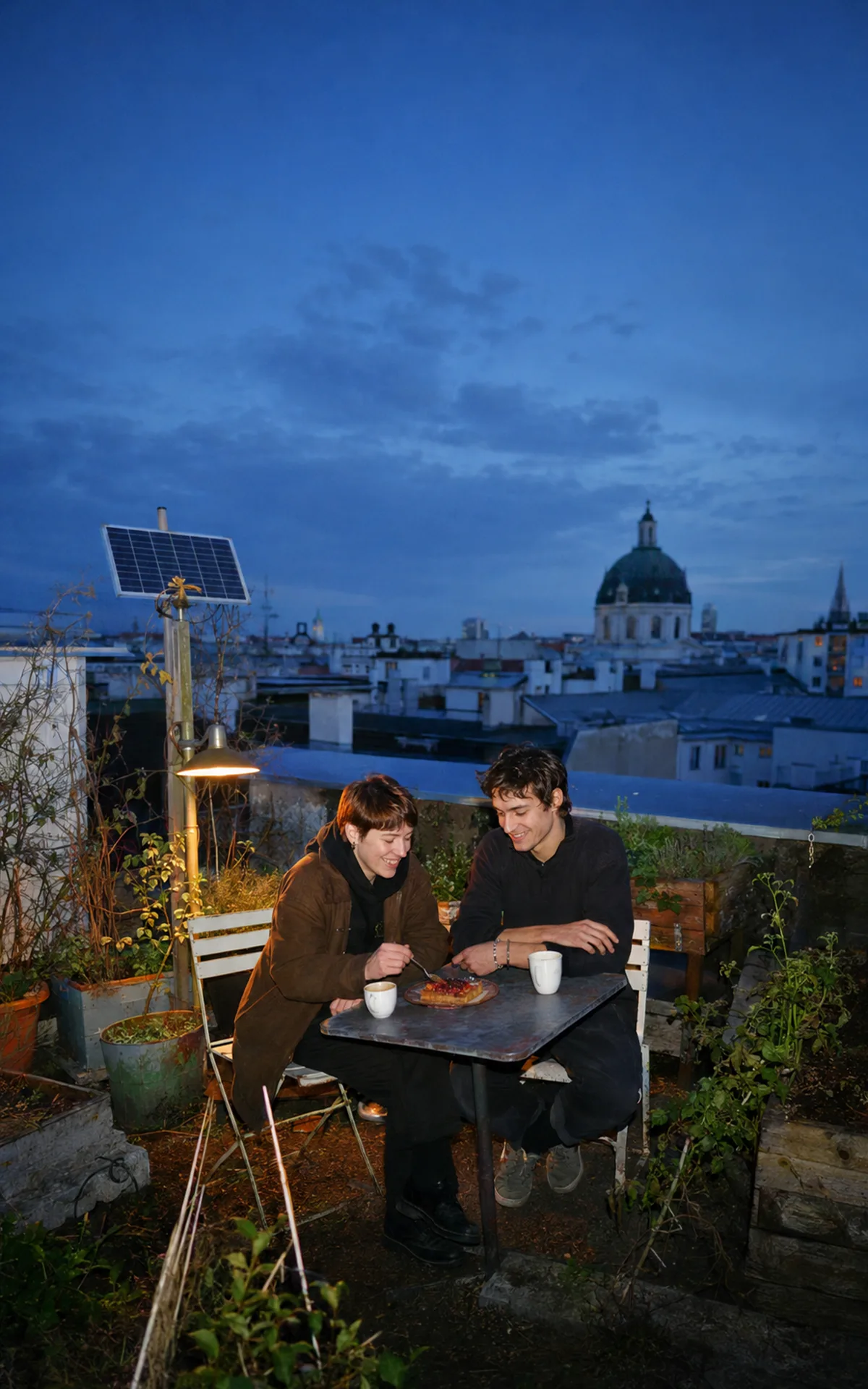
Treatonomics, also known as “Little Treat Culture,” describes the growing importance of small, affordable rewards in times of financial stress.
A special coffee.
A high-quality snack.
A scented candle.
A small cosmetic product.
An unusual accessory.
A limited edition figure or object for one’s hobby.
These purchases are financially much smaller than buying a trip, a car, or a property. Psychologically, however, they serve an important purpose.
They create a brief moment of self-determination.
A person who has little influence on rents, inflation, or the job market can at least decide what the afternoon will look like.
This phenomenon is reminiscent of the so-called lipstick effect. In economically difficult times, consumers forego major luxury purchases, but continue to buy smaller products that convey enjoyment, status, or self-care.
Treatonomics is the contemporary and more personalized version of this pattern. The small luxury is not only consumed; it is documented, aestheticized, and portrayed on social media as a ritual of survival.
The phrase “I deserve a little treat” refers to more than just a purchase.
It explains the expenditure as an emotional repair.
What the Treatonomics data actually shows
A SurveyMonkey study from February 2026 surveyed 2,038 adult US citizens. The participants came from a non-probabilistic online panel, and the data was subsequently adjusted to demographic characteristics of the US population. The results describe a large consumer survey, but not a universal psychological law.
Key findings:
| Behavior | Percentage |
|---|---|
| At least one small treat per month | 62 % |
| Small treats daily or weekly | 43 % |
| Spending of no more than $25 per purchase | 52 % |
| Willingness to incur short-term debt for enjoyment | 36 % |
| Food and beverages as the most important category | 65 % |
| Products for home and hobbies | 37 % |
Generation Z spent more frequently than older groups between $10 and $25 per treat. Older generations, on the other hand, were more likely to be willing to spend more than $50 on a single purchase.
Significant differences were observed between generations in terms of motivations. 44 percent of respondents from Generation Z and Millennials used small treats to motivate themselves towards larger goals. 39 percent used them to emotionally process a stressful day or bad news.
The small reward becomes a psychological technique.
It structures time.
It marks an end.
It says: This week was difficult, but it is over.
Such a purchase can actually bring joy. It can interrupt a tiring day and give people the feeling that they are not completely controlled by external circumstances.
The problem with “treatonomics” is not caused by a single coffee or snack.
The risk begins where consumption becomes the most important or only form of emotional regulation.
When self-care becomes a debt trap
The same study shows the financial ambivalence of the trend.
Frequent buyers reported almost twice as often as occasional buyers that small rewards negatively impacted their long-term financial goals. In addition, the report referred to data indicating that 36 percent were willing to incur short-term debt to finance expenses for things that brought them joy.
A single amount of $10 or $20 seems harmless.
However, if it is spent several times a week, it can add up to a significant monthly amount. Credit cards and “buy now, pay later” services further postpone the point at which the actual financial burden is perceived.
Here, a contradiction arises.
The small pleasure is intended to reduce the feeling of economic powerlessness.
If it is financed by debt, it can reinforce precisely that insecurity against which it was originally intended to be used.
The corporate sector has long recognized this emotional function.
Food, beverages, cosmetics, and retail products are no longer sold solely based on their practical quality. They are positioned as small interventions against exhaustion, stress, and bad news.
The product does not only promise taste or beauty.
It promises to psychologically “repair” the day.
In this way, joy becomes a market segment.
From Milestones to Centimeter Steps
The popularity of small pleasures cannot simply be explained as a lack of financial discipline in a younger generation.
Those who assume that a $6 specialty coffee is the reason why young people cannot afford to buy homes are confusing individual consumption choices with structural price developments.
Giving up small pleasures does not automatically create affordable housing, higher real wages, or secure employment.
Instead, Treatonomics makes it clear how the relationship to the future has changed.
When long-term goals seem almost unattainable, the constant postponement loses its psychological appeal.
Why should a person avoid every small expense for decades if even strict frugality offers no realistic prospect of owning a home or having a stable life plan?
The traditional milestones are giving way to inchstones.
Not the wedding, but the first difficult conversation that a relationship has overcome.
Not owning a home, but the first corner of a rented apartment that truly feels like home.
Not a grand trip, but a free afternoon.
This shift can feel resigned.
However, it can also express a new appreciation for small, real experiences.
The crucial question is whether these experiences must be bought.
Solarpunk: Hope as a Political Practice
iksHaus | KI-generiert nach redaktioneller Konzeption, 2026
The search for hope does not end with consumption.
It also leads to cultural movements that try not only to depict a livable future, but also to practically prepare it.
One of these movements is Solarpunk.
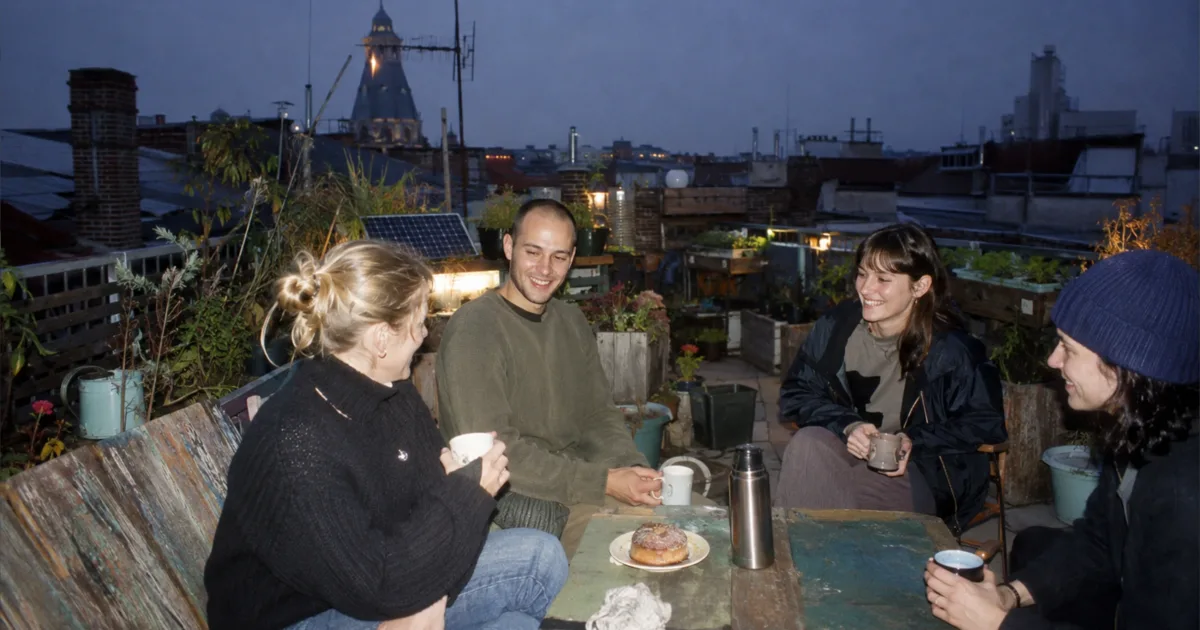
Solarpunk is simultaneously a literary genre, a visual aesthetic, a political vision, and a decentralized practice. The movement emerged in the 2010s and envisions ecological, inclusive, and community-organized futures. Technology is not fundamentally rejected, but should be renewable, repairable, and integrated into social and natural systems.
The word combines two distinct forces.
Solar represents renewable energy, life, and a future beyond fossil fuel dependence.
Punk stands for resistance against economic and political systems that view environmental destruction as an inevitable price of progress.
Therefore, solarpunk is not simply a city with green skyscrapers.
It questions who owns technology.
Who can repair it.
What resources it requires.
How decisions are made.
And whether a green future is also socially just.
A completely automated luxury city that relies on resource extraction and poorly paid labor would not automatically be solarpunk, just because plants grow on its facades.
The movement combines ecology with local self-determination, community-based provision, a circular economy, accessibility, and the right to a future that is not solely based on sacrifice.
Whimsy: The Return of Intentional Play
In the digital culture of 2026, a related need is evident in the so-called “whimsy” trend.
Whimsy describes the conscious integration of playful, unusual, and seemingly irrational elements into clothing, decor, and everyday rituals.
Asymmetrical shapes.
Vibrant colors.
Handmade accessories.
Objects that do not increase productivity but create joy.
The trend is interpreted as a counter-movement to strict minimalism, doomscrolling, and the constant optimization of one’s body and life. On TikTok, the hashtags whimsy and whimsical were used in hundreds of thousands of posts until the spring of 2026. The media describes this development as a form of intentional optimism and playful escapism.
Whimsy and solarpunk are not the same thing.
Whimsy can be completely commercialized and limited to the sale of decorative products.
Solarpunk has a stronger political and ecological dimension.
Despite this, both phenomena overlap at a central point:
They refuse to accept cynicism as the only credible response to a crisis.
Joy is not understood as proof of political naivety.
It becomes a resource.
A person who laughs, plays, creates, and builds relationships does not automatically ignore the crisis.
It can protect those emotional abilities that are necessary for long-term action.
This is the basis of what can be called joyful resistance.
The difference between purchased and created joy
Treatonomics and Solarpunk react to the same underlying sentiment.
Both emerge in a world where people feel they can hardly influence large systems.
However, their responses differ.
Treatonomics says:
Buy yourself a small moment that you can control.
Solarpunk says:
Create together conditions under which more people can experience joy, security, and a future.
The first approach is immediately available.
The second requires time, relationships, and material work.
Both can coexist.
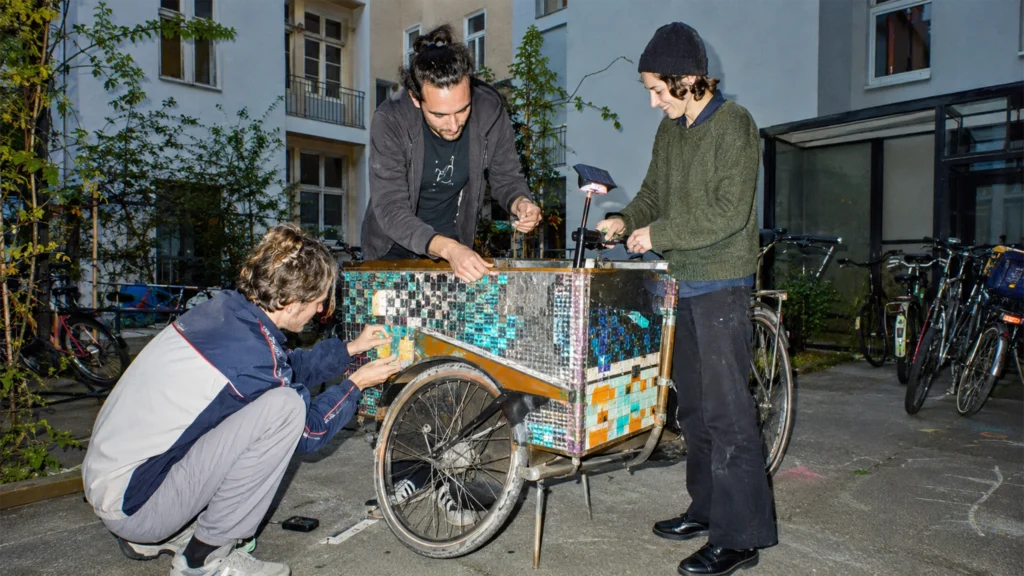
A cup of coffee can brighten a difficult day. However, repairing a bicycle, a community garden, or a swap meet can further change one’s relationship with the surrounding environment.
The difference lies not only between consumption and abstinence.
It lies between joy as a product and as a social practice.
Vienna and the planned neighborhood waste collection point
iksHaus | KI-generiert nach redaktioneller Konzeption, 2026
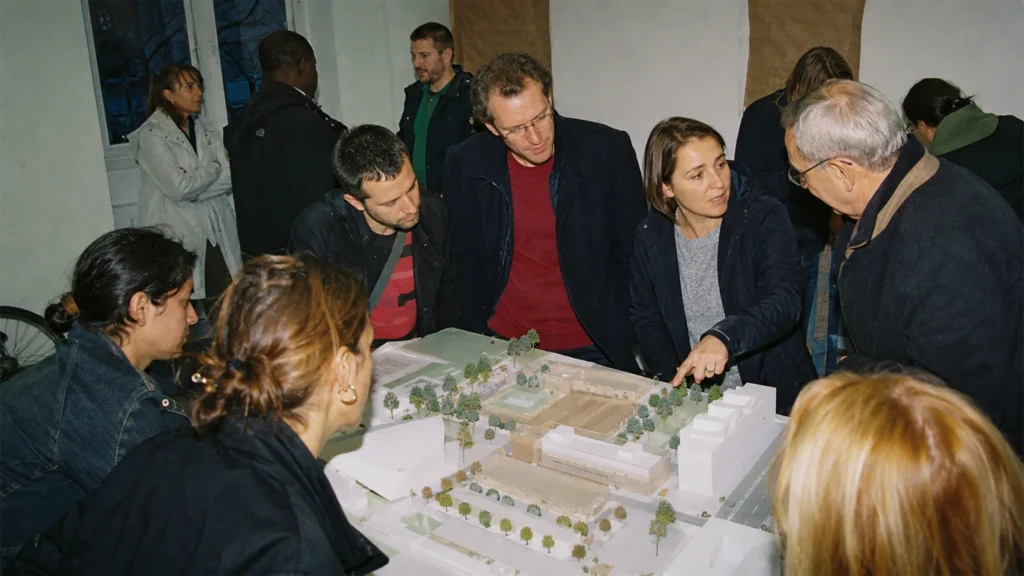
A concrete example in Vienna of the connection between the circular economy and neighborhood is the planned waste collection point on Innstraße.
It is important to note the current status: As of July 2026, the location is not yet a completed neighborhood hub. The city is in the planning and participation phase. In January 2026, public events were held to collect questions, wishes, and suggestions.
The planned location is intended to primarily serve the residents of Leopoldstadt and Brigittenau.
The concept goes beyond a classic waste collection point. The plans include multifunctional areas for repair cafes, swap meets, and upcycling workshops. The plans also include access for pedestrians and cargo bikes, photovoltaic panels, green spaces, recycled building materials, and rainwater management.
This is precisely where the solarpunk quality of the project lies.
Waste is not only viewed as a material that must be removed from the city as efficiently as possible.
The place should also enable knowledge sharing, exchange, and repairs.
A broken device can thus become the starting point of a conversation.
A discarded item can return to the material cycle.
A municipal infrastructure can also be a social space.
Whether the final project actually realizes this potential depends on the concrete implementation.
The concept shows how urban waste policy can evolve from invisible disposal to a visible culture of reuse.
Upcycling as a Viennese micro-economy
iksHaus | KI-generiert nach redaktioneller Konzeption, 2026
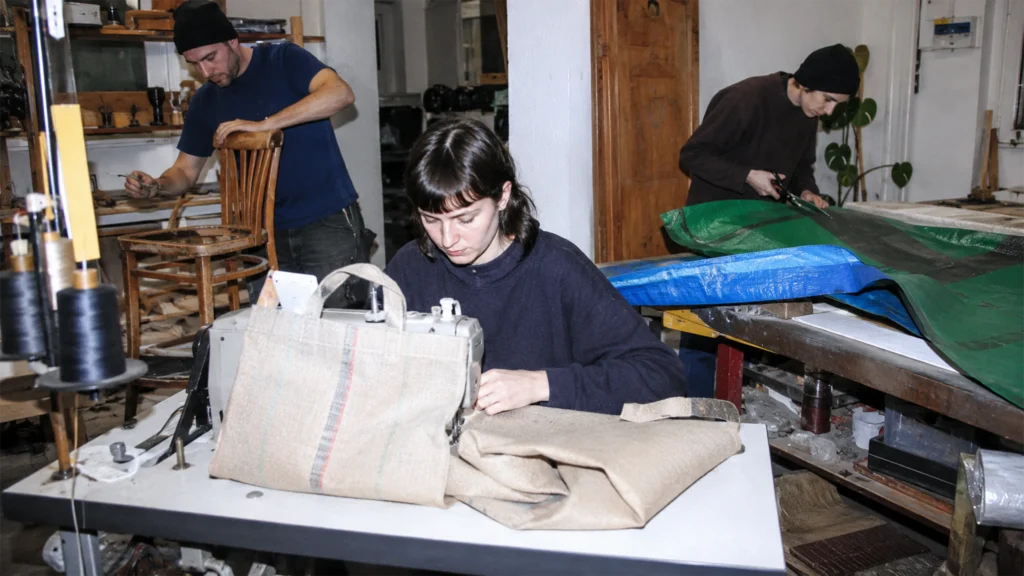
In Vienna, there is already a diverse scene that transforms waste materials into new products and into local economic cycles.
Refished repurposes discarded fish feed and cement sacks into bags and backpacks. Some collections also incorporate former museum flags. Kellerwerk restores and modifies older furniture instead of replacing it with new items. Garbagen transforms industrial waste into bags, books into seating, and discarded escalator parts into sofas. The company combines upcycling with vocational training and social employment.
Such projects alone cannot solve the global resource crisis.
Their significance also lies on a different level.
They change the cultural perception of materials.
A used cement bag is not automatically considered waste.
An old armchair is not necessarily at the end of its life.
A technical component can acquire a new function.
Upcycling requires attention.
Materials must be cleaned, inspected, disassembled, combined, and reinterpreted.
This work stands in direct contrast to a consumer culture in which products are purchased, used, and replaced as quickly as possible.
It also creates local skills.
Sewing.
Repairing.
Upholstering.
Screwing.
Composting.
Gardening.
Mending clothes.
These skills not only reduce resource consumption. They can strengthen the feeling that one is not completely at the mercy of the material world.
Repair as an emotional counter-movement
The connection between ecological practices and psychological resilience is often underestimated.
Climate crises create a feeling that the problems are too large and too complex for individual action.
Repair offers a different experience.
An object is damaged.
The damage is visible.
A person can examine it.
They can use materials, tools, and knowledge.
In the end, something either works again or receives a new form.
This process does not solve the climate crisis.
However, it establishes a relationship between action and result.
This relationship is often lacking in the experience of the polycrisis.
Guerrilla gardens, balcony composting, clothing swaps, and community workshops also have a psychological dimension for this reason.
They bring people into direct contact with the soil, the materials, the neighbors, and the consequences of their actions.
Abstract worry transforms into limited, but real, effectiveness.
Radical eco-optimism does not mean denying the seriousness of the situation.
It means not treating hope solely as a feeling.
Hope becomes a practice.
Joy is not the opposite of seriousness
Joy is sometimes viewed with suspicion in political movements.
Someone who dances, plays music, or engages with beautiful things in the face of the climate crisis may not be taking the situation seriously enough.
This notion conflates constant stress with moral responsibility.
A nervous system cannot remain in a state of constant alert.
Movements require more than just outrage and fear. They need a sense of belonging, humor, relaxation, and the experience that the future can offer more than sacrifice and catastrophe.
Joy can be commercialized.
It can become a sales strategy.
It can temporarily distract from underlying structural problems.
However, it can also connect people and create the emotional foundation for long-term action.
Treatonomics demonstrates how strong the need for small joys has become.
Solarpunk poses the further question:
Could we develop systems in which joy does not constantly have to be purchased?
Places where people can repair, exchange, plant, learn, and celebrate connect ecological practices with social life.
They make sustainability not only a moral obligation.
They make it an experience.
From small rewards to a shared future
A specialty coffee will not solve the housing crisis.
A repaired bag will not transform the global textile industry.
A neighborhood garden will not stop climate change.
However, these observations do not render small actions meaningless.
The relevant question is what relationships and structures emerge from them.
Does the small joy remain an isolated transaction that must be repeated the next day?
Or will it become part of a culture where people care for materials, share knowledge, and collectively shape spaces?
Treatonomics is the understandable reaction of a generation seeking immediate emotional relief.
Solarpunk attempts to translate this joy from a private consumption moment into a collective practice for the future.
Perhaps the most radical idea is not the completely green city.
It is the idea that a more sustainable life does not necessarily have to be poorer, grayer, or stricter.
It can be colorful.
Playful.
Communal.
And full of small things that are valuable not because they were newly purchased, but because people have collectively given them meaning.