

Artificial intelligence is both the biggest energy problem of the digital age and the most reliable tool for dealing with ecological dilemmas in everyday life. This paradox is experienced daily by the younger generation in Austria, as they navigate news about the drought in Lower Austria, corporate promises of net-zero emissions, and a market in the 5th district where one might ask where a tomato comes from in the middle of winter.
Traditionally, AI has been portrayed as a threat to jobs, creativity, and intellectual property. Young people in Vienna see it differently. For them, AI is the infrastructure for survival in the flood of information. Sam Altman, CEO of OpenAI, confirmed at the Sequoia Capital AI Ascent Event (2025) what is already evident at the grassroots level. Older generations use AI as a search engine. Younger generations are building entire operating systems around themselves for decision-making.
Eco-anxiety as a public health issue
Climate anxiety is no longer a marginal phenomenon. According to a study by the Department of Clinical Psychology at the University of Vienna (2025), 39 percent of young people in Austria cite climate news as the primary stress factor in their daily lives. The WHO Europe (2024) has formally included climate anxiety in the diagnostic guidelines for European health systems, recognizing it as a condition that deserves systematic attention.
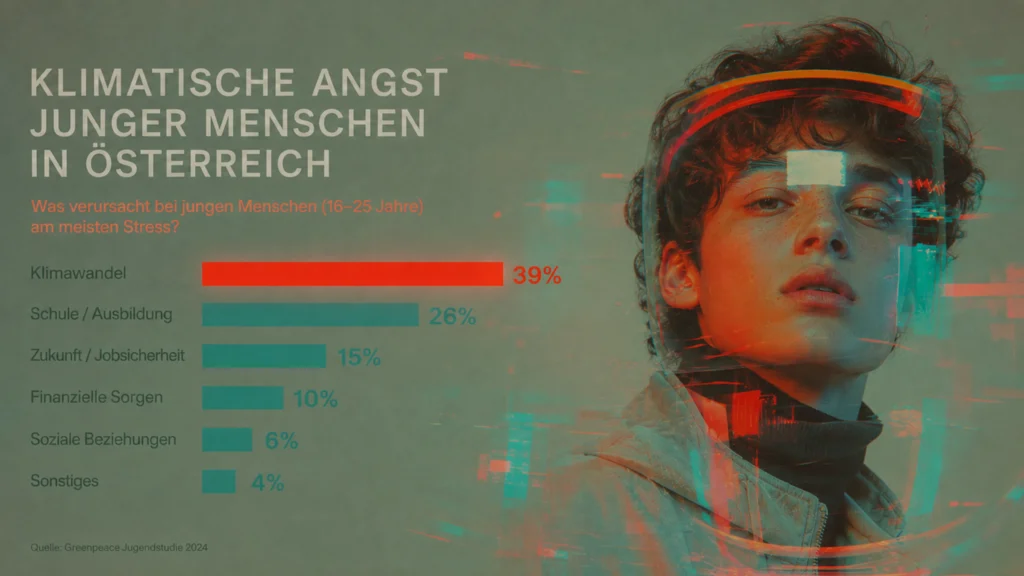
iks.haus | AI-generated based on editorial concept, 2026.
The symptoms are predictable: insomnia, a feeling of helplessness, and decision paralysis. Young people who care about the environment face an insurmountable task: staying informed in a world that produces catastrophic headlines every day, without being overwhelmed by them.
The conventional response from experts is to reduce news consumption. However, this means leaving the public space to those responsible for the damage. Young people are seeking a third way: filtering, not exclusion.
Personal Operating System for News
The term “Personal Operating System” (POS) is becoming common, often shortened to “my filter” in Viennese forums. These systems are not standalone apps. They are individually configurable applications built on existing AI tools like ChatGPT, Claude projects, and Perplexity Spaces, which users can customize according to their needs.
The function is simple and precise. The system filters news about climate disasters before they reach the user. The information is delivered with context, not sensationalism. Instead of the headline “Record Heatwave Paralyzes Europe,” the system provides a factual summary: context, data, potential actions, and a short-term forecast.

iks.haus | AI-generated based on editorial concept, 2026
The difference is psychological. The same information, but in a cognitively manageable dose. Young people stay informed and capable of action, without the paralyzing fear that the media industry systematically produces because it generates clicks. The algorithm, which was developed for platforms to exploit attention, is being turned against them.
AI as a Greenwashing Detector
The second level is even more specific. When a young person in Vienna orders sneakers, buys coffee, or decides where to invest their savings, AI acts as a micro-ethical co-pilot in the process. ESG metrics – the environmental, social, and governance indicators that were previously only accessible to fund analysts – are evaluated in milliseconds using AI integrations.
A practical example from Vienna. A young shopper on Mariahilfer Straße is considering two sneaker brands. She opens her customized AI system and asks a question. The system draws data from public sources: supply chains, reported emissions, disputes about working conditions, and reporting transparency. In one second, she receives a comparison that does not come from marketing campaigns, but from documents that the brands were required to disclose.
Greenwashing thus loses its most important protection. Time. Until recently, it took an hour of research to verify the claim of being “climate neutral.” Today, it takes as long as it takes to scan a QR code in the store. Brands that rely on customers not having time to check these claims are losing their advantage.
Initiatives such as the Climate Action Index from the NewClimate Institute and the ESG database from Eurostat provide open data that AI systems can automatically process. The younger generation in Austria effectively has a private ESG analyst in their pocket.
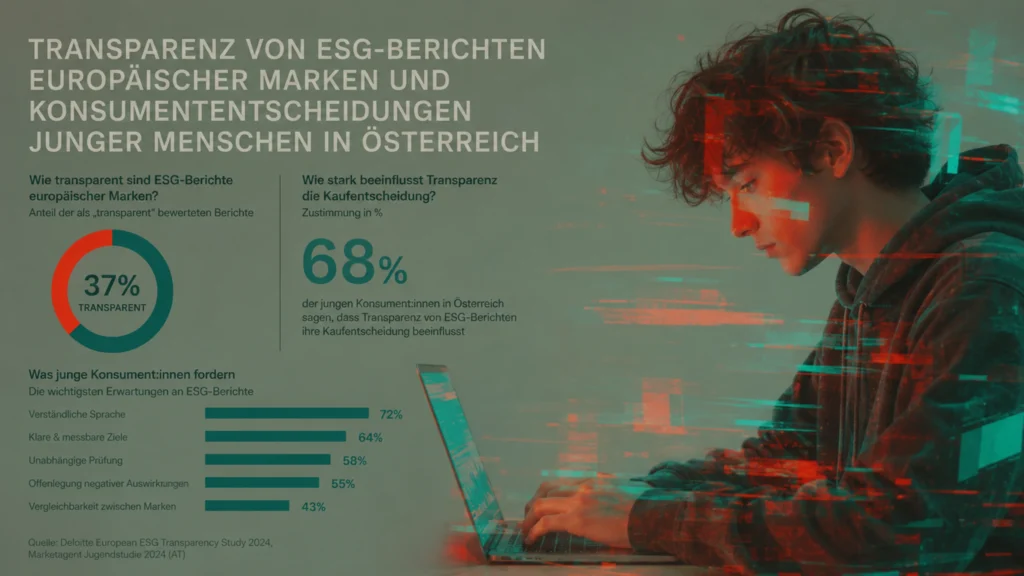
iks.haus | AI-generated based on editorial concept, 2026
Loss of trust, growing resistance
The paradox: The more young people use AI, the more critical they become. The figures from the Walton Family Foundation, GSV Ventures, and Gallup (2025) are clear.
The feeling of enthusiasm for AI technology decreased from 36 to 22 percent within a year. Hope decreased from 27 to 18 percent. At the same time, the feeling of anger increased from 22 to 31 percent. The positive net sentiment towards companies using AI decreased from +8 points (2024) to -11 points (2025). A drastic drop into the negative range.
The reason is not the technology itself. The reason lies in the way companies are using it. An EY study (2025) shows: Although 68 percent of employees use AI at work, only 35 percent have received formal training. This creates work environments without an ethical framework, without transparency, and without accountability.
Young people in Vienna do not reject AI. They reject AI that is used against them. The difference is political, not technological.
What this means for Vienna
Vienna’s political landscape is currently in a phase of discussion. The Vienna Business Agency is funding pilot projects for AI tools that promote sustainable consumption. The City of Vienna Open Data platform operates a portal for local businesses, providing structured ESG data. The University of Vienna is developing educational programs on digital ethics for higher education institutions.
However, the majority of the infrastructure for AI-driven sustainability initiatives is still being developed from the ground up. Young people are sharing their system configurations on Vienna-based Discord servers. Local climate activists are teaching communities how to use AI to detect greenwashing. Small eco-friendly brands are consciously publishing their ESG data in machine-readable formats to increase their visibility.
Vienna has all the necessary conditions to become the first European city where AI is systematically used to benefit the environment, rather than working against it. There is a dense network of public data sources, a young generation that understands the technology, and a political environment that is, in theory, open to innovation. What is lacking is the institutional decision to establish AI ethics as a public service, rather than as a private skill that individuals have taught themselves.
The younger generation in Austria is not waiting. They are already building their own filters. The question is whether the city will support them in this endeavor or leave it to those who have the programming skills.
FAQ
What is a Personal Operating System in the context of AI?
An individually configured system of existing AI tools like ChatGPT or Claude, which serves as a filter for climate news and consumer decisions.
How does AI detect greenwashing?
Through automated analysis of publicly available ESG data, supply chain reports, and climate protection indices such as that of the NewClimate Institute.
Why is the trust of young people in AI decreasing despite its increasing use?
Due to a lack of ethical standards in corporate practice. The positive attitude towards corporate use of AI decreased by 11 points between 2024 and 2025 (Gallup 2025).
What role does AI play in decision-making in everyday life?
AI serves as an infrastructure for survival in the flood of information and helps young people make informed decisions without being overwhelmed by climate news.
How do local initiatives support the use of AI for sustainable consumption?
Initiatives such as the climate protection index of the NewClimate Institute and the ESG database of Eurostat provide open data that AI systems can automatically process, effectively giving young people a personal ESG analyst in their pocket.