

Mariahilfer Gürtel 4. An address previously known as the location of Aids Hilfe Wien. In 2026, the same building will become the first Viennese “one-stop-shop” center for sexual health, the Magnus Ambulatorium for sexual health.
Under one roof: testing, therapy, prevention, and psychosocial support. Without months-long waiting times for a dermatology appointment. Without having to pay for PCR tests out-of-pocket. Without having to justify why you need PrEP.

iks.haus | AI-generated based on editorial concept, 2026
A coalition that rarely comes together
The project was announced on September 15, 2025, and the funding package was confirmed at the meeting of the Vienna Steering Committee on April 22, 2026. The state of Vienna and three major providers of statutory health insurance, ÖGK, SVS, and BVAEB, are funding the center until the end of 2028.
Around the table are Aids Hilfe Wien, the City of Vienna represented by Councilor Peter Hacker, and the insurance providers. The logic is straightforward: prevention is cheaper than chronic treatment, and the previously fragmented system lost patients between specialists.
Why the name Magnus?
The center is named after Dr. Magnus Hirschfeld, a German physician and the founder of modern sexology. In 1919, Hirschfeld founded the Institute for Sexual Research in Berlin, the world’s first scientific institution for sexual health and gender research, and developed the concept of “sexual intermediates,” the theoretical basis of today’s understanding of gender diversity. The Nazi regime destroyed the institute in 1933.
The Vienna Magnus center explicitly embraces this history. Hirschfeld’s statement “Nature knows no norm, only diversity” is embedded in the mission of the clinic. The asterisk in the name carries a specific queer meaning, a signal that the center is a safe space for all gender identities and orientations.

iks.haus | AI-generated based on editorial concept, 2026.
For the queer community, this is no small matter. Minority stress shows that the fear of judgment alone can reduce the frequency of preventative check-ups, even if the individual has not had negative experiences. A clinic that explicitly communicates that it is a safe space changes the equation.
Numbers that relieve hospitals
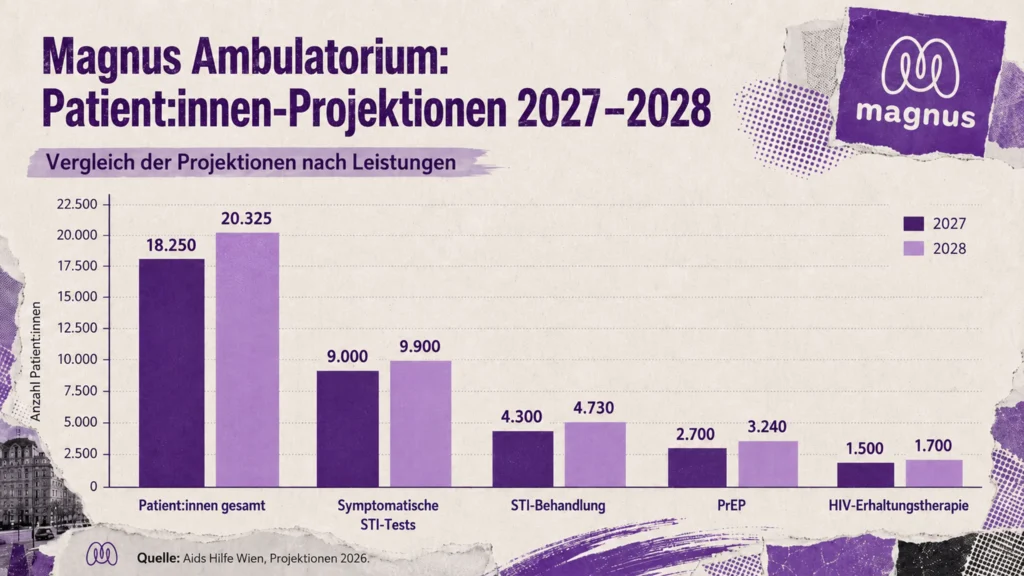
32,000 contacts per year. 18,000 individual patients in the first year of full operation, 20,325 by 2028 (Aids Hilfe Wien, projections 2026).
The distribution of services shows what truly drives the project. Symptomatic STI tests: approximately 9,000 tests per year in 2027. The treatment of STIs includes 4,300 interventions. PrEP usage increases from 2,700 to 3,240 users in one year – an increase of 20 percent. Antiretroviral therapy for HIV-positive patients increases from 1,500 to 1,700.
iks.haus | AI-generated based on editorial concept, 2026.
Behind the numbers lies a harsh public health logic. The AKH hospital, the Penzing clinic, and private dermatovenerologists have been overloaded for years. Hospital outpatient clinics for infectious diseases are expensive to operate and should be reserved for complex cases with comorbidities. Magnus takes on stable PrEP users and HIV-positive patients, thereby relieving critical hospital resources.
Opening Hours for Real People
Magnus is open 61 hours per week. Monday to Friday from 8 am to 7 pm, Saturday from 8 am to 2 pm. Closed on Sundays.
Saturday appointments are crucial for emergency interventions. Post-exposure prophylaxis (PEP) after potential HIV exposure has a time window of a maximum of 72 hours, ideally within the first 24. Without Saturday hours, the weekend turns this window into a race against time.
Anonymous Care for Those Outside the System
Most services are processed through the Austrian e-card. Expensive PCR tests for chlamydia and gonorrhea, which must be performed at three locations (throat, urethra, rectum), are no longer paid for by patients.
The most important aspect is different. The clinic guarantees free and, if necessary, anonymous care for people without health insurance, with a particular focus on patients with HIV.
This is not a humanitarian gesture; it is epidemiology. Untreated individuals outside the system are silent reservoirs of infection. Antiretroviral therapy leads to an undetectable viral load (U=U, Undetectable = Untransmittable), which makes further transmission biologically impossible. Caring for the uninsured protects all those with insurance.
The “Big 5” and Reference Status
The medical director is Dr. Alexander Zoufaly, an infectious disease specialist. The clinic is a reference center for PrEP and PEP, which means concentrating specific knowledge in one place. PrEP is not just about prescribing pills. Users undergo a check of kidney function every three months, an HIV test, and screening for other STIs. Errors in the protocol can lead to permanent viral resistance.

iks.haus | AI-generated based on editorial concept, 2026.
The “Big 5” are HIV, Hepatitis B and C, chlamydia, gonorrhea, and syphilis. The latter three are continuously increasing in urban areas of Europe. Gonorrhea is particularly problematic due to multi-resistant strains that are resistant to third-generation cephalosporins. Rapid diagnosis and treatment under one roof prevent the establishment of superbugs.
In addition to medical professionals, psychologists and social workers are also present on-site. A diagnosis like HIV can trigger fear, shame, and social isolation. A chronic illness can affect residency status, employment, and finances, which particularly affects migrants and young LGBTQ+ individuals who have been rejected by their families.
Big Data for Sexual Health
Magnus is also Vienna’s first statistical center of excellence for STIs. Epidemiological surveillance has suffered for years from inadequate and delayed data due to stigmatization and the fragmentation of outpatient practices.
The central data hub enables early cluster detection, resource optimization, and policy evaluation. Vienna’s public health is shifting from a reactive to a proactive mode.
What this means for people in Vienna
In short: Anyone who needs an STI test, acute PEP therapy, PrEP counseling, or a consultation with a doctor in 2026 will find the right place at Magnus. Mariahilfer Gürtel 4. Station Gumpendorfer Straße, U6 subway line, trams 6 and 18, bus 57A.
The concept is larger than what individual use allows. Magnus demonstrates how public health in the 21st century is built, integrated, destigmatized, and data-driven. Other Austrian provinces and other medical disciplines with a stigma burden (e.g., addiction, psychiatry) already have an operational model.
In 2026, Vienna is not only opening a clinic. It provides proof that progressive human rights philosophy and economically rational preventive medicine can share the same building on Mariahilfer Gürtel.