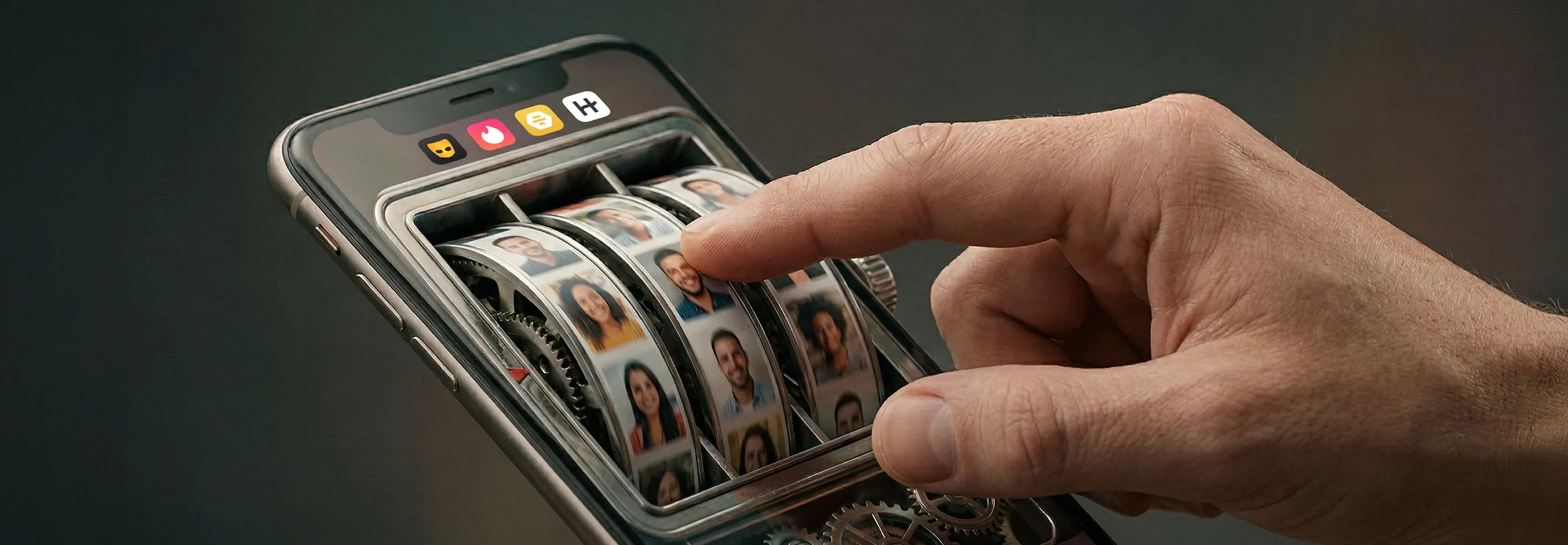
At first glance, everything seems harmless: a few photos, a short biography, a simple swipe left or right. Users believe they are in control of their love lives. However, the real control lies with a digital system that not only facilitates encounters but also increasingly shapes attention, behavior, self-image, and emotional processes.
Dating apps like Tinder and Grindr are much more than just practical tools. They are systems that deliberately shape intimacy. Their power lies not only in bringing people together, but also in how they shape our feelings of attraction, availability, rejection, validation, and worth. They create a psychological framework that structures and influences encounters.
The problem is not just that technology is intruding into our private lives. What is crucial is that our private lives are increasingly organized according to the rules of technology.
From a tool for getting to know each other to an infrastructure for controlling intimacy
The global network of dating apps is now a multi-billion dollar industry that processes vast amounts of sensitive data. These apps are no longer simple lifestyle products, but highly sophisticated digital systems that analyze location data, behavioral data, interaction data, and attractiveness signals in real time. The seemingly simple user experience is based on a complex infrastructure of data centers, geolocation, networks, and recommendation systems that constantly calculate how to keep users engaged with the app for as long as possible.
This is no longer just about technical efficiency. It’s about a new model of connection. It’s not just about technical efficiency, but about a new model for how intimacy is fostered. Intimacy becomes data, and our desires become a pattern that can be measured, predicted, optimized, and sold. Every movement, every decision, every glance at a picture, every message, and every response becomes a signal for the system. The system responds with new suggestions and the constant promise that the desired connection might be just around the corner. It’s no longer just a human experience; it also becomes a marketable resource.
The algorithm is no longer a helper; it has become the silent manager of our desires
Many users still believe that dating apps simply show “what’s available out there.” This is naive. Apps do not show a true reality, but a selected and sorted version determined by an algorithm. This algorithm decides who is shown to whom, who remains visible, who fades into the background, who receives more opportunities, and who becomes almost invisible.
Users no longer move with free choice but within a digital corridor designed by the system. This system subtly influences one’s self-worth, based on visibility, matches, and reactions. The app becomes a benchmark for one’s desirability, directly shaping self-image.
In the mildest case, this creates insecurity. Worse is when a dependence on the algorithm’s validation develops. In extreme cases, what matters is no longer what one wants oneself, but only what performs better on the platform.
We have become too obedient to a system that is not concerned with our well-being, but with our attention.
The main problem with dating apps isn’t their existence. They are designed so cleverly that users often don’t even realize how much they have already become accustomed to their logic. They know the rhythm of waiting, brief moments of excitement, rejection, new attempts, and the constant feeling that something important might happen with the next swipe.
This is the result of deliberate design: these platforms thrive on users staying, not on them finding stable relationships. The more they bind us to themselves, the more valuable we become to them.
Dating apps subtly control our attention. They influence how we seek connection, without forcing us. They take time, focus, self-esteem, and emotional energy – our freedom is limited by habit, hope, and uncertainty, not by force.
Of course, this is not a classic form of slavery, and that term should not be trivialized. But as a warning: if we no longer control our own impulses, but instead increasingly leave them to a system that knows exactly how to keep us engaged, then our freedom is seriously threatened.
Tinder and Grindr don’t just sell the possibility of a connection. They sell the feeling of not being settled
Tinder and Grindr work differently, but follow the same basic idea. Tinder relies on a sequence of decisions, one profile after another, which provides clear behavioral cues. Grindr is designed for direct spatial proximity and conveys the feeling that there is always someone nearby and that contact is possible at any time. One sells the rhythm of evaluation, the other the rhythm of proximity. Both sell expectations. It is enough if there is only an occasional strong impulse for the user to continue – a match, a message, a sudden moment of interest, a promising profile. That is enough for the brain to return and want more.
Eventually, the search shifts from people to signals and confirmations. In this way, dating apps shape our emotional reactions and shift the focus from relationships to the experience of feedback.
From intimacy to “relationship shopping.”
One of the most harmful consequences: people become catalog items. More choices lead to superficiality, distraction, endless comparisons, and a constant search for something better. Interactions become superficial; the focus is on appearance, attractiveness, and availability.
This is referred to as “relationship shopping”: relationships become a consumer experience, people become products, and attention becomes the currency. The result is often emptiness, boredom, and emotional exhaustion – connections without connection, accompanied by loneliness, anxiety, and fatigue. The system is optimized for endless searching, not for finding a match.
The problem is not only psychological but also relevant to security
Dating apps pose significant security risks. They rely heavily on location and proximity, causing users to disclose a great deal of sensitive data. The history of these platforms shows that precise distance information, insecure interfaces, and hidden network traffic can lead to data breaches – such as tracking, stalking, or loss of anonymity.
The problem is exacerbated because many users believe they are protected when they “turn off” or “hide” something in the app. However, in the background, the system continues to process and transmit sensitive data. This is a dangerous illusion of security. When information about sexual orientation, habits, health, or movements is added, a data leak can quickly become a real threat to life. It also exposes our vulnerability in the physical world.
Algorithmic bias further exacerbates inequality
Another important truth: algorithms are not neutral. They do not treat profiles equally. Recommendation systems usually reward what already receives a lot of attention. Those who are popular are shown even more often. Those who have little initial success become increasingly invisible. This creates a cycle in which attention always flows to the same people, leaving others with little chance.
This has psychological consequences. Users do not see the technology behind it, but only the result. When matches or messages are missing, many people think it is their fault. Often, however, it is because they are barely visible to the algorithm.
This is dangerous because a technical system has emotional consequences that the individual perceives as personal failure. Then, the dating app is no longer a neutral platform, but an active part of the uncertainty.
Artificial intelligence will make everything even more ambiguous
The next development makes everything even more complicated. Artificial intelligence has already arrived in dating apps – in photo selection, profile analysis, suggestions for the first message, conversation summaries, and compatibility assessments. Officially, this is supposed to help, but in reality, the platform is interfering even more strongly with our identity and communication.
The more the system dictates how we present ourselves, how we sound, how we start conversations, and how we maintain interest, the less room there is for genuine, spontaneous mistakes. But it is precisely these imperfections that often make relationships real. When both users are only interacting with optimized versions of themselves, it is not just two people talking to each other, but also their digital assistants.
This leads to an important question: Are we moving towards a world where even intimacy is taken over by systems? If so, it is no longer just about technology, but about a fundamental change in our experiences.
Reasonable use is not panic, but a necessity
It is important to remain fair. Dating apps are not inherently bad. For many people, they have enabled friendships, relationships, sexual freedom, or even partnerships. The problem is not that they must be demonized, but that they should finally be seen realistically. The clear interest is: to retain users, increase interactions, optimize attention, and profit from emotional dynamics. Those who do not understand this are easily put in a subordinate relationship to a system that, at first glance, seems like a service, but in reality, dictates the rhythm of emotional life.
Therefore, the real question is not whether one uses dating apps, but whether one uses them consciously, with clear boundaries, and without losing one’s own autonomy. If the app influences our mood, our self-esteem, or our belief in our attractiveness, it has gone too far.
Conclusion: Technology should not become the ruler of our intimacy
Dating apps clearly show what our digital presence looks like. They bring together technology, money, psychology, location data, surveillance, algorithms, and our need for connection. Therefore, they should not be underestimated. They are not only a convenient way to meet people, but also an infrastructure that increasingly influences how we feel, choose, wait, and doubt ourselves.
When used unconsciously, they transform us. Those who use dating apps unconsciously quickly go from being users to being dependent on them. People who are looking for a relationship become people who are only waiting for a reaction. People who want intimacy become people who are dependent on the system’s validation. This is where the greatest danger lies, as we give them too much power over our own minds.
Therefore, responsible use is not moral panic, but basic digital hygiene. Responsible use of dating apps is not scaremongering, but basic digital hygiene. Dating apps can be a tool. But once they control our self-esteem, our rhythm, and our psyche, they are no longer a tool, but silent rulers.