

Bipolar disorder doesn’t ask where you are in life. It doesn’t ask if you have an exam, a presentation, a date, or a project deadline. It strikes when it strikes. And it strikes exactly where your life is most vulnerable: in what you have built up over months and years.
In parts 1 to 3, we separated the illness from the meme, youth from late diagnosis, and biology from sensationalist epidemiological panic. In this part, we delve into everyday life. What bipolar disorder does to school, work, relationships, and finances. And then something specific to our generation: what it does in the realm of screens, algorithms, and 24/7 availability.
School and University: Dropping out in silence
During a depressive episode, a young person with bipolar disorder who is attending school or university may be unable to concentrate on their studies. Anhedonia shuts down motivation, cognitive slowing erases working memory, and hypersomnia consumes learning time. Grades fall, absences increase, semesters are lost, and work is left undone.
During a hypomanic episode, it may seem as though the academic situation is improving. Hyperfocus, accelerated reading, writing seminar papers and projects in a single night. But this focus is distorted. The ideas are grandiose, but disconnected. Instructors often notice the abrupt decline in the quality of the work, and at the same time, the hyperproductivity. Hypomania is not productivity; hypomania is the illusion of productivity.
Statistically, young people with untreated or late-diagnosed bipolar disorder drop out of university to a significant extent. Not because they are incapable of studying, but because the healthcare system does not provide them with timely support.
Work: the economic consequences
In the professional environment, bipolar disorder is associated with exceptionally high and fluctuating absenteeism (long periods of illness) and presenteeism (being physically present at work with drastically reduced productivity).
The most severe consequences occur during manic phases. The classic manic impulsivity, grandiosity, and loss of judgment transform into concrete disasters:
- The rash resignation from a secure job based on the feeling that “something greater is meant for me.”
- The initiation of unrealistic business ventures with a high financial investment.
- The acquisition of large bank loans for projects that are never completed.
- Aggressive conflicts with superiors and colleagues during irritable hypomanic phases.
The economic consequences of a manic episode can persist for years after its end. Loans must be repaid. Assets must be sold. The professional reputation must be rebuilt.
Relationships: the dual nature of the illness
Depressive phases lead to isolation. Anhedonia kills interest in shared activities. The partner begins to feel rejected; friends think that you don’t want to go out with them. The relationship slowly empties of shared experiences.
Manic and hypomanic phases cause a different type of damage. Irritability towards partners and family, aggressive outbursts, intense but unstable relationships. A particularly destructive component of mania is hypersexuality. The affected brain generates impulses that are not in line with the person’s values and obligations during the euthymic phase (the phase of balance). The result is affairs, infidelity, and the destruction of trust, which rarely returns.
The families of those affected are experiencing trauma. Parents feel guilty. Partners may struggle with the realization that “it’s their person, not their illness.” Siblings may distance themselves over years due to their unpredictable behavior. One of the public health problems that receives the least attention when treating bipolar disorder is the lack of support for family members, who bear an enormous psychological and financial burden, as well as significant pressure. This burden can become so great that, over time, even family members themselves may develop physical and mental health problems.
Regardless, the goal is to learn to distinguish the person from the episode. This is a skill, not an instinct. It is something that can be learned. And the first step is to openly discuss what the diagnosis means.
The digital world: a new area of risk
The technology itself is not an etiological cause of bipolar disorder. However, the digital space acts as a powerful catalyst and amplifier of existing vulnerabilities. Current research paints a clear picture.
iks.haus | AI-generated based on editorial concept, 2026.
| Aspect of the influence of the digital world. | What the research shows. |
|---|---|
| Sleep disorder. | The algorithmic design promotes wakefulness, and the blue light from screens blocks melatonin. Sleep deprivation is a scientifically proven trigger for mania. |
| Online exhibitionism and regret. | A 2021 study showed that 66 percent of people with bipolar disorder experience regret over public posts and private messages from the manic phase, compared to 31 percent in the control group. |
| Compulsive and addictive behaviors. | Online shopping, online gambling, and excessive pornography consumption are amplified during manic and hypomanic phases due to a malfunction of the reward system. |
| Digital phenotyping (the positive side). | A 2017 survey showed that 41 percent of those affected consciously recognize changes in their own digital activity as an early warning sign of an impending episode. |
Sleep as the strongest medicine
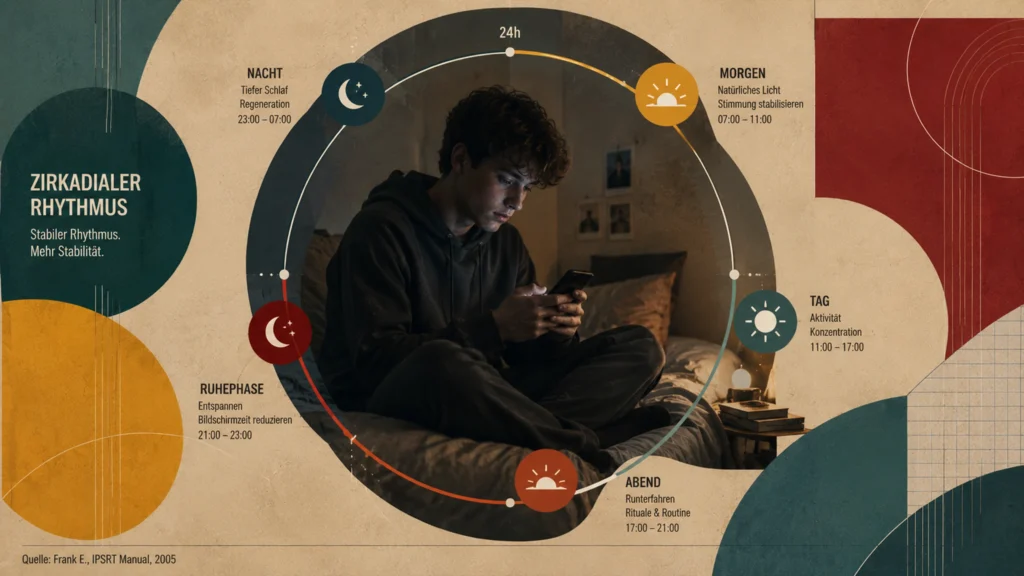
Circadian rhythms and a stable sleep architecture are among the most important, almost sacred, factors in the treatment of bipolar disorder. The reduced need for sleep is not only a consequence of an impending manic episode, but also a trigger. Clinically, it has been proven that sleep deprivation alone can push a stable, euthymic, or even depressed patient over the edge into a full manic episode.
iks.haus | AI-generated based on editorial concept, 2026.
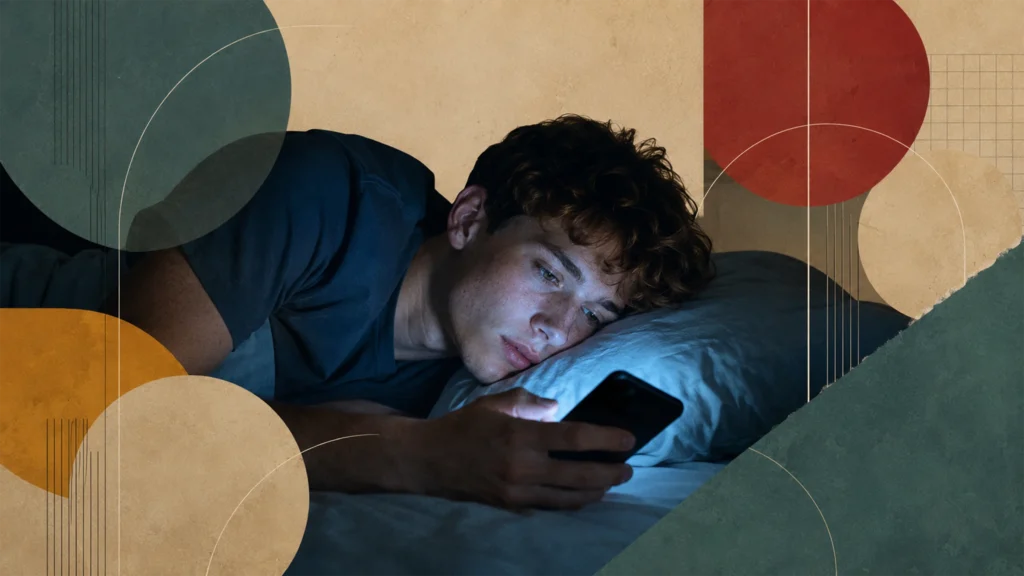
Today’s social media algorithms are primarily designed to maximize engagement and attention. This means that TikTok, Instagram Reels, YouTube Shorts, the X feed, and similar content provide a dopamine stimulus precisely at the moment when the brain should be entering a state of relaxation. The term “doomscrolling” describes the compulsive consumption of content that continues even when feeling tired.
In addition, there is a biochemical problem. The blue light emitted from screens suppresses the release of melatonin from the pineal gland. Melatonin is the hormone that regulates the circadian rhythm, the sleep-wake cycle. The brain does not receive a signal that it is time to sleep. Two hours of compulsive scrolling in bed can impair sleep quality for an entire night and shift the circadian rhythm for the next day. The blue screen literally affects people’s hormonal balance. For a stable patient with bipolar disorder, such a night is not a catastrophe. A week of such nights can trigger an episode.
The digital footprint of the manic phase
Social media provides a platform for manic episodes in a way that has never been seen before in human history. Previously, a manic episode might manifest within a close circle of family and friends. Today, a manic episode manifests in real-time before thousands of followers. There are well-known video recordings of prominent individuals who, during their manic phase, display their state to millions of people without any real insight into their own behavior. In this way, the dignity of a person who is not well is destroyed, the person is dehumanized, and they are exposed to the ridicule of others; the whole thing resembles a cruel digital freak show.
A 2021 study revealed shocking figures regarding the impact of social media on people with bipolar disorder. As many as 66 percent of people with bipolar disorder experienced severe regret over public posts, uncontrolled private messages, or explicit photos and videos that they had shared during an episode. In the control group, this figure was only 31 percent.
Specific manifestations of this digital outburst include:
- Careless sexting with strangers or acquaintances outside of a relationship.
- Sharing explicit photos on Snapchat, Instagram, or in direct messages (DMs).
- Aggressive outbursts against authority figures in comments or public posts.
- Compulsive online shopping, especially in the late hours of the night.
- Engaging in online gambling (Gambling Disorder).
- Contacting ex-partners or abandoned individuals with extravagant messages and promises.
The most serious consequence is not the loss of followers or money. The most serious consequence is the permanent public record. A screenshot does not disappear. Snapchat content is often recorded. The sender does not delete the email from the recipient’s inbox. What you sent at five in the morning during a manic phase can reappear years later in your professional environment.
How the digital world can also be a medicine
There is also another side to the coin. The same platforms and technologies that can act as catalysts can also be a tool for early detection. This concept is called digital phenotyping. The idea is to track phone usage patterns, typing frequency, the number of messages sent, the time spent in apps, and screen time as biomarkers for changes in mood.
A 2017 survey of people with bipolar disorder showed that a significant 41 percent of those affected consciously recognize changes in their digital activity as a clear sign of an impending episode. Mania is often accompanied by a hyperactive online presence, rapid typing, and excessive posting. Depression may be indicated by complete digital withdrawal, ignoring messages, and inactivity.
If the patient and a close person recognize these patterns, they can signal this to the psychiatrist early on. This allows for a proactive adjustment of the stabilizer dosage and can potentially prevent the development of an episode.
Practical limitations that actually work
A structured and targeted limitation of social media use has proven to be one of the best behavioral protective factors. Specifically:
- Less than 2 hours of social media per day.
- Completely disable notifications during the night (from 10:00 PM to 7:00 AM).
- Do not keep the phone in the bedroom (replace it with a simple alarm clock).
- Actively block blue light after sunset (using Night Shift, f.lux, or similar).
- Structured time for responding to messages, not continuously.
- An agreement with a close person who has access to your account and can monitor public posts during periods of risk.
This is not a digital detox from the wellness discourse. It is a clinical intervention that directly affects the stability of the circadian rhythm and reduces the risk of relapse.
What awaits you in part 5
In the final part of the series, we get down to the facts. What the system can and must do. We take a look at what Austria’s healthcare system looks like today – one of the richest countries in Europe. A 90-day waiting time for an appointment with a child psychiatrist in Vienna. 40 percent of private practices that are not accepting new patients. And the solutions that exist are not being implemented.
If you need help
If you recognize these patterns in yourself or in someone close to you, the first concrete step is to establish a sleep routine and reduce nighttime scrolling. The second step is to talk to your family doctor or a psychiatrist. Crisis counseling hotline in Austria: 142 (Telephone Lifeline, 24/7, free of charge).
FAQ
How can TikTok trigger a manic episode?
TikTok and similar algorithmic feeds maximize engagement and attention, which promotes prolonged nighttime content consumption and sleep deprivation. The blue light from screens blocks the release of melatonin and disrupts the circadian rhythm. Sleep deprivation is a scientifically proven trigger for manic episodes in people with bipolar disorder. The algorithm does not cause the illness, but it can lead a stable patient into an acute episode.
What is digital phenotyping?
Digital phenotyping is the tracking of usage patterns of digital devices as biomarkers of mood state. Changes in typing speed, the number of messages sent, screen time, and posting frequency on social media can signal an impending manic or depressive episode, even before the classic clinical symptoms appear. A 2017 survey showed that 41 percent of people with bipolar disorder consciously recognize their own digital changes as early warning signs.
How many hours of sleep are safe for bipolar stability?
Most clinical guidelines recommend 7 to 9 hours of regular sleep with consistent bedtimes and wake-up times, and minimal deviations of ±30 minutes per day. Circadian stability is more important than the absolute number of hours. Interpersonal and Social Rhythm Therapy (IPSRT) explicitly emphasizes maintaining rhythm as a foundation for episode prevention.
What role does the digital world play in bipolar disorder?
The digital world acts as a powerful catalyst and amplifier of existing vulnerabilities. Current research shows that sleep disturbances, online exhibitionism, regret, compulsive behaviors, and digital phenotyping are strongly associated with bipolar episodes. Social media algorithms promote sleep deprivation and disrupt circadian rhythms, which can compromise stability.
How can digital habits influence bipolar disorder?
Digital habits such as constant scrolling, the blue light emitted by screens, and the algorithms of social media can disrupt circadian rhythms and promote sleep deprivation. This can lead to manic episodes. Furthermore, digital phenotyping can serve as an early warning sign of an impending episode if usage patterns such as increased screen time or frequent posting are observed.