On Saturday, June 13th, the Vienna Ringstraße will be closed to traffic. A colorful procession will move through the city center – and in the opposite direction of the usual flow of traffic. The Rainbow Parade is taking place for the thirtieth time, an event that has now become an established tradition: It was held for the first time in 1996 on the Ring in Vienna (City of Vienna, 2026). This year, the organizers expect over 300,000 participants, making the Rainbow Parade the largest demonstration in Austria in terms of attendance (City of Vienna, 2026).
Every year, the central question arises: If equality seems to have been achieved on paper – marriage for all is possible, the city hall supports the parade, and prominent artists perform – why is Pride still a struggle? The answer is clear: Equality in laws does not automatically translate to equality in everyday life. This contradiction makes Pride continue to be necessary.
iks.haus | AI-generated based on editorial concept, 2026.
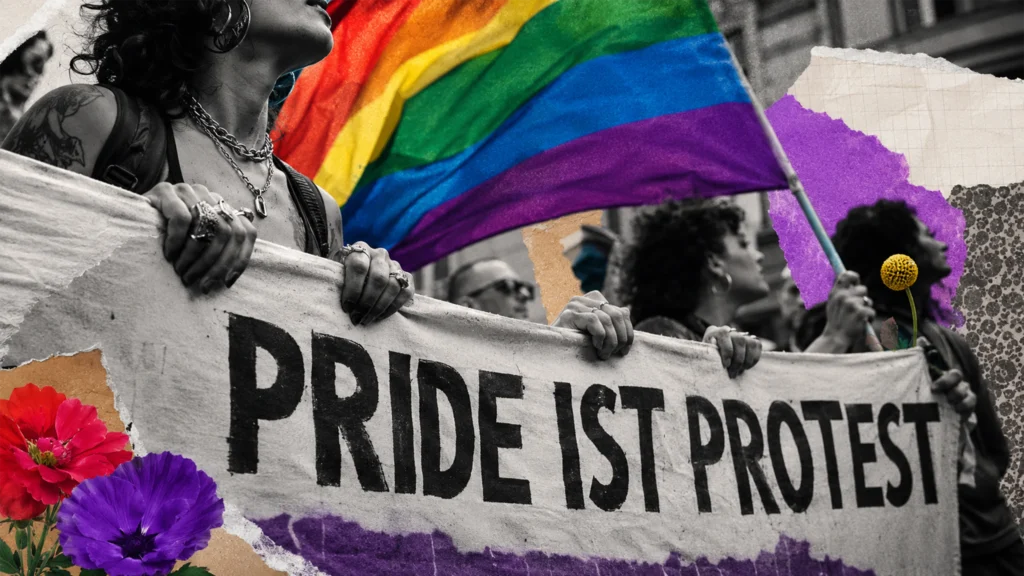
Pride began as an act of resistance: In the early morning hours of June 28, 1969, patrons of the Stonewall Inn in New York resisted a police raid. Marsha P. Johnson and Brenda Howard played important roles. This protest gave rise to the Pride Parade, which has evolved from a demonstration into a celebration.
Vienna adopted this idea in 1996. Thirty years later, the organizers are emphasizing with the motto “VISIBLE since 1996” that visibility is not a goal that can be achieved once and then forgotten (City of Vienna, 2026). The parade around the Ring is a demonstration, a community gathering, a party, and a clear political statement – all in one day.
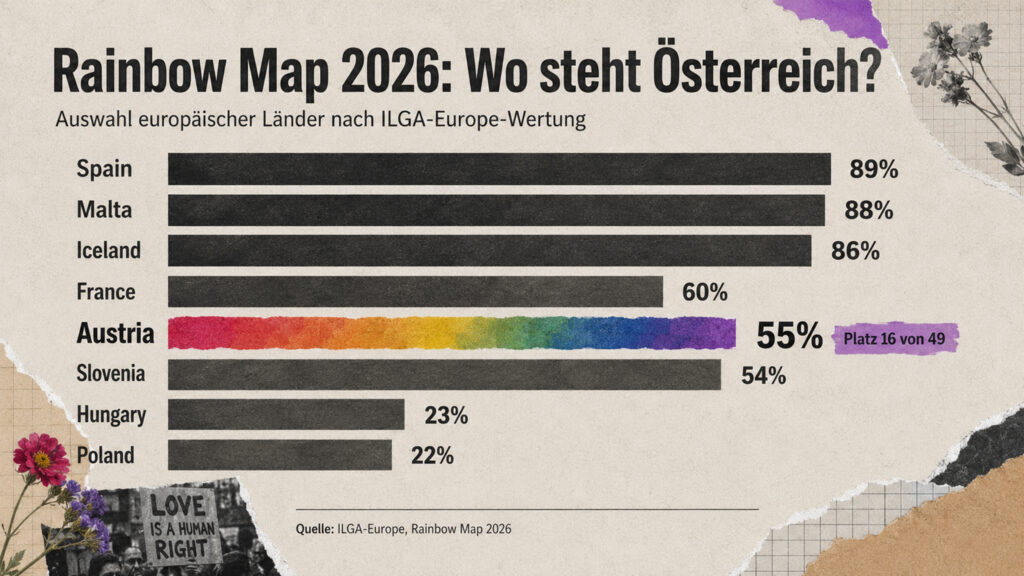
Despite this, there is also a subtle signal in 2026. Due to budget cuts and reduced funding, the Pride Village at the Rathausplatz will only take place for one day this year, instead of the usual several days (Vienna Pride, 2026). As a counterbalance, the organizers have created the Community Fest in the Prater and the Pride Run (City of Vienna, 2026). The message is clear: especially now, when safe spaces and visibility are particularly needed, these cuts are especially painful (HOSI Vienna, 2026, Paraphrase). This raises the central question: Where does Austria stand today? According to the Rainbow Map of ILGA-Europe, Austria ranks 16th out of 49 European countries in 2026. The country only meets 55 percent of the evaluation criteria for the legal equality of LGBTQ+ people (ILGA-Europe, 2026). For comparison: leading European countries such as Spain achieve 89 percent, Malta 88 percent, and Iceland 86 percent (ILGA-Europe, 2026). Fifty-five percent means that Austria still has more than half the distance to go to catch up with the leaders.
iks.haus | AI-generated based on editorial concept, 2026.
Austria continues to move forward. Following a decision by the Constitutional Court, the Ministry of the Interior has introduced a new regulation: non-binary individuals can choose between four gender entries in the registry of personal status (ILGA-Europe, 2026). Marriage for all has been allowed since 2019, and LGBTQ+ people are protected by anti-discrimination laws. These are real advances that should be recognized.
However, there are also things that remain unchanged. The draft law, which would prohibit so-called conversion therapies – practices that falsely claim that queer identity is a disease that can be “cured” – continues to be blocked by the conservative party (ILGA-Europe, 2026). To be clear: The Austrian Parliament unanimously passed resolutions in 2019 and 2021 stating that these practices should be prohibited, but a law still does not exist (Parliament of Austria, 2024). The professional association of Austrian psychologists already considers these methods to be inadmissible (Parliament of Austria, 2024). The problem, therefore, lies with the political will, not with the professionals.
HOSI Wien, Austria’s oldest LGBTQ+ organization and co-organizer of the parade, is not demanding symbolism this year, but concrete measures. Before the parade, the organization is demanding effective protection against hate crimes and a ban on conversion therapies, which explicitly includes transgender and intersex people (HOSI Wien, 2026, paraphrase). The message is clear: Thirty years of the parade show how much the community has achieved through its efforts – but also how much remains to be done (HOSI Wien, 2026, paraphrase).
Specifically: Why is this important for people in Vienna? Because laws are not just theory. Studies on mental health consistently show that acceptance in the environment and visibility protect LGBTQ+ people, especially young people. Safe spaces, the correct pronouns, and family support are not trivial matters – they save lives. When the state fails to implement a law that it has repeatedly and unanimously called for over the years, that is also a message. And this message reaches a fifteen-year-old somewhere in Vienna who is just beginning to discover who they are.
There’s also a broader European context that continues to make Pride important. In April 2026, the European Court of Justice ruled that the Hungarian law against so-called LGBTI propaganda, which was used to ban Pride events, violates the fundamental rights and values of the EU (ILGA-Europe, 2026). In other words, a Pride ban in an EU country was declared unlawful. Worldwide, same-sex relationships are still criminalized in 64 UN member states, and in some countries, the death penalty is a possibility (ILGA World, 2025). For these people, the Vienna Pride parade serves as a voice – a place where what is forbidden elsewhere is possible.
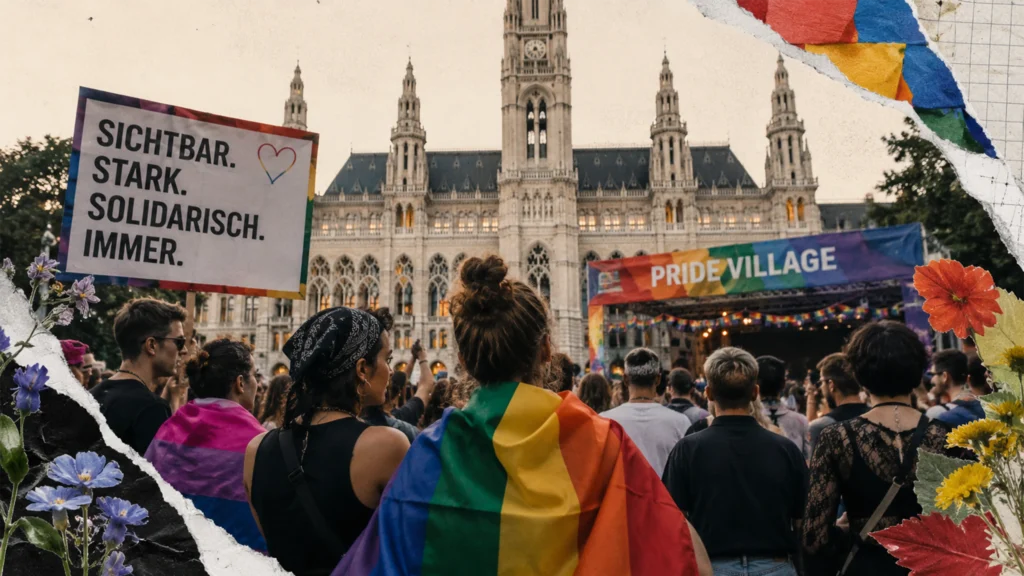
iks.haus | AI-generated based on editorial concept, 2026.
Ultimately, Pride in Vienna in 2026 demonstrates that the fight for equality continues, despite successes such as marriage equality and protection against discrimination. Thirty years of activism have brought progress, but key demands remain unmet – such as a ban on conversion therapies or a place among the leading countries in Europe. The parade on June 13th is a visible testament to this: 55 percent is not enough, and the demand for true equality remains urgent. Visibility alone is not enough; it must be constantly defended because equality has not yet been achieved in reality.
FAQ
When is the Vienna Pride 2026?
The Vienna Pride 2026 takes place from May 29th to June 14th, and the 30th Rainbow Parade will circle the Vienna Ringstraße on Saturday, June 13th (City of Vienna, 2026).
Is marriage equality legal in Austria?
Yes, marriage equality has been legal in Austria since 2019, and LGBTQ+ individuals are protected by anti-discrimination laws.
Why is Pride still important in Austria today?
Austria ranks only 16th in Europe with 55% of equality criteria met (ILGA-Europe, 2026), and a ban on conversion therapies is still lacking, even though the parliament has called for it unanimously twice (Austrian Parliament, 2024).
What is the significance of the Pride parade in Vienna?
The Pride parade is a demonstration, a community gathering, a party, and a clear political statement – all in one day. It showcases how much the LGBTQ+ community has achieved through its efforts, but also how much remains to be done.
Why is the Pride parade in Vienna internationally significant?
The Vienna parade serves as a voice for people living in countries where same-sex relationships are criminalized or where the death penalty is a possibility. It is a place where what is forbidden elsewhere becomes possible.