It’s hard to explain, but the anticipation for the Eurovision Song Contest feels different each time. Every edition brings a new promise. This year, it’s Vienna’s turn. For the third time, the city is hosting the world’s largest music competition. Those who were there in 2015 know: Austrians always give it their all.
The 70th Eurovision Song Contest begins on May 10th with the opening ceremony on the Rathausplatz. Admission is free, and everyone is welcome. The grand finale will take place on Saturday, May 16th, at the Vienna State Hall. The two semi-finals will take place on May 12th and 14th.. Victoria Swarovski and Michael Ostrowski will host the shows. Delegations from 35 countries will participate. This week, Vienna will become something special: a bit of a music festival, a bit of a political performance, a bit of a queer pilgrimage. All of this will happen on the streets, for free and for everyone. “United by Music – in the Heart of Europe.” This motto sounds less like advertising and more like a genuine manifesto.
JJ, Austria at the Eurovision Song Contest 2025 in Basel. Photo: Quejaytee / Wikimedia Commons / CC BY 4.0 / edited.

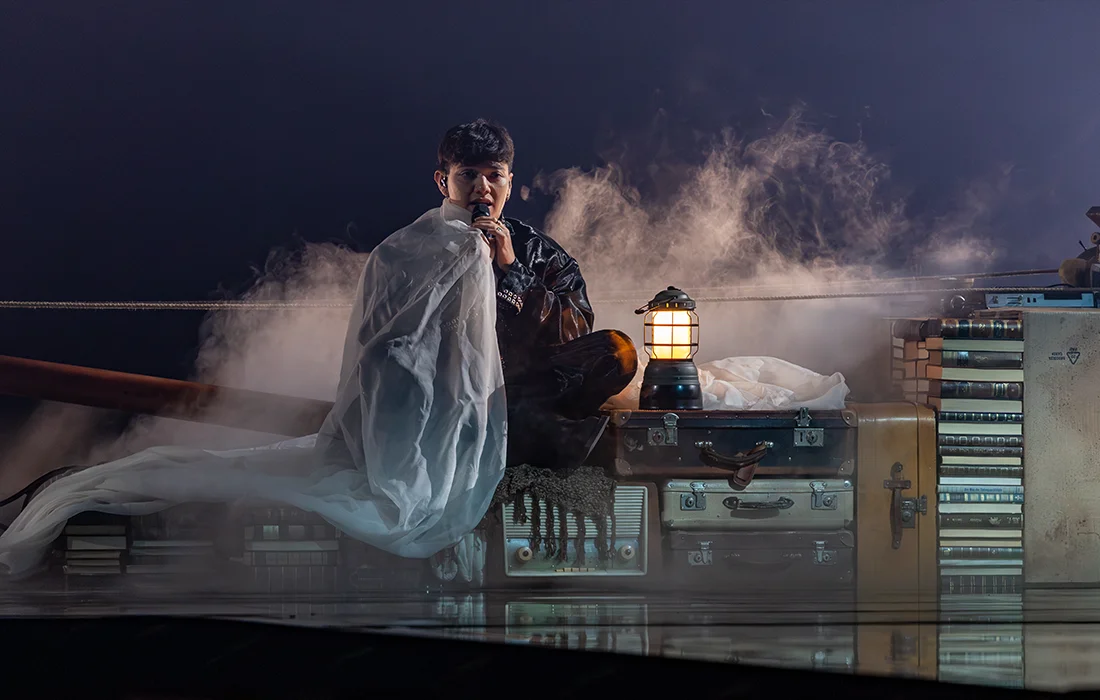
JJ, full name: Johannes Pietsch, is a countertenor and was trained at the Vienna State Opera. Last year, he won in Basel with “Wasted Love.” He brought home the victory. This wasn’t a typical Euro-pop moment. The audience chose something vulnerable, unexpected, and unclassifiable. Now, this moment brings the competition back to the city that shaped him.
But the Eurovision Song Contest 2026 is more than just the story of last year’s winner. This edition represents 70 years of music, identity, and a Europe in transition. Every year, there’s a song, a performance, and a flag in the audience.
Queerness is not a buzzword at the Eurovision Song Contest, but an archive.
Dana International, who won the Eurovision Song Contest in Birmingham in 1998 as the first transgender woman. Conchita Wurst won for Austria in Copenhagen in 2014. She is responsible for the fact that Vienna today has famous same-sex couples prominently displayed in the cityscape. These have been a permanent fixture in the urban landscape ever since. Nemo won in 2024 as an openly non-binary person for Switzerland. Each of these victories was more than just music. It was a signal.
What sets the Eurovision Song Contest 2026 apart from previous editions is something very concrete: it is the most accessible Eurovision Song Contest to date. In January 2026, ORF held castings for performers using International Sign Language (ISL). Nine people from Linz, Shanghai, Vienna, Berlin, Bielefeld, and Hamburg were selected. Their task is to translate each competition entry into a visual performance in international sign language. These performances were developed in months-long workshops together with the artists. This is not an afterthought, but part of the production.
Vibration vests make music felt through the skin. The nine ISL performers come from seven countries. An app called Accessify supports the offering. This is not a symbolic gesture, but real infrastructure.
In addition, there are vibration vests for hearing-impaired visitors, complete subtitles, audio descriptions, and the specially developed Accessify app. Vienna received the EU Access City Award in 2025 as the European city with the best accessibility. The Eurovision Song Contest builds on this foundation, not alongside it.
In addition, there is an exhibition that places all of this in a historical context. “United by Queerness” at the QWien Center, the Viennese center for queer history, runs from February 19th to May 24th. The exhibition showcases seven decades of the Eurovision Song Contest as a cultural and queer phenomenon. On display are costumes, photographs, audiovisual installations, and stories that have long remained hidden, until the Eurovision Song Contest brought them to light. For those who have always sensed that Eurovision is more than just music, there is now proof in 300 square meters.
And then there’s Auri. The mascot for the Eurovision Song Contest 2026 is a fluffy, pinkish-purple creature with sneakers. The colors are reminiscent – consciously or unconsciously – of the bisexual flag. Auri is intended for children, but the message excludes no one: believe in yourself and give others the space to do the same. Few things in pop culture reach the youngest generation so subtly.
A week of Eurovision in Vienna is free on the streets, but not for the soul. It brings with it questions, history, and politics. Music often summarizes all of this in three minutes. That is ultimately the reason why everyone is flocking to the Vienna Stadthalle this year.