Vienna is hosting the live broadcast of the first semi-final of the 70th edition of the Eurovision Song Contest this evening, May 12, 2026. The Vienna State Hall, secured for production on April 29 and placed at the highest security level, is becoming the stage for the most ambitious logistical, security, and accessibility test the city has experienced in a decade.
The figures illustrate the scale of the operation. An estimated 150,000 international guests are currently in the capital, arriving from over 65 countries. The city’s capacity of 84,600 hotel beds in approximately 450 establishments maintains an average occupancy rate of 70%, and 38 officially licensed public viewing locations distribute the audience across all districts.
A city behind electronic fences
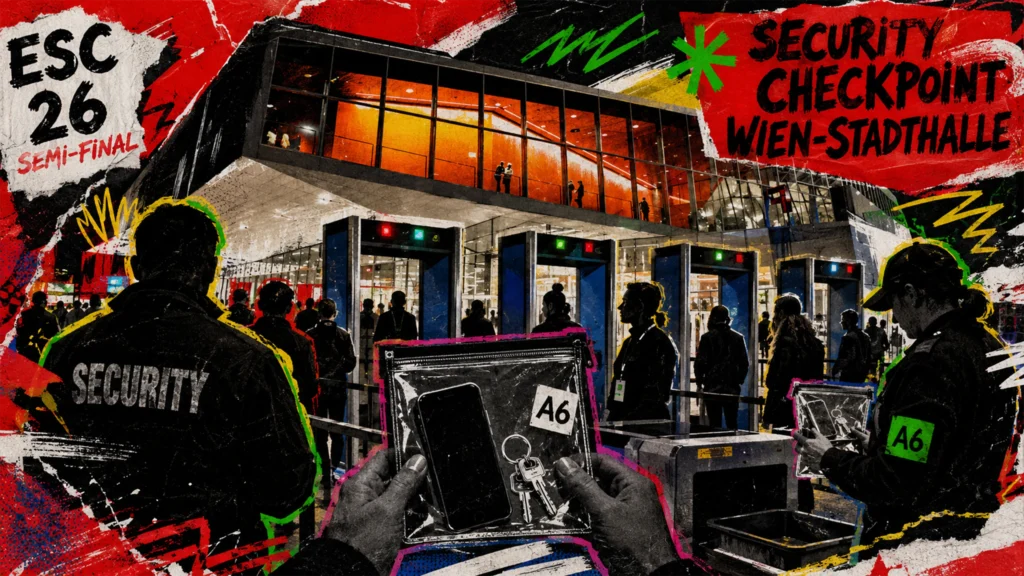
The security architecture for the first semi-final departs from the concept of an open music festival and adopts protocols typically reserved for political summits. Over 500 security personnel are deployed daily around the Vienna State Hall, and all 15,000 employees, from logistics to volunteers, have undergone background checks. All personnel completed a mandatory three-stage training program.
The baggage policy is among the strictest in the history of European cultural events. Visitors are only allowed to carry transparent A6-sized bags. Backpacks, fanny packs, and larger handbags are not permitted at the entrance. Despite initial dissatisfaction, the security throughput at the gates has significantly increased.
A temporary drone flight ban is in effect over the city, within a 1.5-kilometer radius of key locations, with fines of up to €4,600 for repeat offenders. The cyber infrastructure has been secured in collaboration with the national Cyber Security Coordination Group. All tickets for today’s broadcast are exclusively digital, linked to the buyer’s identity, and will only be activated 48 hours before the broadcast.
iks.haus | AI-generated based on editorial concept, 2026.
AUVA certification: a new standard for working conditions
Vienna has achieved a historic breakthrough in the course of organizing the event. The entire production has received the prestigious AUVA quality seal “Working safely and healthily,” which is the first time that an event of this format in Austria has received such certification. AUVA experts have been on site for weeks to ensure that extreme time pressure and the work of hundreds of technicians at heights do not endanger any lives.
Accessibility as a technological revolution
If one thing defines how the Eurovision Song Contest 2026 will be cited in specialist publications in the coming years, it is inclusion. The organizers have rejected the archaic model of ramps and basic services and have introduced solutions that set a completely new standard.
The roof platform in the Vienna Stadthalle is Accessify.Live, an AI-powered web application that is accessed by scanning a QR code. No installations, no registrations, no passwords. Blind and visually impaired visitors will receive real-time audio descriptions of the choreography and stage actions tonight. The system wirelessly synchronizes with the inductive hearing systems in halls D and F, delivering clear sound directly to hearing aids and cochlear implants.
Vibration vests have been introduced for deaf and hard-of-hearing visitors. The wearable device, connected to the mixing console, translates low frequencies, the rhythm section, and the bass into a tactile sensation. For the first time, members of the deaf community are not following the music as passive observers, but are physically feeling the dynamics and tension of each performance.
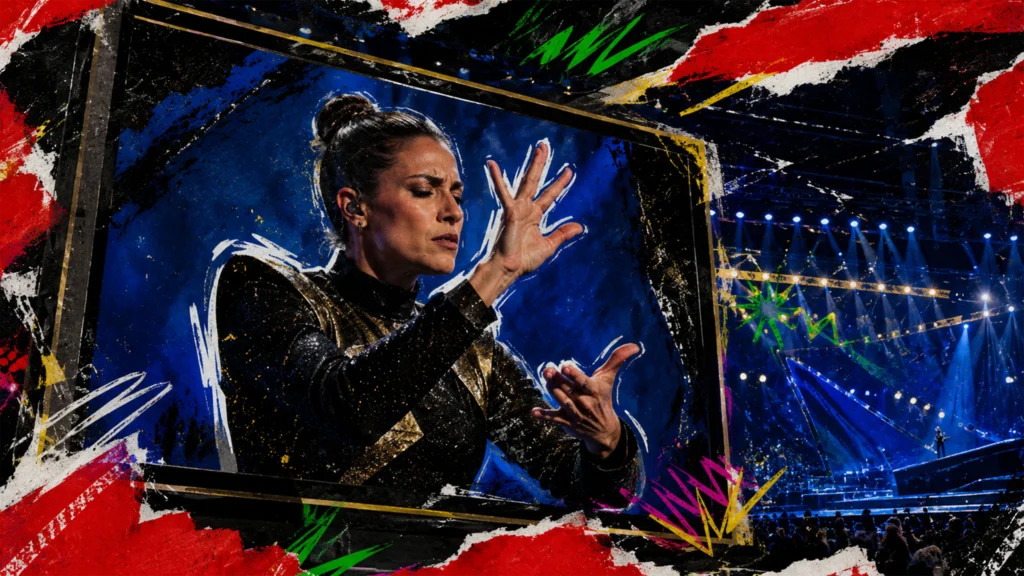
The traditional translation of songs into sign language, previously confined to a small screen, has evolved into “Sign Performances.” Six deaf or hard-of-hearing performers rehearsed for weeks in the studio, creating unique choreographed performances for all 35 segments, blending Austrian Sign Language (ÖGS), International Sign Language, contemporary theater, and physical rhythm. A dedicated video screen is reserved to the left of the main stage in the city hall to display these performances.
iks.haus | AI-generated based on editorial concept, 2026
Safe spaces for neurodivergent visitors
Vienna’s most radical step is aimed at neurodivergent audiences. Visitors with ADHD, autism, or high sensory sensitivity can borrow assistive devices free of charge to alleviate sensory overload, and a “Safe Space” zone is set up deep within the arena: a soundproof room with soft lighting, pleasant textures, and a complete absence of stress. Visitors experiencing hyperstimulation can leave the hall at any time to avoid visual, auditory, and emotional overstimulation.
Service dogs and therapy dogs are exempt from Vienna’s strict city-wide leash laws in crowded areas, and special fenced “off-leash” zones with fresh water stations are set up near the hall.
Public transportation as the backbone of the operation
The Vienna public transportation system may be tested more frequently than the city hall itself. The central element is the renamed U2 line, officially relaunched as the “Song Contest Line,” which transports visitors between the City Hall (Eurovision Village), Karlsplatz, and Praterstern. Announcements at key stations are available in five languages.
The city’s visual landscape will be extensively transformed. Over 550 trams are being wrapped with Eurovision visuals. The main traffic artery near the city hall, Hütteldorfer Straße, will be closed to civilian traffic from May 11th to 17th, and on the days of the broadcasts, parts of the Ringstraße will be diverted onto surrounding streets.
Single tickets cost €2.40, 48-hour tickets cost €14.10, and 72-hour tickets cost €17.10. Ticket holders and accredited journalists receive discounts on the City Airport Train, while the S-Bahn efficiently transports thousands of travelers between the airport and the city center for just €4.
38 Fan Zones: A Dispersed Strategy
City authorities, aware of the risk of bottlenecks, have rejected concentrating the public at one or two locations. Instead, there are 38 licensed public viewing locations throughout all districts. From locations like MAK and Votivkino, to hotel rooftops such as 25Hours and the riverbank (Strandbar Herrmann), to industrial sites like the Ottakringer Brewery with a 700 square meter dance floor.
The central fan zone is the Eurovision Village at the Rathausplatz, with a capacity of 30,000 people during peak broadcast times. Admission is free, the area is open daily from 2 PM to midnight, and tonight, the audience will be watching the event on 15 giant video walls with live feeds from the Stadthalle.
The “ivie” app, the official digital city guide for Vienna, has been transformed into the “Host City App.” A dedicated module, the “ESC Fan Zones Guide,” geo-locates users and directs them to the nearest, less crowded zones, effectively acting as a silent algorithm for the even distribution of pedestrian traffic. The app holds the prestigious WACA Silver Certificate and is fully compliant with the WCAG 2.1 AA standards.
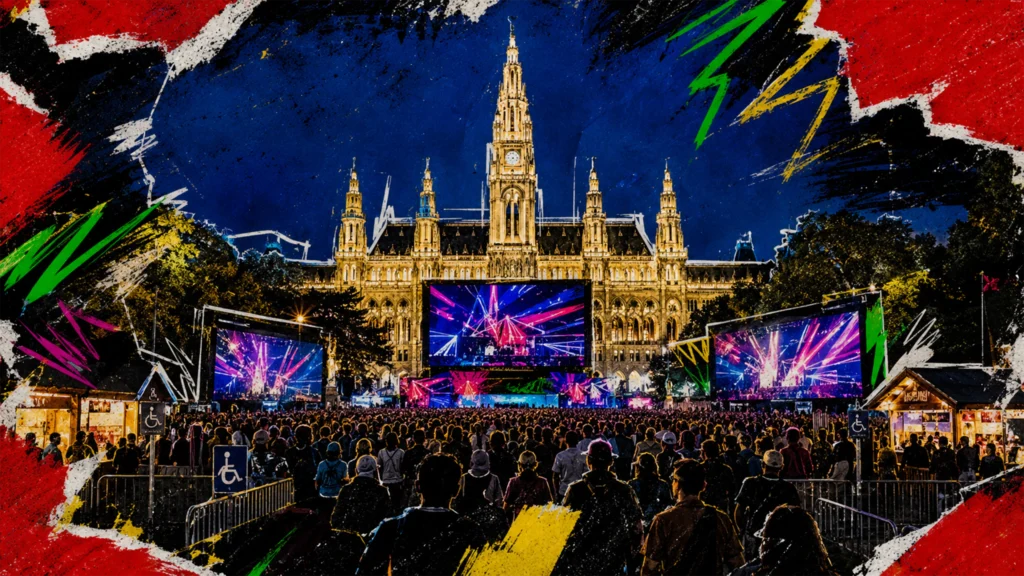
iks.haus | AI-generated based on editorial concept, 2026.
The Boycott as a Financial Shadow
Behind the euphoria of the Stadthalle, the 2026 Eurovision Song Contest will go down in history as the first edition to feature an unprecedented, coordinated boycott by five national broadcasters. Spain, the Netherlands, Ireland, Slovenia, and Iceland have withdrawn delegations or refused to participate in the standard format, due to decisions made by the European Broadcasting Union (EBU) related to current geopolitical conflicts.
The boycott has had significant financial consequences. Spain and the Netherlands are the fifth and sixth largest contributors to the event budget. Although Bulgaria, Romania, and Moldova have returned after long breaks, experts estimate that these countries cannot compensate for the gap left by Western European broadcasters, either financially or demographically.
Local sentiment shows skepticism. A survey by Der Standard shortly before the semi-final revealed that only 26% of Austrians agree that the Eurovision Song Contest “brings Europe closer together,” while 52% believe that the production is too expensive for the state budget in the current economic climate.
Conclusion: a new model for large-scale events
Vienna is already demonstrating two things. First, a city with 84,600 hotel beds and a dense public transportation network has the rare capacity to host a gigantic event without disruption, even under extreme security protocols. Second, that the era in which inclusion was reduced to wheelchair ramps is over, and a new era is beginning in which vibrating vests, choreographed sign performances, and neurodivergent safe zones are introduced as standard.
The question for future organizers of large-scale events is no longer whether this level of accessibility can be technically achieved. The question is whether they dare to not do it.