Saturday evening, May 16th. The Vienna Stadthalle is buzzing under the spotlights, the Rathausplatz is vibrating to the beat of the Eurovision Village, and the whole country is holding its breath, just before the largest music spectacle in Europe crowns its winners. Sunday, May 17th, early morning. The spotlights are replaced by a completely different kind of light. A light that doesn’t come from the production team, but from a question: Who is allowed to be visible here when the celebration is over?
This is IDAHOBIT, the International Day Against Homophobia, Transphobia and Biphobia. The date is not accidental. On that very day in 1990, the World Health Organization removed homosexuality from the international classification of diseases (WHO, 1990). Decades later, this means one thing clearly: Less than 36 years ago, being queer was a diagnosis in medical literature. The generation that fills the clubs on the Gürtel today and writes comments under J.J.’s “Wasted Love” has never experienced this world. That’s precisely why they recognize every sentence that tries to bring that world back through the back door.
The motto for 2026: “At the heart of democracy”
The global IDAHOBIT committee, coordinated by ILGA World and the May17.org platform, is setting a very clear tone this year. The motto for 2026 is “At the heart of democracy” (May17.org, 2026). Translated into plain language: LGBTQ+ rights are not a fringe issue. They are a litmus test of whether democracy is functioning.
The argument is dangerously simple. When a state says that a certain group does not deserve the same protection, the threshold does not stop there. It shifts the next time, then again, then again. That’s why this year’s call to action, from Brussels to Vienna, uses a garden metaphor: Justice and equality are the soil from which democracy grows, and anti-gender rhetoric is the weed that poisons that soil.
This year, more than 155 countries have registered over 5,000 events around IDAHOBIT (May17.org, 2026). This includes 35 jurisdictions where consensual same-sex relationships are still criminalized, meaning that every candle lit there carries a risk that one can hardly imagine in Austria.
Austria in the ILGA Rainbow Map 2026
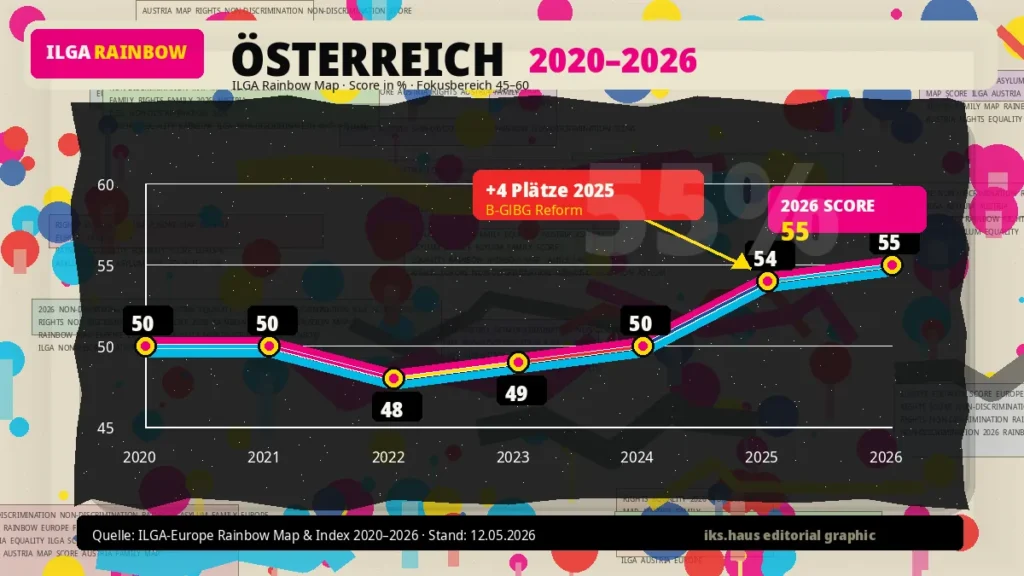
Five days before IDAHOBIT, on May 12, 2026, ILGA Europe released the new edition of its annual Rainbow Map, a tool that ranks 49 European countries based on how well they legally and politically protect LGBTI people. The scale ranges from 0 to 100% (ILGA Europe, Rainbow Map 2026).
iks.haus | AI-generated based on editorial concept, 2026.
In the 2025 edition, Austria recorded the largest jump of all countries, climbing four places. The reason: an amendment to the Federal Act on Equality, which expands the definition of “gender” to include gender identity, gender expression, and sex characteristics (ILGA Europe, 2025). Translated into everyday language: This provides transgender, non-binary, and intersex people with a legal basis on which they can rely in court.
However, the same report contains a sentence that should not be overlooked. The ÖVP has announced that it intends to repeal these protective measures by October (ILGA Europe, 2025). This means that a progress that was only recently achieved could be reversed with a single vote.
At the same time, at the end of last year, the FPÖ called on the Lower Austrian education authority to reduce the official school registration form back to only two gender categories (ILGA Europe Annual Review, 2026). At first glance, this appears to be a technical administrative debate. But on closer inspection, it is a direct intervention targeting children who do not fit into the binary system, specifically at the beginning of their first grade.
Numbers to remember
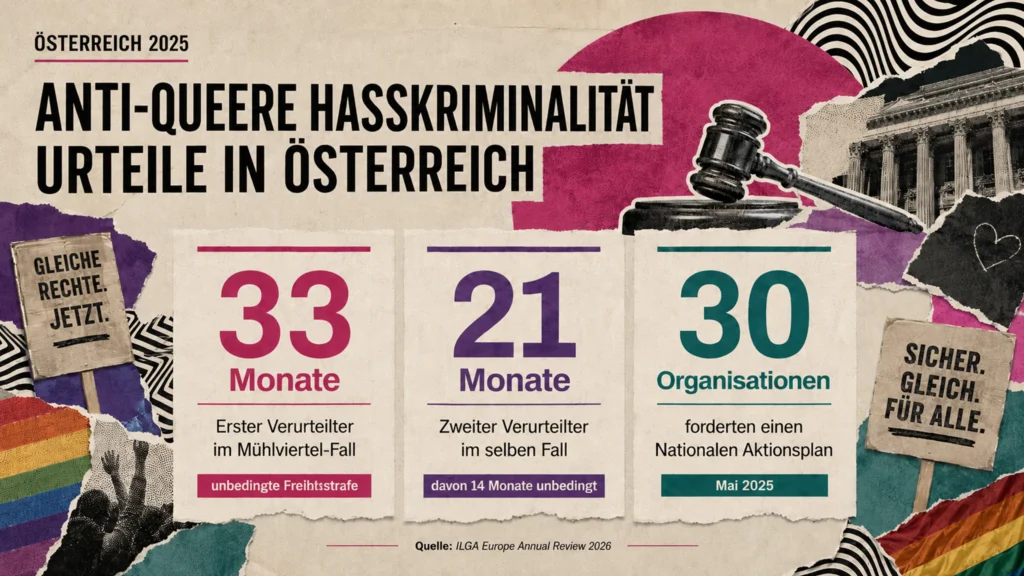
In 2025, 30 LGBTI organizations in Austria publicly called for a national action plan to combat hate crimes (ILGA Europe, 2026). The reason is not abstract. The Regional Court of Linz convicted two perpetrators who had lured, threatened, and extorted victims through dating apps in the Mühlviertel region. One received an unconditional sentence of 33 months in prison, the second received a sentence of 21 months, of which 14 were unconditional (ILGA Europe Annual Review, 2026).
iks.haus | AI-generated based on editorial concept, 2026.
In August of the same year, the Regional Court of Vienna convicted a 64-year-old man who had threatened a neighbor with homophobic violence (ILGA Europe Annual Review, 2026). The courts are working. But, as the organizations emphasize, the courts react to the attacks. An action plan exists to ensure that attacks decrease before they happen.
On the positive side: In May 2025, the Greens presented a draft of the Conversion Protection Act (295/A). The goal is to prohibit so-called conversion practices, which attempt to “change” sexual orientation or gender identity, with special protection for minors and young adults up to the age of 21 in vulnerable situations. The penalties range up to one year in prison and up to €30,000 in fines for promoting such offers (ILGA Europe Annual Review, 2026).
What the local organizations are saying
HOSI Vienna is celebrating its 30th anniversary this year with the Rainbow Parade, which will take place on June 13, 2026. The seasonal motto is: “VISIBLE since 1996”. Behind this slogan lies a very unromantic reality. At the beginning of the year, HOSI released a statement titled “Visibility Cannot Be Cut”, responding to the cuts that the city is making to Pride programs, while simultaneously promoting Austria’s image on the tourism market as a country that is open and diverse (HOSI Vienna, 2026).
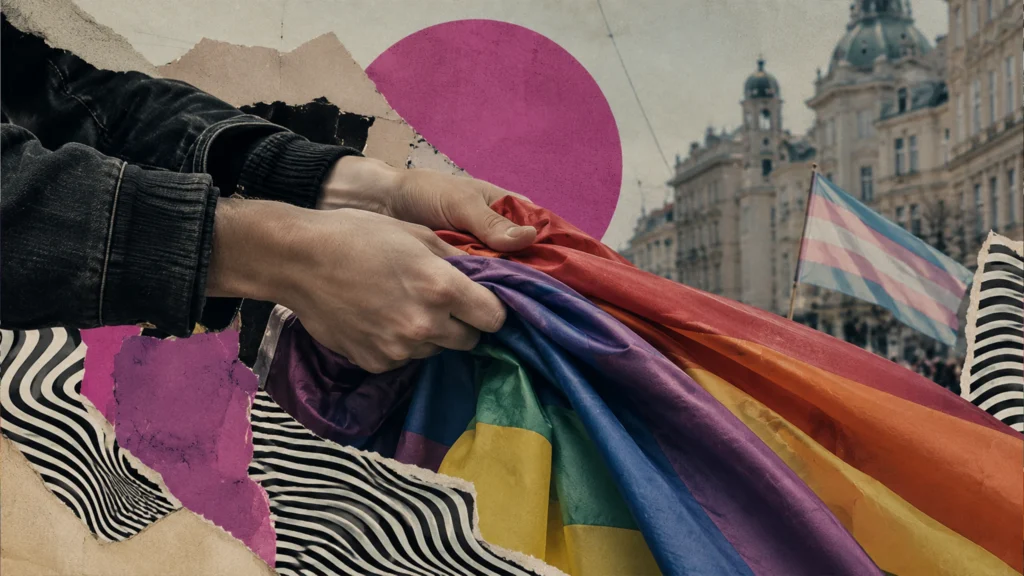
iks.haus | AI-generated based on editorial concept, 2026.
Queer Base, the organization based in the Turquoise-Pink-Purple Villa, which provides legal, psychological, and social support to queer refugees, will be taking to the streets for IDAHOBIT. The demonstration, under the motto “Break the Binary,” starts at Christian-Broda-Platz and ends at the Square of Human Rights near the Museumsquartier (Queer Base, 2026). The protest is directed against the treatment of individuals in asylum proceedings, who are required each year by a foreign official to “prove” their identity, as if in a general knowledge exam.
The Rainbow Family Center is inviting everyone to a family picnic in the Willy Frank Park, a public space in the 5th district (RBFZ Vienna, 2026). The idea is simple and, precisely for that reason, political. Queer families in the park, with children, blankets, and juice. Once they become a familiar sight, the rhetoric that portrays them as a threat loses its power.
What this means for the younger generation
The young Austrian audience, which has grown up with figures like Conchita Wurst (2014) and J.J. (2025) as an integral part of the cultural landscape, is least susceptible to the rhetoric that portrays queer rights as an “imported problem.” However, as the ILGA Europe Annual Review for 2026 shows, this generation is also increasingly exposed to coordinated disinformation campaigns on social networks, particularly targeting transgender and non-binary individuals (ILGA Europe, 2026). Amnesty International launched the #ResistWithPride 2026 campaign this year, which explicitly aims to debunk myths that circulate in foreign information manipulation and interference (FIMI) campaigns, and is primarily targeted at younger audiences (Amnesty International, 2026).
iks.haus | AI-generated based on editorial concept, 2026.
The bottom line is simple: May 17th in Austria is not nostalgic. It’s not a ceremony. It’s not an extended Saturday after-party. It’s the day when we measure the true value of the rights enshrined in laws, when someone from the outside tries to remove a few lines from those laws.
The generation that walks along the Mariahilferstraße, paints posters in Linz, Graz, and Klagenfurt, organizes picnics in the park, or simply shares a post on May 17th, doesn’t ask for permission. They demand that the rights they have just fought for remain in place in October, and in October of the following year, and in the years that follow.
Eurovision is over. The bill for visibility is delivered on May 17th.