

The relationship between religion and LGBTIQ identity is one of the most complex questions in contemporary psychology. Public debates often create the impression that religiosity and LGBTIQ identity are mutually exclusive. However, empirical research reveals a much more nuanced reality.
On the one hand, there is ample evidence that religiously motivated rejection can increase the risk of depression, anxiety disorders, suicidal ideation, and chronic shame. On the other hand, religion and spirituality are an important source of meaning, resilience, and mental stability for many LGBTIQ individuals.
The crucial question for mental health is not whether religiosity exists, but rather what the relationship is between the religious community and the individual’s identity.
1. Religiosity is not the same as religious extremism
The most important distinction at the beginning is between religiosity and extremism.
Religiosity includes:
- Belief,
- Spiritual practice,
- Belonging to a community,
- A moral framework,
- The experience of meaning.
Religious extremism encompasses:
- The absolutization of one’s own beliefs,
- The demonization of those with different views,
- Intolerance towards pluralism,
- The moral disqualification of certain groups,
- The justification of discrimination.
From a psychological perspective, the problem does not necessarily lie in the content of the belief itself, but in the rigidity of the system. Rigid systems often create chronic anxiety, shame, and social control.
2. The identity conflict as a central psychological problem
For many LGBTIQ individuals, the greatest suffering does not necessarily stem from their sexual orientation or gender identity itself.
The suffering arises from the question:
“Can I remain a part of my family, my community, and my religious tradition if I am who I am?”
This conflict creates a double threat:
- The loss of authenticity,
- The loss of belonging.
From the perspective of attachment theory, this is a very deep conflict between the need for connection and the need for an authentic life.

iks.haus | AI-generated based on editorial concept, 2026
3. The Minority Stress Model
Ilan H. Meyer’s model of minority stress is currently considered the most important theoretical framework for understanding the mental health of sexual minorities.
The model posits that psychological distress does not arise from sexual orientation itself, but from chronic stress caused by:
- Stigma,
- Discrimination,
- The expectation of rejection,
- Hiding one’s own identity,
- Internalized stigma.
When these processes occur within a religious environment, their impact can be particularly strong because they originate from individuals who embody moral authority.
4. Internalized Homophobia and Internalized Transphobia
One of the most serious consequences of religiously motivated rejection is the internalization of negative messages.
The affected person begins to believe:
- That they are sinful,
- That they are unacceptable,
- That they are morally deficient,
- That they deserve rejection.
Over time, societal stigma transforms into self-stigma. At that point, external condemnation is no longer necessary, because the person themselves becomes their own critic.
5. Shame as a Central Emotion
In clinical practice, it is repeatedly observed that shame is more important than guilt.
Guilt says:
“I have done something wrong.”
Shame says:
“I am wrong.”
When a religious community defines sexual orientation or gender identity as proof of moral corruption, the identity itself can become the center of shame.
Possible consequences include:
- Self-rejection,
- Perfectionism,
- Difficulties with intimacy,
- Sexual dysfunction,
- Depression.
6. Religious Trauma
In recent decades, the concept of religious trauma has been receiving increasing attention. It is not an official diagnosis, but rather a clinical concept.
Possible symptoms include:
- Panic attacks,
- Chronic fear of punishment,
- Compulsive religious thoughts,
- Depression,
- Dissociative symptoms,
- Difficulties making autonomous decisions.
This is particularly common among individuals who were raised with the message that their sexual orientation or gender identity permanently distances them from God.
7. Rejection by the Family
For mental health, the family’s reaction is often more important than the official doctrine.
When parents:
- reject their child,
- cut off contact,
- threaten to disown them,
- use religion as a source of shame,
the risk of mental health problems increases significantly.
Supportive parents, on the other hand, are one of the strongest protective factors.
8. What The Trevor Project Teaches Us
This brings us to one of the most important findings in the entire field of research.
The Trevor Project conducted a large study of nearly 34,000 young LGBTIQ individuals. The results surprised many researchers.
Contrary to the stereotype that LGBTIQ individuals generally reject religion, it was found that:
- A significant portion of the respondents consider religion or spirituality to be an important part of their lives.
- Many pray regularly, meditate, or participate in spiritual practices.
- Religiosity itself was not associated with higher rates of suicidal ideation.
The most important finding: Negative consequences were strongly associated with religiously motivated rejection by parents and the community.
In other words, it is not religion itself that is the strongest predictor of mental distress, but rather the experience of being rejected by important people in the name of religion.
This finding likely explains why some religious LGBTIQ individuals have excellent mental health, while others develop serious mental health problems.
9. Conversion therapies
Among the most controversial topics are attempts to change a person’s sexual orientation or gender identity.
The majority of relevant professional organizations state:
- There is no evidence of their effectiveness.
- There is evidence of their potential harm.
Individuals who have undergone such programs often experience:
- Depression,
- Suicidal thoughts and suicidal tendencies,
- Feelings of worthlessness,
- Chronic shame.
At the European Union level, there was recently an attempt to ban so-called conversion therapies. However, the European Commission rejected the proposal from the Parliament, stating that it has no authority to impose its position on individual member states. Although the scientific community has repeatedly demonstrated that so-called conversion therapies constitute a form of psychological abuse, there remains a certain reluctance within parts of the European administration to officially ban this form of abuse throughout the entire EU.
10. When religion becomes a protective factor
The Trevor Project and other studies have shown something very important: religion can be a strong protective factor.
When a person experiences:
- Acceptance,
- Belonging,
- Spiritual meaning,
- Support from the community,
Religiosity can contribute to resilience and better mental health.
This means: The problem is not necessarily religion itself, but the way it is applied.
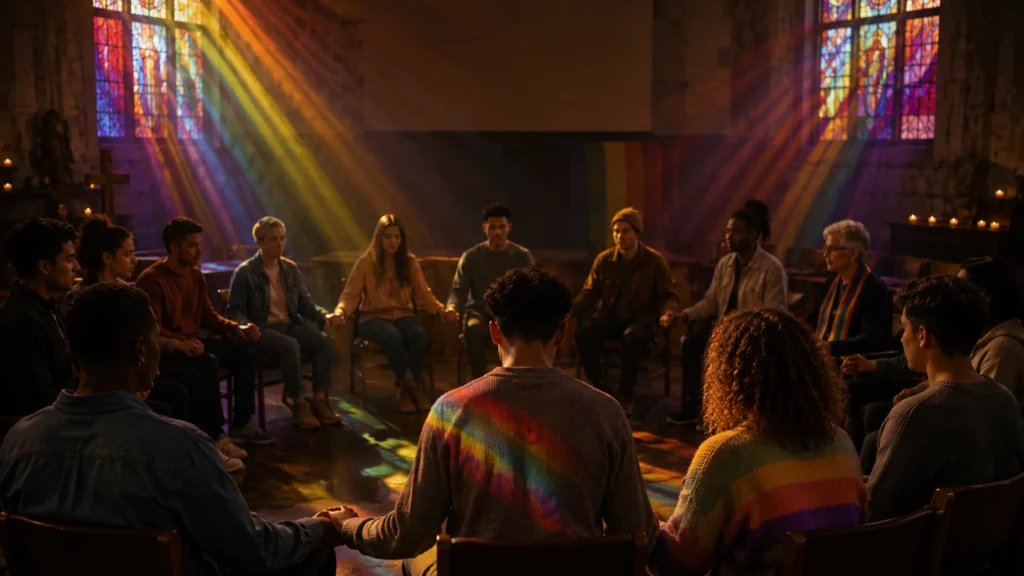
iks.haus | AI-generated based on editorial concept, 2026.
11. Religious communities and their relationship with LGBTIQ+ individuals
It is important to distinguish between several levels here.
Affirming communities
Some denominations actively welcome LGBTIQ+ individuals and integrate them into all areas of community life.
Examples include:
- United Church of Christ.
- Metropolitan Community Churches.
- Episcopal Church.
- Large parts of the Evangelical Lutheran Church in America.
- Large parts of the United Church of Canada.
- Many congregations within the Anglican Communion.
These communities generally allow same-sex marriages or blessings, as well as the ordination of LGBTIQ+ clergy.
Partially inclusive communities
Some communities emphasize the dignity and respect for LGBTIQ+ individuals, but do not affirm same-sex marriages or sexual relationships.
Examples:
- The Catholic Church.
- The Orthodox Churches.
- The majority of conservative Protestant denominations.
Within these communities, there is a significant difference between the official doctrine and the experiences of individual local congregations.
Clearly non-affirmative communities
Some communities consider homosexual relationships or transgender identity to be incompatible with their theological teachings and strongly oppose their social acceptance.
Examples include certain conservatives:
- evangelical communities,
- fundamentalist Protestant groups,
- Salafist Islamic movements,
- ultra-Orthodox Jewish communities.
However, even within these groups, there are significant differences in how individual people are treated.
Internal pluralism within religious communities and affirmative movements
One of the most common errors in public debates is the perception of religious communities as monolithic structures. Even if the official doctrines of individual denominations may be relatively clearly defined, there are significant differences within almost all major religious traditions in terms of theological interpretations, pastoral practices, and attitudes towards LGBTIQ individuals (Subhi). & Geelan, 2012).
From a mental health perspective, this fact is of particular importance because it allows many LGBTIQ individuals to find ways to integrate identity and spirituality without abandoning their religious affiliation.
Catholicism
Although the official doctrine of the Catholic Church continues to not recognize same-sex marriages as a sacramental form of community, numerous pastoral and theological movements have emerged in recent decades, aiming for a greater inclusion of LGBTIQ individuals.
Among the most well-known are:
- La Tenda di Gionata (Italy)
- New Ways Ministry (USA)
- Dignity USA.
- Quest (United Kingdom)
Of particular interest is the work of the Italian movement La Tenda di Gionata, which promotes dialogue between Catholic communities and LGBTIQ individuals, and organizes spiritual encounters, educational programs, and pastoral support.
Prominent Catholic theologians and pastoral actors include:
- James Martin
- Margaret Farley
- Charles Curran
- Jeannine Gramick
The work of the Jesuit James Martin is particularly significant, as he advocates for an approach based on respect, compassion, and sensitivity towards the experiences of LGBTIQ individuals (Martin, 2017).
It is also important to note that the papacy of Pope Francis has created space for a pastoral language that emphasizes the dignity of all people and the need to avoid discrimination, without altering fundamental doctrinal positions. This has simultaneously affirmed the pastoral work of numerous priests and religious orders worldwide who, despite persecution and pressure, have cared for LGBTIQ individuals since the early 1970s, and have even secretly blessed same-sex couples in their churches.
Protestantism
Within Protestantism, the greatest differences exist between the denominations.
Some communities, such as:
- United Church of Christ
- Metropolitan Community Churches
- Episcopal Church
- United Church of Canada
Fully affirm LGBTIQ individuals, allow same-sex marriage, and ordain LGBTIQ clergy.
Among the most influential theologians of the affirmative approach are:
- Matthew Vines
- Megan DeFranza
- Justin Lee
- Walter Wink
Her work often relies on a reinterpretation of biblical texts that are traditionally used in debates about homosexuality.
Anglican Tradition
The Anglican Communion is one of the most interesting examples of internal pluralism. While some provinces bless same-sex marriages and openly ordain homosexual bishops, others hold decidedly conservative positions.
Gene Robinson, whose episcopal ordination sparked a worldwide debate within the Anglican community, is one of the most prominent figures who symbolized this change.
Judaism
There are also significant differences within Judaism. Reform Judaism and large parts of conservative Judaism accept LGBTIQ individuals and support religious marriages.
Notable authors include:
- Steven Greenberg
- Elliot Kukla
Steven Greenberg is particularly interesting as the first openly homosexual Orthodox rabbi who has attempted to reconcile traditional Jewish theology with homosexual identity.
Islam
The situation in the Islamic world is extremely heterogeneous. While the majority of traditional Islamic institutions maintain a negative attitude towards homosexual relationships, inclusive movements are also emerging.
Examples include:
- Muslims for Progressive Values
- Inclusive Mosque Initiative
Notable authors include:
- Scott Siraj al-Haqq Kugle
- Amina Wadud
Their work is an attempt to reinterpret Islamic sources in light of contemporary knowledge about sexuality and human rights.
Importance for Mental Health
The findings of The Trevor Project become even more understandable when considered in the context of this internal religious pluralism.
An LGBTQ+ individual who finds:
- an affirming parish,
- a supportive priest,
- an inclusive mosque,
- an affirming synagogue,
- a spiritual community that embraces their identity,
can experience all the psychological benefits of religiosity without simultaneously being subjected to chronic rejection.
That is precisely why more and more authors are arguing that the question in therapy should not be:
“Are you religious?”
But rather:
“How does your religious community react to your identity?”
This question often provides a much clearer insight into potential sources of psychological distress or psychological resilience (Ryan et al., 2020; The Trevor Project, 2022).
Conclusion
The most important message from the research, especially the findings of The Trevor Project, is that the relationship between religion and the mental health of LGBTQ+ individuals cannot be understood through a simple juxtaposition of “religion” and “LGBTQ+ identity.”
The crucial variable is not religiosity itself. The crucial variable is the experience of acceptance or rejection.
When religion becomes an instrument of shame, threat, and social exclusion, it is associated with increased psychological risks. When religion becomes a source of meaning, connection, hope, and dignity, it can become one of the strongest protective factors for mental health.
From a psychological perspective, the question is therefore not whether religion and LGBTQ+ identity are compatible, but under what conditions a person can preserve both their identity and their need for belonging, without chronic shame and without losing their own dignity.
References
Martin, J. (2017). Building a bridge: How the Catholic Church and the LGBT community can enter into a relationship of respect, compassion, and sensitivity. HarperOne.
Meyer, I. H. (2003). Prejudice, social stress, and mental health in lesbian, gay, and bisexual populations: Conceptual issues and research evidence. Psychological Bulletin, 129(5), 674 bis 697.
Ryan, C., Toomey, R. B., Diaz, R. M., & Russell, S. T. (2020). Parent-initiated sexual orientation change efforts with LGBT adolescents. Journal of Homosexuality, 67(2), 159 bis 173.
Subhi, N., & Geelan, D. (2012). When Christianity and homosexuality collide: Understanding the potential intrapsychic conflict. Journal of Homosexuality, 59(10), 1382- 1402.
The Trevor Project. (2022). Religion and spirituality among LGBTQ youth. New York, NY: The Trevor Project.
The Trevor Project. (2023). Religiosity and suicidality among LGBTQ youth. New York, NY: The Trevor Project.
FAQ
Is religion bad for the mental health of LGBTQ individuals? No. Studies show that religiosity itself is not associated with higher rates of suicidal ideation. What is crucial is whether the community accepts a person or rejects them in the name of religion.
What is religious trauma? Religious trauma is a clinical concept referring to the psychological consequences of rigid religious upbringing, such as chronic fear of punishment, panic attacks, obsessive thoughts, or depressive symptoms.
Are conversion therapies banned in the EU? No, a Europe-wide ban does not exist. The European Commission rejected a corresponding proposal from the Parliament, as the responsibility lies with the member states.